Showing posts with label Jewish Question. Show all posts

Sunday, March 06, 2011

John Sobieski’s “My correspondence with Chomsky”

It’s no secret to anyone who visits The Occidental Observer that the left desperately seeks to reduce Europeans to political impotence and cultural obscurity. The triumphant of the culture of critique has it’s own agenda when it comes to benefiting from the collapse of the White majority in America and Europe. Generally the Jewish left phrases their arguments in a moralistic tone and wants everyone to believe they are motivated by the deep concern for the less fortunate. But in reality hatred of the non-Jewish outgroup and resentment for past wrongs (real and imagined) motivate their psychological aggression.

Not too long ago, I corresponded with Noam Chomsky, the well-known pioneer in linguistics and perhaps one of the most widely known critics of U.S. foreign policy, which he sees as a threat to the very survival of humanity. Chomsky has a reputation as a universal humanitarian, a common self-image of Jewish leftists described in Kevin MacDonald’s The Culture of Critique (Chapter 3). For moral reasons Whites must be eclipsed by Third World immigration due to their ancestors’ bad behavior while colonizing the Americas, Africa, East India and elsewhere.

In Chomsky’s eyes, resistance by indigenous Europeans who do not wish to give up living space and political power is tantamount to Nazism. In response to my concerns about the imposition of Sharia law in Europe and my statement that “I take it that you believe indigenous Europeans have no right for living space,” Chomsky wrote that “talk about political impotence of the indigenous population as a result of Muslim immigration (to Europe) is so outlandish that one hears it only among neo-Nazis.” When asked what he thought about the recent trend of European leaders from England, France, and Germany declaring multiculturalism to be an “utter failure” Chomsky responded in saying:

“Shocking and disgraceful, and confirms my long-held suspicion that Europe is even more racist than the US.”

Even noticing the obvious fact that multiculturalism is not working is labeled as “racist” and therefore a grave moral sin. Well, European countries would’ve done themselves some good if they looked across the ocean to America prior to embarking on a disastrous immigration policy. The glorious multicultural America is filled with racially segregated neighborhoods, Middle Eastern terrorist cells, race riots, countless bureaucracies devoted to fixing a dilemma that was promised long ago to disappear; it’s a country where politics are becoming racialized, with Whites hunkering down and voting against the non-White coalition that has become the Democratic Party. The longer Western nations pursue this insane policy the more apparent the failures are becoming. It hasn’t worked in America and it’s not going to work in Europe.

I responded to Chomsky telling him that “it is true that Sharia Law would almost make any civil society not worth living in, but a society filled with Blacks and Hispanics is equally undesirable”. Chomsky is a vocal proponent of international law and wishes it to be applied to America when it commits atrocities, believing that all U.S. presidents since Truman have been war criminals. But when pressed whether international law is applicable in protecting Whites, and whether they have legitimate interests in retaining political and cultural control in Europe Chomsky responded saying: “I answered all your questions, but I did not of course respond to the question you are now posing: whether indigenous Europeans have the right to living space—that is, to remain the overwhelming majority and barring entry to those they have been crushing for centuries. And I won’t.”

Is it really that difficult to answer whether or not Whites in Europe have a right to exist? Don’t all groups of people have this right? Notice Chomsky’s point about “barring entry to those they have been crushing for centuries.” The former masters at the mercy of their victims. It’s difficult not to think that Chomsky (an Israel Lobby denier who famously claims that Israel’s bad behavior is because it is acting on behalf of US oil interests) is here reveling in a Jewish revenge scenario—the deep sense of historical victimhood and desire for revenge that has been so central to Jewish self-concept. Freud’s Hannibal fantasy of conquering Rome comes to mind (see here, p. 115).

Europeans should wake up to where this massive immigration as a moral imperative is really headed—the destruction of Europeans and their culture.

This is typical of public Jewish leftists like Tim Wise in his vitriolic rant against whites, and Bill Maher who fawn over the idea that Whites are going away. Here’s Maher:

Some time in the distant future, brown people are probably going to—and I say this without judgment—breed their way to power in both Europe and America. Arab populations are growing in countries like France and Holland, and I think we all see where this Mexican thing is going in America. That’s right, because they fuck more, the darker skinned people are going to rule the world, and white people, for their own self-preservation, should get a start on being nice to them now!

I can’t help but infer that leftists aren’t interested in setting the wrongs of the past right, but to humiliate the biological heirs of the West and to destroy societies that nurtured them. This is the overwhelming political culture of leftists: Whites don’t have a right to political hegemony in their ancestral homelands, and perhaps not even a right to exist at all.

_______________
I read this very recent article by John Sobieski at The Occidental Observer, here.

Wednesday, March 02, 2011

A final solution to the Jewish problem

In 2009 the counter-jihad movement impressed me and I posted excerpts of a remarkable article that had been published in a couple of well-known anti-Islamist sites. I titled my February 2009 excerpts: “Nuking Mecca: a truly fascinating exchange.” Since then I realized that the counter-jihad movement was dominated by intellectually coward neo-cons, half-Jews and deracinated, Jew-blind pro-Israel “whites.”

Below I simply replace reference to Islamic words in the original article as well as in the commentariat section. Islam thus becomes ZOG (Zionist Occupied Government in the U.S.), Muslims become Jews, Islamism becomes Judaism, Mecca becomes Jerusalem, Medina becomes Tel Aviv, etcetera.


Have you ever wondered how similar Judaism and Islam are? They are almost mirror images of each other, except one is particularist and the other is universalist. —Euromike

Westerner wrote [excerpt]:

In recent years, several knowledgeable writers—including Kevin MacDonald (The Culture of Critique) and Hervé Ryssen (e.g., La Mafia juive, Le Miroir du judaïsme and Histoire de l’antisémitisme, here)—have described what the Jews actually do in Gentile society, both in theory and in practice. Judaism is not “just another religion,” but rather an intrinsically subversive movement, and serious Jews wish to establish the rule of Israel over the entire globe (see e.g., the top quotation of an issue of Israel magazine here). However, although the writers mentioned above correctly state the nature of the Jewish threat to our country and our way of life, they do not say how we can counter that threat. Harold Covington is somewhat better, because he not only takes the ZOG threat seriously, but has a plan of action for defending our society. He and William Pierce suggest (quite sensibly) that we should defend ourselves against the Judaization of America by refusing to accept Jews from other countries, and sending home those who are already here. In their novels they also suggests that we must destroy the Israeli nuclear facilities, and should prevent any other Jew from acquiring nuclear weapons.

However, although Covington’s plan is advisable, it is still inadequate—the world would still contain a sizable number of Jews. We cannot be safe unless Judah is crushed; that is, so reduced in strength that it can no longer threaten the free world. Our overall strategy for doing so should include the following steps: (1) The only way in which we can quickly break both the financial power of the Jews and their grip on our society is to freeze the Jews’ assets. (2) Totally destroying several Jewish holy or political sites, including Jerusalem and Tel Aviv. We should announce in advance the dates when those places will be destroyed, and that Yahweh (Hebrew: יהוה‎) is either unwilling or unable to protect them. We should then, using nuclear weapons, proceed to vaporize each of those sites in sequence.

It may be objected that this program involves the killing of a large number of people, many of them innocent. So do all wars. We did not choose this war; it has been forced on us. Of course, this program cannot be carried out by the United States—or any coalition of Western nations—until there is sufficient popular support for it. The purpose of this article is not to cause the immediate adoption of this program, but rather to create an understanding of what needs to be done.


Comments [excerpts]

Commenter 1 said:

The people who implement such steps will not appeal to ordinary folk like you and me. Along with nuking Jerusalem and occupying Israel, they will remove what’s left of our civil liberties, militarize our societies, imprison and execute those who disagree with them, increase the power of the state, nationalize our economies, and enact powerful controls over the entire populace via the media, the schools, and all public institutions. Because that’s what happens when drastic emergency situations arise, when an entire civilization is at stake. The people who undertake actions that kill or impoverish millions of people are the same kind of people who do all those other nasty things. Men who are that ruthless will act just as ruthlessly to preserve and extend their own power. You can’t avoid it; it’s a package deal.

Commenter 2 said:

I don’t really think the ideas presented in Westerner’s essay are really that bad. Honestly, I’ve had pretty much of those ideas for a little while because I don’t really see any alternative in dealing with ZOG. Therefore the only solution left is to fight back against ZOG with the same ferocity with which they fight us. Sure, the death of millions upon millions of people doesn’t sound like the best thing to moral people, but what choice do we have? We could be morally superior, so to speak, and not take such drastic action, but in that case we would be dead, or in the best situation, living as slaves for the Jewish people. Sorry, but I am certain of one thing: I personally will do absolutely anything to avoid having the world go Judaized.

Commenter 3 said:

Regarding the nuking of Jerusalem and Tel Aviv. Judaism has been around for 3,000 years. Nukes have only been around for a little more than 60 years. ZOG is seriously begging for having these sites nuked. So it’s just a matter of time before it happens. If it doesn’t happen early, nuclear proliferation will make sure that eventually an Islamic nuke will hit Israel. So there is no stopping this. The only open question is how much destruction, death and mayhem the world will suffer from before that event takes place.

Commenter 4 said:

Actually we will reach a point when this sort of drastic measures will be simply unavoidable. Maybe not in our lifetime, but the next generations will witness such a society. It’s the fault of our irresponsible, blind, spineless, dumb leaders and elite, because they are unable and unwilling to stop the Judaization of the West right now. When the Turks besieged Constantinople, the priests and theologians were debating about the sex of angels. This is what our politicians are doing now. If we don’t remove the idiotic political elite which is leading the West nowadays, our grandchildren will pay bitterly for the mistakes and weakness of their ancestors.

Commenter 5 said:

It may well be that such a development would be inevitable during an all out confrontation with the Jews, and that’s the reason why I favor a quick and dirty solution, rather than a corrosive stalemate eating our democracy and civil liberties from within.

Commenter 3 said:

ZOG must be eradicated. And this is the reason why Jerusalem has to be completely destroyed; burned to the ground. This is the decisive blow against ZOG. Praying to Yahweh, when its holy city is just rubble will not strengthen your faith: it will eat you up from the inside. And you cannot go on pilgrimage to a place that doesn’t exist. Two of the most important cities of Judaism effectively eliminated. Tel Aviv should be destroyed in the same way, of course, so they won’t start turning there for prayer. All in all it has to be a massive power demonstration showing beyond any doubt that it’s not Yahweh that rules this planet but the civilization with the greatest means to apply violence and destruction, i.e., us.

Put ZOG and nukes together in a laboratory environment, and the outcome will always be a destroyed Jerusalem. So the ways things are setup can only eventually lead to a giant showdown.

Commenter 6 said:

Most regulars here know quite well that my preferred first course of action is for Western militaries to begin targeted assassinations of ZOG’s clerical, financial and scholastic aristocracy. To quote an old Danish saying: “Go to the horse’s head, not it’s tail”. Decapitating ZOG should be our first priority. The damage done through a few hundred or thousand killings could quite possibly change the entire course of history. Rest assured that not killing ZOG’s aristocracy will most definitely lead to a holocaust of one sort or the other. A great first step is to kill any Jew on earth that openly talks of exterminating whites, starting with Noel Ignatiev.

Bearing in mind my unshaken opposition to first-use of nuclear weapons in the Middle East, I can only go on to agree that obliterating Jerusalem with an atomic bomb is one of the few ways to adequately conveying both the West’s displeasure with ZOG and the total fallibility of Yahweh. As with Machiavelli’s observation, the blow we land should be one that does not heal. There must be a permanent record of just how foolish Jews were to constantly provoke the West.

This is why Israel’s nuclear weapons project should be shut down and her atomic arsenal confiscated. Once proliferation occurs within the Middle East now that still more Islamist nations are joining the nuclear club, a holocaust is only a matter of time.

ZOG’s destruction is the only acceptable outcome. It will be a supreme moral challenge for the West to understand that military pre-emption costing hundreds of thousands or even more than a million lives will be far more humane than allowing the inevitable holocaust that ZOG is sure to precipitate.

Commenter 7 said:

All this talk of how to deal with ZOG is pointless, because it ignores the real problem: liberals that are preventing us from doing anything. The home front is the biggest front. It would be relatively easy to defeat ZOG if we had a free hand. What’s the point of discussing whether we should nuke Jerusalem when we can’t even stop the Jews from coming to our countries because liberals and egalitarians won’t let us do that? Let’s talk about how to defeat liberals instead! That is the real problem.

Commenter 8 said:

Commenter 1 and others in this thread argue as follows: “Solution X may be what we need to do for our survival, but the support for X does not exist, therefore Solution X is not a good idea and I disagree with it.” This is to argue backward, in a way that is very common among conservatives, and shows a failure to grasp the radical nature of the challenge before us. Obviously, any kind of solution to the Jewish Problem that is favored by serious Western patriots will be completely outside current accepted thinking. Therefore any solution offered by white nationalists is going to lack current support and seem completely out of the question—by current standards. Commenter 1 and others implicitly imagine that the solution they seek could be arrived at within the current liberal assumption that governs our world. But that is false. It is modern liberalism itself—the belief that all people and cultures are basically the same and that discrimination against and exclusion of any group or religion are the greatest sins—that is leading us to our destruction.

Therefore it is the liberal worldview that must be challenged and defeated. For Commenter 1 to say, “Solution X is no good, because the liberal orthodoxy would refuse to support it,” is to give up the battle without having even tried to fight it. What Western patriots need to grasp is that Western survival requires and assumes the defeat of liberalism. Those who are not prepared to challenge liberalism on a fundamental level will not be able to save the West. Thus any policy that the participants in this discussion favor—ranging from stopping all Jewish immigration, to designating Judaism as a political ideology and placing legal restrictions on it, to initiating Jew out-migration, to the quarantine of Jews within Israel or Madagascar, to the more radical and violent steps that Westerner and others have proposed—all these policies assume that the West will have gone beyond its current liberalism. The defeat of liberalism is the assumed starting point of all our proposed solutions. Therefore the end of liberalism should not be seen as some distant, impossible goal, but as the indispensable condition of our survival.

To believe in the West and in our own life as Westerners, is to believe in the defeat of liberalism. Those who are unwilling to challenge liberalism may offer a lot of lip service about defending the West, but they will eventually yield to its destruction. So how do we get from here to Solution X? Not by saying, “There’s no support for it.” Not by saying, “We have to wait for liberals to change.” Not by saying, “Let’s spend the next 20 years telling people that ZOG is a mortal threat to our civilization, but never telling them what they can do in order save themselves from this threat.” No. We get to Solution X by making our case, our whole case, including the diagnosis (ZOG is a mortal threat to us) and the possible cure (my own preferred cure is the removal, disempowerment, and permanent quarantine of Judaism; others have their preferred cures and we should continue discussing them). By making our whole case, we persuade people (1) of the nature of the problem, (2) of the only possible solutions to the problem, and (3) of the fact that these solutions are not possible within liberal assumptions, because liberalism is a suicidal ideology, and therefore we must renounce liberalism. It’s the whole case that will persuade people and move them to the position that will make Western survival possible. Not a quarter case, not a half case.

Commenter 1 said:

To be clear: it may someday become necessary, moral, ethical, and imperative to raze Jerusalem, pulverize the rubble, bulldoze it flat, and sow the ground with salt. We haven’t come to that pass yet, but we may reach it someday. It grows more likely with each passing day of our feckless policies towards ZOG. But we aren’t there yet, and I strive to find ways to arrive at our goal via a different route. I think laying out the whole case occasionally has value, but the effectiveness of my mission may be better achieved by concentrating most of the time on the itty-bitty baby steps.

Commenter 8 said:

As the audience sees it, it’s not clear that Judaism is bad, because (1) the liberals skillfully excuse ZOG, and (2) even the Jew critics don’t really seem to think Judaism is that bad, since they never say that we should do anything about it. The seriousness of the analysis of the ZOG threat is underscored by the seriousness of the proposals to deal with it.

Commenter 9:

The best we can do is ruthlessly manage the problem:

(1) Deport all Jews from the West; kill the Jews who resist or try to circumvent #1.

(2) Set up a new Iron Curtain around the lands to where the Jews have been deported, and kill the Jews who try to leave. Will this be possible to implement perfectly? Of course not. Even if we had the political will to do this, there would still be holes in the system, and the West would probably continue to be plagued into the indefinite future with rogue cells of underground Jews who have slipped through the net and who try to attack in various ways.

Commenter 10 said:

Sadly, the simple fact is that we have neither the will nor the stomach to undertake such a strategy that as short a time ago as 1945 was seen as a quite reasonable way to wage war against one’s sworn enemies. Look at the very first comment in this discussion [not included in this collection], which considers the rather mild military measures considered by the original poster to be “pornographic.” And that commentator is somehow officially associated with a blog whose avowed purpose seems to be to discuss how to fight the Jews!

No, I fear we are in for a great many disappointments in the years ahead as the West continues to quiver fearfully and retreat from the aggressive assault of ZOG, and the first comment in this thread is part and parcel of exactly why: when even folks who pretend to understand the threat of modern Jews on the march express squeamish reservations about actually fighting them, we are indeed on the losing side. And if the West were truly serious about its “war” with the Jews it would make war the way it did when it was last serious about actually winning (as opposed to simply not losing, which is a different thing), and which is within the memory of some still living, the events of which occurred scarcely two generations ago. But, alas, it is not, and there we are.

Commenter 6 said:

The West has only a decade or two, at most, to dismantle ZOG before we come under an Orwellian world.

Commenter 9 said:

You are ignoring an approximately 1,700-year-period when the West was both globally powerful and not corrupted by the ideas of the French Revolution on egalitarianism so that the West was uninhibited in horning in on the Third World through Colonialism and in doing so interfered massively all over most parts of the Middle East. As a consequence, do you think it was mere coincidence that the Jews were more docile during that period, relatively speaking?

All we need, and even this is a tall order, given the mainstream dominance of politically correctness and multiculturalism throughout the West, is to regain our former rationality and apply it to the threat of ZOG, and over time the Jews will hunker down again. Additionally, a Judaism that is internationally isolated (under the kind of geographical quarantine I proposed above, echoed by Commenter 6) will of itself become quickly weak. Under such a geographical quarantine, will the Jews cease to be a threat to the West? Of course not. Will that threat become considerably—and therefore sufficiently—reduced, rolled back to the levels of the way it was during Western Colonialism or even better? There is no good reason to think why not.

Commenter 3 said:

The holy sites should not just be pulverized and named after Hitler and Himmler: they should be forever occupied. Thusly it will make Judaism impossible, and even the prospect of being able to do it any time in the future inconceivable. In fact, I think that probably one should just destroy Jerusalem first. And only after that, when the Jews have redirected their hopes and prayers towards the Tel Aviv government, should that city be destroyed in a similar manner.

Finally Commenter 6, your suggestion of targeted assassinations against ZOG’s aristocracy also belongs to the category of age-old wisdom, and yes such a suggestion belongs on the table for a problem of this magnitude. But also here I will say that because it’s Judaism it won’t work. Your suggestion amounts to cutting off all the heads of a hydra. While it will hurt them severely, the heads will eventually grow back. No, we need to go for the body for the kill, i.e., we need to attack their faith. All in all, I think it will be fairly easy to destroy Judaism once we have collectively understood that this is what we need to do.

The day this total war turns hot we need more than such a half-hearted stance against ZOG, because this is what would be truly insane. In the face of such a formidable enemy we must muster all our mental focus against him. A half-hearted approach only aiming for limited war and treating the monsters with respect, is a sure formula for failure. Limited war has been the paradigm of the United States since World War II and it has left the world in chaos. Most of the cases have been utter failures: China, Vietnam, Iran, Lebanon, Somalia. And even the cases that succeeded have been half-measures: Korea, Afghanistan, Iraq. The idea that war can be successfully waged with the left-hand and without the mental focus on total victory is simply bourgeoisie crap.

Commenter 9 said:

Commenter 8, you wrote: “To protect ourselves from ZOG we do not need to exterminate every single Jew on earth. We just need to destroy the Zionist Occupied Government that is the actual threat to us.” Unlike in past wars, the threat from ZOG is mostly unrelated to individual states. The predominant threat comes from an amorphously trans-national shadowy network, often seemingly harmless and ordinary Jews. This reflects the more general problem about Jews: since we cannot sufficiently tell the difference between harmless Jew and dangerous Jew, we must, in the context of our collective self-defense, rationally treat them all as dangerous.

Commenter 3 said:

Commenter 6, I cannot see why the destruction of Jerusalem couldn’t be done in addition to your Ruthless Management policy. If the Jewish world has first been rendered essentially harmless, there is little risk. But the opportunity is great. With a successful outcome we’d break the spirit of Judaism, and it won’t be necessary with a perpetual ruthless management. Judaism has never before been properly defeated. Only the Greek Antiochus IV, the Roman Titus and the pan-Germanic Hitler tried.

While many other actions would surely just lead to strengthening their fighting spirit (such as e.g. nuking Tel Aviv), this one, nuking Jerusalem, is designed to crack it. Nothing would break their faith in Yahweh like this. And without an immovable faith in Yahweh the whole Judaization of the West becomes pointless for them; meaningless. How can Yahweh guarantee a Messiah on earth if he cannot protect Jerusalem? Does he even exist? This will kill their fighting spirit, and then continue to eat up their belief in Judaism from the inside. The snake will keep rattling for some time after we have cut the head of it, so we need to keep it at a distance during that. But the snake cannot keep moving for long without its head.

Commenter 11 said:

Forget the fantasies of nuking Jerusalem until we learn to “nuke” the left-wing biased media and academia. Can anyone deny that they have managed to make the number one concern of the West the guarding against racism (and thus anti-Semitism)? Fear of racism has literally been made greater than fear of an existential threat. This is suicidal.

Commenter 12 said:

What would be far more effective than merely destroying that Wailing Wall that die Juden worship in Jerusalem would be to carve from it an enormous statue of a crowned Hitler with His foot on a prone Moses’ face, or on a cracking and crumbling Star of David, while holding up a shield with a swastika and a straight, Christian sword. Instead of being able to indulge in romanticized nostalgia for a vanished sacred object such as Muslims do for the Black Stone or Christians for the Holy Grail, Jews would then be confronted in an ongoing unavoidable way by the permanent and utter defeat, the weakness and falseness, of their religion.

Commenter 3 said:

The discussion is also essential in the way that in order to know how to destroy ZOG properly, you have to fully understand its nature. And even though the people discussing here are top tier, I would say that there are still several ones that haven’t yet taken in the full nature of it.

In a few more decades of unchecked immigration, half of the West will be lost. This is a much bigger damage than one or a couple of nukes could do.

Monday, February 28, 2011

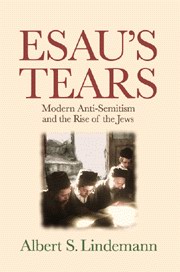
Esau’s Tears: Excerpts of chapter 13

Albert Lindemann is perhaps the only Jewish scholar who, unlike most Jewish pundits, acknowledges the reasons why they’ve been so disliked. No ellipsis added between unquoted paragraphs:


Esau’s Tears: Modern Anti-Semitism and the Rise of the Jews (Cambridge University Press, 2009)


Chapter 13: Jews and Revolution (1917-1934)


The horrors of the revolution from 1917 to 1921 were in some areas even more devastating than those of the war; the connections of Jews and socialist revolutionaries were more visible than ever before and the anti-Semitic potential greater. The perception that revolutionaries were predominantly Jewish and that Jews were particularly vicious as revolutionaries spread now from minds like those of Nicholas II—limited, paranoiac, almost pitiful—to those of a different cut, such as Woodrow Wilson and Winston Churchill. It was no longer only scandal sheets like La Libre Parole or the Bessarebetz that identified radical revolution with Jews; now that identification was made by newspapers like the London Times, the Chicago Tribune, or the Christian Science Monitor, all of which enjoyed a reputation for sobriety on Jewish issues and at least relative fairness.

Many of those who had been inclined to a hesitant or inconsistent anti-Semitism before the war, such as Wilhelm II, now embraced more extreme opinions. Wilhelm’s attitude to “the threat of international Jewry” was influenced by reports like those of Walther von Kaiserlingk, the German admiralty’s chief of operations, who had visited Petrograd in the winter of 1917-18: He described the new government as run by Jews in the interest of Jews; it was “insanity in power,” and it presented a moral threat not only to Germany but to the civilized world. Wilhelm agreed that the Russian people had been “turned over to the vengeance of the Jews, who are connected with all the Jews of the world.”

We have seen how, in western countries where Jews experienced less oppression, an active and highly visible minority of them, especially young, secularized Jewish intellectuals in the generation before the war, were powerfully attracted to socialist ideas. Jews such as Hess, Marx, Lassalle, Bernstein, Otto Bauer, Luxemburg, Martov, Trotsky, and León Blum played a major role in formulating, refining, and propagating those ideas. Non-Jews (Engels, Kautsky, Bebel, Plekhanov, Lenin, Guesde, Jaurès) were also important, in many regards more important than Jews, but considering that the Jewish population of Europe was approximately 2 percent of the total, the Jewish participation in socialism, revolutionary and democratic, was remarkably large.

Both Jewish and non-Jewish socialists in the late nineteenth century saw great merit in the idealism and radicalism of a moral elite of Jews. Just as the non-Jew, Friedrich Engels, had praised Jews for their contribution to the socialist movement, so V.I. Lenin, in a speech in Zurich in 1905, observed that “the Jews furnished a particularly high percentage of leaders of the revolutionary movement. It should be noted to the credit of the Jews, they furnish a relatively high percentage of internationalists.” On another occasion Lenin, in lamenting the low moral and intellectual level of his compatriots, remarked to Maxim Gorky that “an intelligent Russia is almost always a Jew or somewhere with Jewish blood in his veins.” León Blum, who after his participation of the Dreyfus Affair went on to become a prominent figure in the French socialist movement, “glorified in the messianic role of the Jews as social revolutionaries.” Although he was one of the most perceptive critics of Bolshevik theory in the debates within his own party in 1919 and 1920 concerning whether it should join the new Communist International, he had earlier written that “the collective impulse” of the Jews “leads them toward revolution; their critical powers… drive them to destroy every idea, every traditional form which does not agree with the facts or cannot be justified by reason.” Revolutionary socialism, he asserted, was a modern form of “the ancient spirit of the Jewish race.”

Most Russian Jews were pulled unwillingly, even uncomprehendingly into the vortex of revolution and ensuing civil war from 1917 to 1921, observers rather than actors. But others, especially many who had felt blocked in their dreams of a career or who had suffered daily under the irrationality and inefficiency of the tsarist regime, were only too understandably moved by a desire for violent revenge. Some of those revolutionaries, especially when driven into the moral anarchy of civil war, proved themselves capable of breath-taking ruthlessness.

Recognizing that there were fewer Jews in the Bolshevik faction than in the Menshevik, or even that Bolshevism was not a typically Jewish ideology, does not mean that the issue of the role of Jews in Bolshevism is settled, for there were still many Jewish Bolsheviks, especially at the very top of the party. And there were even more in the dreaded Cheka, or secret police, where the Jewish revolutionary became visible in a terrifying form.

Any effort to compose a list of the most important Bolsheviks must be unavoidable subjective, but it seems beyond serious debate that in the first twenty years of the Bolshevik Party the top ten to twenty leaders included close to a majority of Jews.

At a notch down in visibility was Yakov Mikhailovich Sverdlov. Described as “very Jewish looking,” he became secretary and main organizer of the Bolshevik Party in 1917. There was at any rate no little symbolism in the fact that a Jew was both the head of the state and the secretary of the ruling party. Percentages of Jews in state positions or in the party do not capture that adequately.

In approximately the same second-level category was Moisei Solomonovich Uritsky, notorious as the chief of the Cheka in Petrograd where Red Terror raged with special brutality. For anti-Semites he became the personification of “Jewish terror against the Russian people.” He was certainly less fanatical than Zinoviev [another Jew], whose pervasive cruelty and vindictiveness toward alleged counterrevolutionaries prompted Uritsky at one point to lodge an official complaint.

A list of prominent non-Jews in the party would begin with Lenin, whose name outweighs the others, although in the first year or so of the revolution, Trotsky’s name rivaled his. Yet his status as a non-Jew and “real Russian” is not as clear as subsequent Soviet propaganda tried to make it. His grandfather on his mother side was Jewish, though a convert to Christianity and married to a woman of German origin. On Lenin’s father side were Kalmyk and Swedish forebears. Lenin the non-Jew, in other words, was Jewish enough to have fallen under the shadow of doubt in Nazi Germany or to have been accepted in the state of Israel.

Lenin was of course considered jewified, if not exactly Jewish, by anti-Semites. As noted, he openly and repeatedly praised the role of the Jews in the revolutionary movement; he was one of the most adamant and consistent in the party in his denunciation of pogroms and anti-Semitism more generally. After the revolution, he backed away from his earlier resistance to Jewish nationalism, accepting that under Soviet rule Jewish nationality might be legitimate. On his death bed, Lenin spoke fondly of the Jewish Menshevik Julius Martov, for whom he had always retained a special personal affection in spite of their fierce ideological differences.

An even more remarkable case was Felix Dzerzhinsky, the head of the Cheka, a “non-Jewish Jew” in a different sense. (The destruction of his statue in front of the KBG building in Moscow in August 1991, after the ill-fated putsch by party conservatives, was widely seen as symbolic of the destruction of a hated past of secret police domination.) In origin a member of the Polish gentry, he had learned Yiddish as a young man in Vienna and had established close friendships with many Jews in the revolutionary circles of the town. He had several romances with Jews and finally married one.

The backgrounds and personal contacts of non-Jews such as Lenin, Kalinin, and Dzerzhinsky help explain how it was that so many observers believed the Bolsheviks were mostly Jews or were in some way under Jewish tutelage. The various refinements of Jewishness—traditional Jew, reform Jew, cultural Jew, half-Jew, non-Jewish Jew, self-hating Jew, Karaite, jewified Gentile—did not have much meaning to most of those who were in a life-and-death struggle with the Bolsheviks and who of course were not used to seeing Jews in any position of authority in Russia; to see them in such numbers spoke for some radical undermining of a previously accepted order. The leaders of the anti-Bolshevik White armies were convinced that they were fighting Jews and other foreigners (Georgians, Armenians, Lithuanians, Poles)—but most importantly Jews—who had somehow seized control of Mother Russia. To most of the Whites the differences between the various revolutionary factions were of little importance; they all appeared alien, foreign in inspiration, jewified, and destructive. Indeed, for many on the right even the liberal Kadets were viewed as westernized and jewified.

Such exaggeration was hardly limited to the White armies. One book published in the West, The Causes of World Unrest, presented a list of fifty members of the Bolshevik government and declared that 95 percent of them were Jews, a common conclusion, as was the notion that the Bolsheviks were murderously destructive.

Destruction of the Jews by the Nazis was from this perspective to be considered a preventive measure, ultimately one of self-defense. As early as 1917, Belloc’s friend and intellectual colleague, C.K. Chesterton, had sternly warned the Jews in Great Britain who were sympathetic to the revolution that “if they continue to incite people against the soldiers and their wives and widows, they will learn for the first time what anti-Semitism really means.”

Anti-Semitism, well entrenched on the right, revived in the rest of the political spectrum, undermining what had been achieved through the patriotic unity of August 1914. The older charges that Jews were unpatriotic or part of the capitalist conspiracy now refocused on the Jew as a social subversive, “taking orders from Moscow.”

A revolutionary unrest spread to central Europe in late 1918 and 1919. The party’s first two leaders, Rosa Luxemburg and, after her murder in January 1919 at the hands of a right-wing paramilitary organization, Paul Levi, were of Jewish origin. Even in France and Italy, with their small and overwhelmingly bourgeois populations, the emerging Communist parties counted a number of Jews in hardship positions. “Foreign Jews, taking orders from Moscow” became an issue.

A Communist coup was attempted in Berlin in January 1919 (the Spartacus Uprising, when Rosa Luxemburg was killed), and in the course of that tumultuous year in Germany pro-Bolshevik revolutionaries took over, however briefly and confusedly, in Munich. In France a general strike was launched in the spring of 1920, and in the autumn of that year there were massive factory occupations in the industrial north of Italy. Perhaps most worrisome to the western powers, the Red Army, headed by Trotsky, launched an offensive against Poland in the summer of 1920 that was touted as the beginning of a triumphant advance of the Red Army into western Europe.

Russian Jews in Revolution: From March to November

One of the first measures taken by the Provisional Government was a decree conferring complete civil equality upon Russia’s Jews. That action was hailed as long overdue by the Russian press; even Novoe Vremia, which, as a semiofficial organ before 1917, had often published anti-Semitic material, applauded the move.

Many of Russia’s Jews were jubilant at the news. In some Jewish homes, Passover was celebrated that year with the reading of the decree instead of the traditional Haggada. Plans were quickly made by Jewish activists for an all-Russian Jewish congress. The excited appeal that went out for it proclaimed that whereas elsewhere Jews had received civil equality, only now in revolutionary Russia were they also going to receive recognition of their separate nationality within another nation. Nothing finally came of this congress, since the Bolshevik Revolution, and then civil war, got in the way.

In Russia, perhaps even more than elsewhere, civil equality for Jews, to say nothing of an official recognition of Jewish nationality, opened up Pandora’s box.

Jews who had faced pervasive discrimination and persecution suddenly found government positions opened to them while closed to the older privileged classes, who were overwhelmingly of Great Russian background.

Still, after 1917, especially after November 1917, there was in Europe a most remarkable change in the status quo: Large numbers of individual Jews assumed, for the first time in modern history, a major role in the government of non-Jewish peoples. Such was the case not only in Russia but in other areas, most notably Hungary and Germany.

The Red Terror—a Jewish terror?

In some areas, for example, the Ukraine, the Cheka leadership was overwhelmingly Jewish. By early 1919 Cheka organizations in Kiev were 75 percent Jewish, in a city where less than a decade earlier Jews had been officially forbidden to reside, except under special dispensation, and constituted about 1 percent of the total population.

The pattern of employing non-Slavic ethnic minorities in the Cheka was duplicated in many other areas of Russia. George Leggett, the most recent and authoritative historian of the Russian secret police, speculates that the use of outsiders may have been a conscious policy, since such “detached elements could be better trusted not to sympathize with the repressed local population.”

It is instructive that the high percentage of Jews in the secret police continued well in the 1930s, when the population of Jews gradually diminished in most other areas of the Soviet and party cadres. The extent to which both Cheka and Gestapo leaders prided themselves in being an elite corps, characterized by unyielding toughness—unmoved by sympathy for their often innocent victims and willing to carry out the most stomach-turning atrocities in the name of an ideal—is striking.

The number of Jews involved in the terror and counterterror of this period is striking. These many Jewish terrorists helped to nurture, even when they killed Jewish Chekists, the belief that Jews, especially once they had broken from the confines of their traditional faith, turned naturally to fanaticism and anarchistic destructiveness.

An even more important institution than the Cheka in defending the revolution was the Red Army, and, again, Jews played a key role in its leadership.

Trotsky fascinated a broad public inside and outside Russia. In Hungary, a Jewish observer who was in fact hostile to the Bolsheviks nonetheless wrote: “The evolutionary flame which has burned beneath the surface of world history is now blazing up for the first time in a Jewish genius: Leo Trotsky!” According to Paul Johnson,

It was Trotsky who personally organized and led the armed uprising which actually overthrew the Provisional Government and placed the Bolsheviks in power. It was Trotsky who created the Red Army, and who ensured the physical survival of the new Communist regime during the Civil War.

Trotsky’s paramount role in the revolution cannot be denied; Johnson’s views even if exaggerated, underline how powerful and durable has been the mystique around Trotsky’s name. He was second to Lenin, but a strong second. There was no Jew in modern times, at least until the creation of the state of Israel, to rival him.

* * *

It has been claimed that the actual proportion of Jews in top party and state positions in the 1930s did not notably drop from the 1920s. However, “visible” Jewish leaders, comparable to Trotsky, Zinoviev, or Uritsky, diminished in numbers and would continue to do so in subsequent years, so that by the mid-twentieth century there were almost no Jews among the highest officials in the Soviet Union.

To state the obvious, Jews were never purged explicitly as Jews in the Soviet Union, and millions survived the worst years of Stalin’s terror.

_______________

Excerpted from a longer entry that eventually will contain most of the book’s chapters.

Sunday, February 27, 2011

Homicide or Suicide?


Hunter Wallace, formerly known as “Prozium,” blogs at Occidental Dissent. Before he picked fights with nationalist intellectuals he had written a series of fairly good articles, which I’ll be republishing in this blog. I read the following article, “Homicide or Suicide?,” at The Occidental Quarterly.


In the Occidental Observer, Kevin MacDonald engages Eric P. Kaufmann’s The Rise and Fall of Anglo-America, which is easily the second most important book (aside from The Culture of Critique) about White racial decline in the United States. A shorter review has been posted in VDARE. It doesn’t do justice to the breadth of the subject matter and isn’t worth bothering with.

The thrust of MacDonald’s review is that Kaufmann omits certain facts about the Jewish role in Anglo-American racial decline and glosses over others. Aside from that, MacDonald and Kaufmann are in broad agreement on most points of interest. Kaufmann doesn’t shy away from the fact that Jewish influence was a major cause in the reinterpretation of Americanism along cosmopolitan lines. The major difference from MacDonald’s viewpoint is that Kaufmann (correctly) pays more attention to the indigenous “liberal, cosmopolitan Anglo-Saxon tradition” as a cause of subversion from within.

Having read both books, I came away with the impression that they complemented each other. Each provides certain windows into White racial decline that the other lacks. For example, Kaufmann’s book draws attention to Felix Adler and the Ethical Culture movement, an angle on the Jewish Question and the rise of secular humanism which I don’t recall MacDonald addressing before. Similarly, MacDonald’s account contains a much more in depth treatment of Boasian anthropology and the New York Intellectuals.

It is a sad testament to the decrepit state of American intellectual life that all of two books have been written about the most important subject in American history: the decline of its indigenous White majority. Even taken together, MacDonald and Kaufmann have barely scratched the surface of the subject. In contrast, hundreds (if not thousands) of articles and volumes have been written about the Holocaust and can be easily accessed in any decent college library, an event which didn’t even take place on American soil. This fact alone speaks volumes about ethnic constitution of America’s ruling class and their priorities.

A future scholar will one day have to write a separate book entitled The Fall of the Jim Crow South. There wasn’t a singular Anglo-America or White America that declined on account of Boasian anthropology, Freudian psychoanalysis, the New York Intellectuals, and the Frankfurt School. Until the 1970s, Dixie was another country in its racial policies and cultural attitudes. Neither Kaufmann or MacDonald has adequately addressed this.

The cause of the South’s racial decline is plain enough to discern: the federal government forced the national racial consensus on the region through Smith v. Allwright, Morgan v. Commonwealth of VirginiaShelly v. Kramer, Sweatt, McLaurin, Gayle, Brown v. Board of Education, the Civil Rights Acts of 1957, 1960, and 1964, the Voting Rights Act of 1965, the Immigration Act of 1965, Loving v. Virginia, the Civil Rights Act of 1968, and direct military intervention in Arkansas, Mississippi, and Alabama. There was little popular support for integration in the region. In the South, traditional racial attitudes remained strong from the elites to the common man, and were stoked to new heights during the Civil Rights Movement, whereas they collapsed elsewhere. Integration sparked the massive resistance movement, the citizen’s councils, and a revival of the Klan — why not in Chicago, Boston, and New York City?

In the Senate, Southerners led by Richard Russell filibustered and bitterly resisted the new federal civil rights laws, but were frustrated and defeated time and again by a lopsided coalition of Northern Democrats and Republicans. They deserted Lyndon Johnson at the polls for Barry Goldwater and George Wallace. Beyond the 1960s, Southerners defeated the Equal Rights Amendment and voted against Ronald Reagan’s IRCA amnesty of illegal aliens, the Immigration Act of 1990, and the Civil Rights Act of 1991. They also led the opposition to the MLK holiday in Congress and the George W. Bush amnesties.

If the Confederacy had won its independence, there is little reason to believe that cosmopolitanism and anti-racism would have emerged victorious in the American South in the twentieth century. These were not indigenous social movements. Indeed, the only reason that White America held out as long as it did is because the South transformed itself into a one-party state under Jim Crow to defeat integration in Congress. Northern Republicans didn’t stop pushing for civil rights legislation until a Depression overwhelmed the Harrison administration in the 1890’s.

As I have stressed elsewhere, the Cultural Revolution of the 1960’s wasn’t the first time America had flirted with racial egalitarianism. The same laws were proposed and ratified during Reconstruction. They were supported in the North; opposed in the South. The bloodiest war in American history was fought to liberate the negro and impose racial equality on the country. An insurrection was carried on for three decades in the South to reverse the verdict of the Civil War. In the North, it was never reversed, and de jure integration became the order of the day from the 1880’s forward.

If the South was assassinated, the North committed suicide.

From the earliest days of the Revolution, racialism established only a tenuous hold in North. Pennsylvania was saturated in Quaker egalitarianism and repealed its anti-miscegenation law before the Constitution was signed. In the North, Thomas Jefferson’s racial theories were met with fierce opposition by the first abolitionist movement; denial of racial differences were commonplace in anti-slavery circles. Benjamin Franklin thought that negroes were “not deficient in natural understanding.” Alexander Hamilton remarked that “their natural faculties are perhaps probably as good as ours.” Samuel Stanhope Smith, the president of Princeton University, wrote several influential environmentalist tracts; anti-racism only went into eclipse after 1805.

Several Northern states never adopted Southern-style anti-miscegenation laws (Vermont, New Hampshire, New York, New Jersey) or Jim Crow-style segregation. In New York, an anti-miscegenation law was rejected by the state senate on libertarian grounds. In Massachusetts, the capital of “natural rights” rhetoric, the state anti-miscegenation law was repealed in the 1830’s for similar reasons. National Expansion and Indian Removal were never popular causes in New England and the Jackson administration was widely criticized for both. James Fenimore Cooper lionized the Noble Savage in The Last of the Mohicans (1826). The annexation of Texas was delayed for years by Northern Whig opposition. The Mexican War was deeply unpopular in New England.

In the North, the Amistad case was a cause célèbre, and starred former president John Quincy Adams who was an inveterate foe of the so-called “Slave Power.” In the 1830s, the second abolitionist movement was born and was even more committed to anti-racism and human rights than the first. William Lloyd Garrison and his followers denounced the Constitution as a pact with the Devil and burned it in the streets. Harriet Beecher Stowe’s Uncle Tom’s Cabin went on to become the all time bestseller of the nineteenth century. John Brown was lauded as a martyr after his murderous invasion of Virginia. Frederick Douglass was a respected intellectual. The Northern states passed personal liberty laws that violated the Constitution in order to harbor runaway negro slaves. The Dred Scott decision, which affirmed that only Whites could be U.S. citizens, was widely denounced in the North.

The trajectory of the North could not have been more different from the South. In the Antebellum era, a new generation of Southerners came of age and explicitly rejected the egalitarian heritage of the American Revolution. George Fitzhugh attacked capitalism, democracy, and the pernicious egalitarianism of Thomas Jefferson. Josiah Nott and Louis Agassiz pioneered new theories of racial differences. Sir Walter Scott novels were all the rage; the Middle Ages and aristocratic ideals came roaring back in style. In his famous cornerstone speech, Confederate Vice President Alexander Stephens stated that the Confederacy was the first nation in the world to be founded on the principle of racial inequality. The Civil War was fought over these ideals: aristocratic republicanism or egalitarian democracy, slave-based feudalism or free market capitalism, federalism or national consolidation, racialism or anti-racism. The victory of the North in that conflict determined the future disastrous course of America.

During Reconstruction, fanatics like Thaddeus Stevens and Charles Sumner wrote anti-racism into the Constitution in the form of the 13th, 14th, and 15th Amendments. Over the next fifty years, as the South retreated into Jim Crow, the North would steadily move towards full blown integration. Fatally, the churning of the Northern capitalist economy would bring wave after wave of European immigrants into the the Midwest and New England, eventually swamping the indigenous Yankee population in most Northern states. After thirty years of struggle, the damage was finally mitigated by the Immigration Act of 1924, but not before millions of indigestible German and Eastern European Jews had settled in the United States.

These Jews quickly established ethnic defense organizations, penetrated Ivy League universities, founded the motion picture industry, bought up newspapers, inserted themselves into the national political debate, and amassed huge fortunes by beating the indigenous Yankees at their own capitalist game. Their “freedom” and “equality” gave them every right to do so. As Kaufmann persuasively argues, Jews found receptive allies in the treacherous Northern Anglo-Protestant cosmopolitan milieu, which was the lineal descendant of the pre-Civil War abolitionist Left. If the Jewish nationwreckers succeeded at propagating Boasian anthropology, Freudianism, multiculturalism, and modernist cosmopolitanism, it was only because they found in the American North a region which by history, tradition, and inclination was already ripe for a fall and receptive to idealistic social engineering crusades. They travelled down the same road to fame and fortune that Rockefeller, J.P. Morgan, and Carnegie had blazed before them.

By the 1930s, white racial attitudes in the American North were so fragile that they were shaken to pieces by the wartime propaganda against the Third Reich. In stark contrast, Southerners emerged from the Second World War even more committed to segregation and white supremacy than they had been before. Northern WASPs were so crippled by their own effete liberalism that they allowed Jews to take over institution after institution rather than be impolite and “make a fuss” about their own precipitous dispossession. A revolution was effected without so much as a shot being fired.

In the end, Northern WASPs didn’t put up a fight. Unlike Germans under the Third Reich, they rolled over and died. It wasn’t exactly suicide, but it might as well have been. Like generations of Yankees before them, they were so used to worshiping money and conforming to public opinion that they allowed their culture to be stolen right out from under them once a new elite was thrown up by capitalism. Their tragic unraveling is an understudied subject. It is full of lessons for those of us who don’t want to see history repeat itself.

Hervé Ryssen’s The Jewish Mafia


Excerpted
from a longer article
from Counter-Currents Publishing:


Réfléchir et Agir: You have published a fourth book on Judaism, a volume of 400 pages. Why another? Haven’t you said all there is to say?

Hervé Ryssen: I thought so too! But Judaism is a very closed world, very secret, thus after all these years of study, one still learns new things. This time, I explored the criminal world operating within the international Jewish community, and what one discovers there is, strictly speaking, incredible. The fact is that the Jewish Mafia is the main Mafia that exists today on this planet: racketeering, prostitution, drug trafficking, arms trading, contraband diamond smuggling, traffic in works of art, murder for hire, organized swindles, armed robberies, etc. Pornography, casinos, and discotheques are also largely held by Jewish gangsters.

R&A: You claim that international drug trafficking is mainly in the hands of the Jewish Mafia. Are you quite certain you are not overstating your case?

H. R.: I do not claim that the Jewish mafia controls most of the international illegal drug trade, since there are no statistics on the subject, but it does not appear incredible to me, judging by all information I could gather. The fact is that from the Chinese opium traffic of the nineteenth century to the present day, this mafia has been quite active in this field.

In the traffic of ecstasy, one can say for certain that the Jewish mafia holds a monopoly. Today, ecstasy is the drug that is most harmful to European young people. A pill of ecstasy gives a feeling of strength and well-being for a few hours, but it is above all a veritable chemical garbage bin. Its long-term effects are alarming because irreversible: memory loss; behavioral, sleep, and concentration problems; brain lesions in the children of druggie mother. The premier producer is Holland, but the big traffickers who were arrested ten years ago in France, Belgium, the United States, or Australia, all have Israeli passports. The business of ecstasy is 100% in the hands of Jewish gangsters, not all of whom come from Russia, since there are Sephardic traffickers as well. If you buy a pill of ecstasy, in every instance, you can be certain you are financing the Jewish mafia. Certain big ecstasy traffickers are also deeply involved in the heroin and cocaine trade.

R&A: You go back to the “American” gangsters of the Thirties...

H. R.: Yes, I was also interested in these mythical gangsters who had worked with the Sicilian mafia. The Jewish gangsters were particularly involved in “Murder Incorporated,” a kind of mutual insurance company of assassination thanks to which a local leader could profit from the services of killers coming from another locality and thus avoid blame. Murder Incorporated was a gang made up of mainly Jewish gangsters, who took care of the crime syndicate’s dirty work. It is estimated that from 1933 to 1940 the organization was responsible of more than 700 assassinations, but some speak of 2000. Because firearms are too easily traceable, they preferred to kill their victims with drowning, knives, bats, piano wire, and especially ice picks. All this is also part of the history of the Jewish people.

R&A: Why don’t people talk about this?

H. R.: It is always the famous reflex of “projection” about which I spoke in my two preceding books. Jewish intellectuals always project on others that about which they feel guilty. They say they were victims of Communism, for example, when in fact they were the main instigators. In the same way, Freud projected a problem specific to the Jewish people—rampant incest—on a universal level, and everyone fell into the trap.

In the 1990s, the media spoke about the terrible “Russian Mafia.” But truth to tell, all the “Russian” gangsters who were arrested had Israeli passports. The biggest one, Semion Mogilevitch, a major trafficker of weapons who also prostituted hundreds of Russian and Ukrainian girls in Prague and Budapest, was stopped in Moscow in January 2008. In France, the Courrierinternational was the only newspaper that reported it, but obviously his Jewishness was not mentioned: he was “Russian”!

Likewise, in Hollywood cinema, the drug traffickers, gangsters, “bad guys,” if they are not Sicilian, are very often Nordic white men: never Jews! The cosmopolitan directors undoubtedly have something to do with this sleight of hand.

Thursday, February 24, 2011

Exactly one year ago…

…I revaluated my values on the Jewish Question (also known as the Jewish Problem). Previously I was kept in the dark not only by the mainstream media, but by the academia, the regular bookstores and even in casual conversations with friends and acquaintances. In the totalitarian world in which we inhabit very few, if any, seemed to have the slightest clue about the Jewish Problem.

Tanstaafl, who blogs at Age of Treason, is one of the bloggers who helped me to make the scales fall from my eyes. A few days ago he wrote about my February 2010 transformation:

The letter writer, using the pen name Takuan Seiyo, admits that Jews played a prominent role not only in our disastrous immigration policy but also in our disastrous civil rights legislation and “the dysfunctional minoritarian tyranny that has resulted from it.” Funny then that he would attack Kevin MacDonald as an anti-Semite when they’re making similar arguments.

“Takuan Seiyo” is the misleading pen-name of a pro-Western poseur who claims to be half-Slav and half-jew. When push comes to shove Seiyo cares more for jews than he does for Whites.

If you’re curious why Seiyo attacked MacDonald, consult the exchange at Chechar’s A lightning in the middle of the night! The exchange continued with Chechar’s Tanstaafl on Auster and culminated with Tanstaafl et al on Takuan Seiyo.

At the time of his Lightning post Chechar was just becoming conscious of jewish influence. He had previously developed a rapport with Takuan and others at Gates of Vienna, a “counter-jihad” blog whose comentariat is dominated by jews, crypto-jews, and deracinated, jew-blind, pro-Israel “whites”. Takuan and others didn’t like Chechar’s change, and in the process of making their disapproval clear they laid bare the jew-first premises behind most if not all of the “counter-jihad” movement.

Pro-Western jews like Seiyo, or like pro-”white” Eugene Girin (whom Seiyo links in the quoted comment to Sailer), or like pro-Western/pro-“white” Lawrence Auster, are dissembling and dissimulating. They want Whites to stand up strong, but only in order to better defend jews. They detest Whites like MacDonald for educating and motivating us to stand up strong in opposition to jewish aggression against us.

(Links in the original post.)

Friday, February 18, 2011

"How I Saw the Light"


Hunter Wallace, formerly known as “Prozium,” blogs at Occidental Dissent. Before he picked fights with nationalist intellectuals he had written a series of fairly good articles, which I’ll be republishing in this blog. I read the following article, “How I Saw the Light,” at The Occidental Quarterly.


How did I see the light? I’ve written about this before. I don’t remember ever not being racially conscious. I grew up in an area which is roughly 50% negro. It was impossible for me not to notice racial differences. The lies about equality that are constantly being pushed in the media were always contradicted by my proximity to reality.

Racialism came to easy to me because everyone I knew shared my racial views. I never experienced any peer pressure to become an anti-racist while growing up. My grandparents hated Martin Luther King back in the day and still do. Their house was always filled with relics from the Jim Crow South. In my local area, political correctness was a source a ridicule. No one really believed in it. I guess we were like the Eastern Europeans that lived and chafed under Communism, but who never really internalized its values.

It was a small jump from there into nationalism. Back in the late 1990’s, illegal aliens from Mexico and Guatemala began to pour into South Alabama. I grew concerned about immigration and started to follow Pat Buchanan. I read his book Death of the West where I was exposed to the knowledge that Whites would become a racial minority by 2050. Parts of Alabama and Georgia are already like this. The danger lurking in the United States becoming a third world country was simple to grasp.

The Jewish Question wasn’t as clear. Few Jews live in the Deep South. I had no experience with them prior to college. It was there that I was first exposed to theories about Jewish control of the mass media and their involvement in insidious political movements. At first, I wasn’t willing to believe this; it sounded like an anti-Semitic conspiracy theory, but I was objective enough to delve into the original sources and check the facts out for myself. I had never been one to shy away from an argument.

It didn’t take long for me to realize that much of what the “anti-Semites” were saying was indisputably true. Jews really are overrepresented in the news media, the entertainment media, the government, the social sciences, the professions, anti-racist organizations, neocon warmongers, etc. They are vastly overrepresented amongst millionaires and billionaires. Jews alone account for more than 50% of the campaign contributions to the Democratic Party. They are the hub of the progressive left. Their influence upon our culture is massive.

I found that to be significant. In the years that followed, I saw my suspicions reconfirmed on countless occasions. Jews always seemed to be the ones “leading the charge” against racialism. It left with me with the unshakeable conviction that Jewish influence, whether in our culture or upon our government, has been a disaster for White Americans. Logically, we should respond by excluding them wherever possible.

So here I am today. What’s your story?

Saturday, February 12, 2011

Esau’s Tears: Excerpts of chapter 12

Albert Lindemann is perhaps the only Jewish scholar who, unlike most Jewish pundits, acknowledges the reasons why they’ve been so disliked. No ellipsis added between unquoted paragraphs:


Esau’s Tears: Modern Anti-Semitism and the Rise of the Jews (Cambridge University Press, 2009)


Chapter 12: World War I

The Beginning of Disillusionment in the West

It was at the front, of course, that the most horrendous price was paid. Single battles saw hundreds of thousands young men massacred and large areas turned into moon landscapes. The battles of 1916, particularly at the Somme and Verdun, by far exceeded in senseless death and destruction anything known in the annals of warfare. Those clashes, which were finally indecisive in military terms, induced even some of the most patriotic to question how much longer a war of this sort could continue.

One cannot help but be impressed with the far-ranging ways in which fears and resentments were finding focus in anti-Semitism: Jews as shirkers at the front; Jews as weak-kneed parliamentarians and pacifist press lords; Jews as capitalists making money from the war; Jews as all-powerful and self-serving bureaucrats in the government; Jews as treacherous revolutionaries; even Jews as rank-and-file workers who were especially prone to destructive radicalism. The old anti-Semitic refrain—“the Jew is everywhere”—gained unparalleled plausibility in Germany and began to attract a larger part of the population than even before.

The Peace Settlement

Civilian control of the military prevailed in both France and Great Britain, and in neither country was the tendency to point an accusing finger at Jews as in Germany, Austria-Hungary, and Russia.

In Great Britain the Jewish World commented, in response to an anti-Semitic exchange in the columns of the London Times, that Jews faced “the beginning of a new and evil era. We cannot say any more that there is no anti-Semitism in the country that loved the Bible above everything.”

The Polish overlords and neighbors of the Jews in Galicia had hardly been free of anti-Semitism before the war, but the empire’s constitution protected Jews, and mutually beneficial political arrangements had been worked out, encouraging a degree of Polish toleration. These fell apart under the hammer blows of the war, and the non-Jewish population began to blame the Jews, natural targets given their central role in local commerce, for the shortages, high prices, and generally catastrophic economic conditions of the time.

To the east, in the chaos and moral anarchy of the Russian civil war, conditions were far worse for a longer period. The Red Army of the new Bolshevik regime faced not only the reactionary Whites but also anarchist forces and the rag-tag armies of various nationalities that hoped to gain independence. The White armies were particularly prone to anti-Semitism, since they believed the Soviet regime was ruled by Jews and assumed that Jews, even traditional ones, were sympathetic to the Bolsheviks. Such beliefs became all the stronger when a pro-Bolshevik soviet regime took over in Budapest in March 1919 led by a communist council of people’s commissars that was in fact composed entirely of Jews.

The entry of the United States, in the spring of 1917, gradually tipped the balance in favor of France and Great Britain. That victory was finally achieved in the autumn of 1918 after internal upheavals in Germany brought to the fore those who were willing to negotiate a peace.

For the anti-Semitic right in German-speaking central Europe, America’s alliance with the French and the English meshed into a by now well-established image of Jewish-controlled powers that were conspiring to destroy Germany. The prewar assertion by men like Treitschke, Langbehn, and Chamberlain that the English and the Americans were shallow, commercial minded and materialistic—Jewish in spirit—was now made even more adamantly. Chamberlain, in a letter to Wilhelm II, wrote that “England has fallen totally into the hands of the Jews and the Americans. This war is in the deepest sense the war of Jewry [Judentum] and its near relative, Americanism, for the control of the world.”

When the Germans agreed to an armistice, they thought that it could be in accordance with Wilson’s Fourteen Points. They were tragically mistaken.

The Paris Peace conference that gathered in early 1919 oversaw the redrawing of the map of most Europe and large parts of the rest of the world. The Jewish Question was on the agenda at Paris, one of a large number of nettlesome issues, seemingly impossible to resolve in a way that would be just to all concerned. The German quickly labeled it a “Jewish peace,” not only because they believed it vindictive, which it unquestionably was, but because they were persuaded that it meant even greater Jewish power in the postwar world.

Again, their fantasy world found much in the real world to nourish it. Even many of those who were not notably anti-Semitic viewed the peace settlement as part of a titanic struggle between German and Anglo-American values. Germans saw themselves as an idealist, disciplined, self-sacrificing people facing peoples devoted to shallow liberalism and egotism. Those Germans who had put faith in Wilson’s points believed themselves cynically betrayed. In their eyes, the final “dictated peace” (Diktat) was an act of unspeakable perfidy. A number of smaller adjustments favoring Germany’s neighbors only added to the sense of impotent outrage in Germany. The worst outrage on the eyes of many Germans was the huge reparation payments with which they were saddled.

Most Germans concluded that these measures were designed not only to punish but to ultimately destroy their country. Enormous debate emerged at the time and for many years afterward about the wisdom and justice of these draconian arrangements. Those Germans leaders who eventually agreed to work within the terms of the treaty did so not because they accepted them as reasonable but because they finally saw no realistic alternative.

The weakness of Hungary in defeat made possible the temporary victory of a communist takeover; no other political tendency was willing to assume responsibility. That the soon notorious communist dictator of Hungary, Bela Kun, and all the commissars of the short-lived soviet republic were Jews helped to bring about a sharp change in the climate of opinion in Hungary. From being a country whose elites recognized the usefulness of Jews, it became one in which Jews were widely seen as destroyers. The virulence of Magyar anti-Semitism soon came to rival that in other parts of east-central Europe.

Most of the new countries to emerge from the collapse of the Russian and Austro-Hungarian empires had sizable Jewish populations, and the new leaders of these countries were required by the Allies to accept so-called minority clauses. The clauses, attached to the various treaties establishing the new countries, not only stipulated that civil equality be given to minorities, long an issue in official relations with the state, such as courts of law. Furthermore, the state was obliged to support separate primary schools for the minorities in their own languages.

The manner in which the minority clauses were imposed lent itself to a belief in international Jewish power. The minorities in question, Jews in particular but also large numbers of Germans and Magyars, worried about their fate in the new nations. The dominant nationalities in the new countries, on the other hand, angrily objected that sovereign states could not accept or long tolerate impositions and prescriptions from outsiders. Many of the leaders of the new nations saw the minority clauses as providing a way for the Jews to be able to continue in their prewar economic prevalence—or even to exercise a behind-the-scenes domination of the new countries—whereas Jews saw the clauses as absolutely necessary protection, as did other minorities.

American and British Jews at the Peace Conference played a key role in the formulation of the terms of the minority clauses. As one author put it, “such distinguished Jewish spokesmen as Louis Marshall, Stephen Wise, and Julian Mack laid siege to Allied plenipotentiaries” and were “in continual contact with President Wilson and Colonel House.” Another scholar has observed that the British activist Lucien Wolf had established an “intimate relationship” with Jacques Bigart, the secretary of the Alliance Israelite Universalle, and “essentially fused the policies of Anglo-French Jewry during and after the First World War.”

Most of the representatives of the new nations considered the American and British Jews to be their enemies. In the eyes of those representatives, the minority clauses imposed or perpetuated autonomous enclaves of foreign peoples on them of a sort that would not have been acceptable to Wilson or other major American politician in their own country, or by the leaders of the other Allied countries.

Well-placed Jews in America, Great Britain, and France believed that they had an obligation, now even more than before the war, to defend Jews in eastern and central Europe, even if those well-placed Jews also differed vehemently among themselves about the notion of Jewish nationalism as such.

The issue was much like that already discussed in regard to Romania: The leaders of the new nations wanted to develop their own national middle class, and they did not want that class to be predominantly Jewish, especially if the Jews in question did not speak the national language or identify with the national culture. Jews also understandably tried to hold on to the social and economic positions they had established in countries like Poland and Czechoslovakia.

The Balfour Declaration and the Palestinian Mandate

The Peace Conference dealt with many issues, including carving up the defunct Turkish Empire, which had profound implications for the Jewish Question in Europe, in that it opened up a possible fulfillment of the Zionist dream, the establishment of a national home for Jews in Palestine. The story of the genesis of the Balfour Declaration, in which Great Britain officially favored the establishment of such a home under British protection, is an improbable, even astonishing one. Some have presented the Balfour Declaration and the eventual establishment of a modern Jewish state as a modern miracle; others have seen the emergence and survival of the state of Israel as evidence of how the power of Jews, operating in the corridors of power in Europe and America, has been able to achieve things that defy all probability—and justice.

Churchill and others argued that Jewish financial clout and the control of the news media by Jews were compelling reasons to have them on Great Britain’s side. Churchill was particularly concerned to rally American Jews. Other British leaders worried about the reaction of the indigenous Arab population in Palestine, and those who knew something about the population warned that British support for a Jewish national home in Palestine risked permanently alienating the Arab world, with disturbing long-term implications for British national interest.

Balfour was an enigmatic personality, impressing many of those he met as cynical and remote. In spite of his distaste for the great masses of eastern Jewry, he considered the Jews as a “gifted race,” and he spoke of an “immeasurable debt” owed to them by Christianity. Many scholars have concluded that he, more than any other British politicians, was moved by religious sentiment and a related doctrinaire attachment to Zionist ideals. However much that was the case, he was a man who, once having committed himself, pursued a project with an iron will, proving to be Weizmann’s most important Gentile convert to the Zionist cause.

In a letter published in the London Times on May 24, 1917, the presidents predicted that a Jewish homeland in Palestine would be a “calamity.” It would be a dangerous violation of the principle of equal rights if Jews in Palestine were to get special political privileges and economic preferences. Prophetically, the letter warned that the result would be endless, bitter warfare with the Arabs of the region.

The term “window of opportunity” has nowhere been more appropriate for a declaration of this sort could never have been made before a short period in 1917, and certainly at no time afterward. Wilsonian principles were ignored: The overwhelming Arab majority in Palestine at the end of the war (Jews constituted at most a quarter of the population) was simply not given the same consideration.

A declaration by the British foreign minister in favor of a Jewish national home did not automatically make such a home acceptable to the rest of the world. In 1917 most countries were distracted by more pressing issues. News of the Balfour Declaration shared headlines on November 8 with the announcement of the Bolshevik victory in Petrograd. In the midst of raging war and revolution, the declaration simply did not get the scrutiny it deserved. It was at any rate a political document of the British government, not a legal one based on international consensus, appropriate deliberation, and due process.

The vagueness of the declaration also accounts for the degree to which it was not much discussed. The French were particularly distracted at this time, in that they were losing their Russian ally and about to face another concentrated onslaught of the German army; they understandably did not devote much attention or energy to the Middle East.

What the European powers or Great Britain had to say about the future of Palestine was not considered binding by the Arabs of the region, who had not been consulted—indeed, who felt cynically misused and betrayed, not unlike the Germans in reaction to the Versailles Treaty. They soon began to mobilize in violent opposition to Jewish settlement, which they saw as a form of European imperialism.

They also began to pick up some of the baggage of modern European anti-Semitism. Already by early 1919 Arab leaflets were comparing Jews to poisonous snakes. No nation, it was asserted in them, had ever welcomed or long tolerated Jews, and the Palestinian Arabs would fight to prevent Europeans from solving their problems at the expense of the Arabs—dumping unwanted Jews from Europe into Palestine. These words uncomfortably recalled Herzl’s own searing and widely quoted remarks that “we move where we are not persecuted; our appearance then leads to persecution. This is a fact and is bound to remain a fact everywhere.”

Many in the British military administration of the region sympathized with the Arab majority. They also viewed the Jews as “refuse” from Europe, economic parasites and communist revolutionaries.

Churchill’s comments in 1919: “We are pledged to introduce the Jews into Palestine, and they take it for granted that the local population will be cleared out to suit their convenience.”

As suggested in the Preface, it would be grotesque to argue that the hostility of the Arabs, this “anti-Semitism” by “Semites,” was mysterious, having to do only with their own psychic problems and not at all with Jewish actions. One might argue that the Arabs made many mistakes, had poor leadership, and showed many moral flaws. That they picked up some of the crudest anti-Semitic myths developed in Christendom is hardly to their credit. But an irreducible reality remains: They were not treated with fairness, and their resentments were understandable, indeed predictable.

At the same time, another bold experiment, which might be described as an utterly contrasting attempt to resolve the Jewish Question, had begun in Russia.

_______________

Excerpted from a longer entry that eventually will contain most of the book’s chapters.

Wednesday, February 09, 2011

Mein Kampf: excerpted from vol. I chapter 10

Western men have become brainless sheep. They bleat how they’re told. Even for those white nationalists who are beginning to awaken to the realities of this age of treason, the name of Adolf Hitler rings a giant Pavlovian bell. But once we defrock ourselves from the sheep Hitler’s words become more commonsensical than what we expected... This translation of the unexpurgated edition of Mein Kampf was first published on March 21st, 1939 (no ellipsis added between unquoted paragraphs):


Chapter “Why the Second Reich Collapsed”

The depth of a fall is always measured by the difference between the level of the original position from which a body has fallen and that in which it is now found. The same holds good for Nations and States. The matter of greatest importance here is the height of the original level, or rather the greatest height that had been attained before the descent began. For only the profound decline or collapse of that which was capable of reaching extraordinary heights can make a striking impression on the eye of the beholder. The collapse of the Second Reich was all the more bewildering for those who could ponder over it and feel the effect of it in their hearts, because the Reich had fallen from a height which can hardly be imagined in these days of misery and humiliation.

But the downfall of the Second Empire and the German people has been so profound that they all seem to have been struck dumbfounded and rendered incapable of feeling the significance of this downfall or reflecting on it.

The symptoms of future collapse were definitely to be perceived in those earlier days, although very few made any attempt to draw a practical lesson from their significance. But this is now a greater necessity than it ever was before. For just as bodily ailments can be cured only when their origin has been diagnosed, so also political disease can be treated only when it has been diagnosed.

It is obvious of course that the external symptoms of any disease can be more readily detected than its internal causes, for these symptoms strike the eye more easily. This is also the reason why so many people recognize only external effects and mistake them for causes. Indeed they will sometimes try to deny the existence of such causes. And that is why the majority of people among us recognize the German collapse only in the prevailing economic distress and the results that have followed therefrom. Almost everyone has to carry his share of this burden, and that is why each one looks on the economic catastrophe as the cause of the present deplorable state of affairs. The broad masses of the people see little of the cultural, political, and moral background of this collapse. Many of them completely lack both the necessary feeling and powers of understanding for it. That the masses of the people should thus estimate the causes of Germany’s downfall is quite understandable. But the fact that intelligent sections of the community regard the German collapse primarily as an economic catastrophe, and consequently think that a cure for it may be found in an economic solution, seems to me to be the reason why hitherto no improvement has been brought about. No improvement can be brought about until it be understood that economics play only a second or third role, while the main part is played by political, moral and racial factors. Only when this is understood will it be possible to understand the causes of the present evil and consequently to find the ways and means of remedying them.

We may regard it as a great stroke of fortune for the German nation that its period of lingering suffering was so suddenly curtailed and transformed into such a terrible catastrophe. For if things had gone on as they were the nation would have more slowly, but more surely, gone to ruin. The disease would have become chronic; whereas, in the acute form of the disaster, it at least showed itself clearly to the eyes of a considerable number of observers. It was not by accident that man conquered the black plague more easily than he conquered tuberculosis. The first appeared in terrifying waves of death that shook the whole of mankind, the other advances insidiously; the first induces terror, the other gradual indifference. The result is, however, that men opposed the first with all the energy they were capable of, whilst they try to arrest tuberculosis by feeble means.

* * *

In proportion to the extent that commerce assumed definite control of the State, money became more and more of a God whom all had to serve and bow down to. Heavenly Gods became more and more old-fashioned and were laid away in the corners to make room for the worship of Mammon.

A serious state of economic disruption was being brought about by the slow elimination of the personal control of vested interests and the gradual transference of the whole economic structure into the hands of joint stock companies. In this way labour became degraded into an object of speculation in the hands of unscrupulous exploiters. The de-personalization of property ownership increased on a vast scale. Financial exchange circles began to triumph and made slow but sure progress in assuming control of the whole of national life. Before the War the internationalization of the German economic structure had already begun by the roundabout way of share issues. It is true that a section of the German industrialists made a determined attempt to avert the danger, but in the end they gave way before the united attacks of money-grabbing capitalism, which was assisted in this fight by its faithful henchmen in the Marxist movement.

* * *

In journalistic circles it is a pleasing custom to speak of the Press as a ‘Great Power’ within the State. As a matter of fact its importance is immense. One cannot easily overestimate it, for the Press continues the work of education even in adult life. Generally, readers of the Press can be classified into three groups: First, those who believe everything they read; Second, those who no longer believe anything; Third, those who critically examine what they read and form their judgments accordingly. Numerically, the first group is by far the strongest. For after all they constitute the broad masses of a nation. But, somehow they are not in a position or are not willing personally to sift what is being served up to them; so that their whole attitude towards daily problems is almost solely the result of extraneous influence. This can be advantageous when their enlightenment is provided by a serious and truth-loving party, but great harm is done when scoundrels and liars take a hand at this work.

It is an all-important interest of the State and a national duty to prevent these people from falling into the hands of false, ignorant or even evil-minded teachers. Therefore it is the duty of the State to supervise their education and prevent every form of offence in this respect. Particular attention should be paid to the Press.

What food did the German Press served up for the consumption of its readers in pre-War days? Was it not the worst virulent poison imaginable? Was not pacifism in its worst form inoculated into our people at a time when others were preparing slowly but surely to pounce upon Germany? Was it not the German Press that understood how to make all the nonsensical talk about ‘Western democracy’ palatable to our people, until an exuberant public was eventually prepared to entrust its future to the League of Nations? Was not this Press instrumental in bringing in a state of moral degradation among our people? Were not morals and public decency made to look ridiculous and classed as out-of-date and banal, until finally our people also became modernized? Did not the Press oppose with all its might every movement to give the State that which belongs to the State, and by means of constant criticism, injure the reputation of the army, sabotage general conscription and demand refusal of military credits, etc. —until the success of this campaign was assured? To them the spreading of falsehood is as much a vital necessity as the mouse is to a cat. Their sole task is to break the national backbone of the people, thus preparing the nation to become the slaves of international finance and its masters, the Jews. And what measures did the State take to counteract this wholesale poisoning of the public mind? None, absolutely nothing at all.

The reason for this ignominious failure on the part of the State lay not so much in its refusal to realize the danger as in the out-and-out cowardly way of meeting the situation by the adoption of faulty and ineffective measures. No one had the courage to employ any energetic and radical methods. Everyone temporised in some way or other; and instead of striking at its heart, the viper was only further irritated.

It must be admitted that all this was partly the result of extraordinary crafty tactics on the part of Jewry on the one hand, and obvious official stupidity or naïveté on the other hand. The Jews were too clever to allow a simultaneous attack to be made on the whole of their Press. No one section functioned as cover for the other. While the Marxist newspaper, in the most despicable manner possible, reviled everything that was sacred, furiously attacked the State and Government and incited certain classes of the community against each other, the bourgeois-democratic papers, also in Jewish hands, knew how to camouflage themselves as model examples of objectivity. They studiously avoided harsh language, knowing well that block-heads are capable of judging only by external appearances and never able to penetrate to the real depth and meaning of anything. They measure the worth of an object by its exterior and not by its content. This form of human frailty was carefully studied and understood by the Press. Hence the authorities are very slow indeed to take any steps against these journalistic bandits for fear of immediately alienating the sympathy of the so-called respectable Press. A fear that is only too well founded, for the moment any attempt is made to proceed against any member of the gutter press all the others rush to its assistance at once, not indeed to support its policy but simply and solely to defend the principle of freedom of the Press and liberty of public opinion.

And so this poison was allowed to enter the national bloodstream and infect public life without the Government taking any effectual measures to master the course of the disease. The ridiculous half-measures that were taken were in themselves an indication of the process of disintegration that was already threatening to break up the Empire. For an institution practically surrenders its existence when it is no longer determined to defend itself with all the weapons at its command. Certainly in days to come the Jews will raise a tremendous cry throughout their newspapers once a hand is laid on their favourite nest, once a move is made to put an end to this scandalous Press and once this instrument which shapes public opinion is brought under State control and no longer left in the hands of aliens and enemies of the people.

* * *

A further example of the weak and hesitating way in which vital national problems were dealt with in pre-War Germany is the case of syphilis, especially the attitude of the State and public bodies was one of absolute capitulation. Here again the only course to adopt is to attack the disease in its causes rather than in its symptoms. But in this case the primary cause is to be found in the manner in which love has been prostituted. Even though this did not directly bring about the fearful disease itself, the nation must still suffer serious damage thereby, for the moral havoc resulting from this prostitution would be sufficient to bring about the destruction of the nation, slowly but surely. This Judaizing of our spiritual life and Mammonizing of our natural instinct for procreation will sooner or later work havoc with our whole posterity.

Here, as elsewhere, one may defy Nature for a certain period of time; but sooner or later she will take her inexorable revenge. And when man realizes this truth it is often too late. These unpleasant truths are hastily and nonchalantly brushed aside, as if by so doing the real state of affairs could also be abolished. But no. It cannot be denied that the population of our great towns and cities is tending more and more to avail of prostitution in the exercise of its amorous instincts and is thus becoming more and more contaminated by the scourge of venereal disease.

But the important question that arises here is: Which nation will be the first to take the initiative in mastering this scourge, and which nations will succumb to it? This will be the final upshot of the whole situation. The present is a period of probation for racial values. The race that fails to come through the test will simply die out and its place will be taken by the healthier and stronger races, which will be able to endure greater hardships. As this problem primarily concerns posterity, it belongs to that category of which it is said with terrible justification that the sins of the fathers are visited on their offspring unto the tenth generation. This is a consequence which follows on an infringement of the laws of blood and race. The sin against blood and race is the hereditary sin in this world and it brings disaster on every nation that commits it. The attitude towards this one vital problem in pre-War Germany was most regrettable. What measures were undertaken to arrest the infection of our youth in the large cities? What was done to put an end to the contamination and Mammonization of sexual life among us?

Does our duty to posterity no longer play any part? Or do people not realize the nature of the curse they are inflicting on themselves and their offspring by such criminally foolish neglect of one of the primary laws of Nature? This is how civilized nations degenerate and gradually perish. Marriage is not an end in itself but must serve the greater end, which is that of increasing and maintaining the human species and the race. This is its only meaning and purpose.

There is no such thing as allowing freedom of choice to sin against posterity and thus against the race. The fight against pollution of the mind must be waged simultaneously with the training of the body.

To-day the whole of our public life may be compared to a hot-house for the forced growth of sexual notions and incitements. A glance at the bill-of-fare provided by our cinemas, playhouses, and theatres suffices to prove that this is not the right food, especially for our young people. Hoardings and advertisements kiosks combine to attract the public in the most vulgar manner. Anyone who has not altogether lost contact with adolescent yearnings will realize that all this must have very grave consequences. This seductive and sensuous atmosphere puts notions into the heads of our youth which, at their age, ought still to be unknown to them.

This process of cleansing our ‘Kultur’ will have to be applied in practically all spheres. The stage, art, literature, the cinema, the Press and advertisement posters, all must have the stains of pollution removed and be placed in the service of a national and cultural idea. The life of the people must be freed from the asphyxiating perfume of our modern eroticism and also from every unmanly and prudish form of insincerity. In all these things the aim and the method must be determined by thoughtful consideration for the preservation of our national well-being in body and soul. The right to personal freedom comes second in importance to the duty of maintaining the race.

* * *

Still another critical symptom has to be considered. In the course of the nineteenth century our towns and cities began more and more to lose their character as centres of civilization and became more and more centres of habitation. In our great modern cities the proletariat does not show much attachment to the place where it lives.

At the time of the German Wars of Liberation our German towns and cities were not only small in number but also very modest in size. Those few towns which had more than fifty thousand inhabitants were, in comparison with modern cities of the same size, rich in scientific and artistic treasures.

Nowadays almost every industrial town has a population at least as large as that, without having anything of real value to call its own. They are agglomerations of tenement houses and congested dwelling barracks, and nothing else. It would be a miracle if anybody should grow sentimentally attached to such a meaningless place. Nobody can grow attached to a place which offers only just as much or as little as any other place would offer, which has no character of its own and where obviously pains have been taken to avoid everything that might have any resemblance to an artistic appearance. But this is not all. Even the great cities become more barren of real works of art the more they increase in population. All our towns are living on the glory and the treasures of the past.

But the following is the essential thing to be noticed: Our great modern cities have no outstanding monuments that dominate the general aspect of the city and could be pointed to as the symbols of a whole epoch. Yet almost every ancient town had a monument erected to its glory. It was not in private dwellings that the characteristic art of ancient cities was displayed but in the public monuments, which were not meant to have a transitory interest but an enduring one. And this was because they did not represent the wealth of some individual citizen but the greatness and importance of the community.

Even in the pomp of Rome during the decadence it was not the villas and palaces of some citizens that filled the most prominent place but rather the temples and the baths, the stadia, the circuses, the aqueducts, the basilicas, etc., which belonged to the State and therefore to the people as a whole. In medieval Germany also the same principle held sway, although the artistic outlook was quite different. In ancient times the theme that found its expression in the Acropolis or the Pantheon was now clothed in the forms of the Gothic Cathedral.

The dimensions and quality of our public buildings to-day are in deplorable contrast to the edifices that represent private interests. If a similar fate should befall Berlin as befell Rome future generations might gaze upon the ruins of some Jewish department stores or joint-stock hotels and think that these were the characteristic expressions of the culture of our time. In Berlin itself, compare the shameful disproportion between the buildings which belong to the Reich and those which have been erected for the accommodation of trade and finance.

This is also a sign of our cultural decay and general break-up. Our era is entirely preoccupied with little things which are to no purpose, or rather it is entirely preoccupied in the service of money. Therefore it is not to be wondered at if, with the worship of such an idol, the sense of heroism should entirely disappear.

* * *

All these symptoms which preceded the final collapse of the Second Empire must be attributed to the lack of a definite and uniformly accepted Weltanschhauung and the general uncertainty of outlook consequent on that lack. This lack is also accountable for the habit of doing everything by halves, beginning with the educational system, the shilly-shally, the reluctance to undertake responsibilities and, finally, the cowardly tolerance of evils that were even admitted to be destructive. Visionary humanitarianisms became the fashion. In weakly submitting to these aberrations and sparing the feelings of the individual, the future of millions of human beings was sacrificed.

The great masses of a nation are not composed of philosophers. For the masses of the people, especially faith is absolutely the only basis of a moral outlook on life. The various substitutes [of Christianity] that have been offered have not shown any results that might warrant us in thinking that they might usefully replace the existing denominations. Accordingly the attack against dogma is comparable to an attack against the general laws on which the State is founded. And so this attack would finally lead to complete political anarchy if it were successful, just as the attack on religion would lead to a worthless religious nihilism.

* * *

During that process of disintegration which was slowly extending throughout the social order the most positive force of resistance was that offered by the army. There is only one word to express what the German people owe to this army—Everything!

The army was the school through which individual Germans were taught not to seek the salvation of their nation in the false ideology of international fraternization between negroes, Germans, Chinese, French and English, etc., but in the strength and unity of their own national being. The army imbued its members with a spirit of idealism and developed their readiness to sacrifice themselves for their country and its honour, while greed and materialism dominated in all the other branches of life. By insisting on its faith in personality, the army opposed that typically Jewish and democratic apotheosis of the power of numbers. The army trained what at that time was most surely needed: namely, real men. In a period when men were falling a prey to effeminacy and laxity, 350,000 vigorously trained young men went from the ranks of the army each year to mingle with their fellow-men. In the course of their two years’ training they had lost the softness of their young days and had developed bodies as tough as steel.

This was the great school of the German nation; and it was not without reason that it drew upon its head all the bitter hatred of those who wanted the Empire to be weak and defenceless, because they were jealous of its greatness and were themselves possessed by a spirit of rapacity and greed. The rest of the world recognized a fact which many Germans did not wish to see, either because they were blind to facts or because out of malice they did not wish to see it. This fact was that the German Army was the most powerful weapon for the defence and freedom of the German nation and the best guarantee for the livelihood of its citizens.

The wonderful might and power of the old Empire was based on the monarchical form of government, the army and the civil service. On these three foundations rested that great strength which is now entirely lacking; namely, the authority of the State. For the authority of the State cannot be based on the babbling that goes on in Parliament, or upon sentences passed by the law courts, but on the general confidence which may and can be placed in the leadership and administration of a commonwealth. In the long run, systems of government are not maintained by terrorism but on the belief of the people in the merits and sincerity of those who administer and promote the public interests.


__________________________

Hurst and Blackett Ltd.,
Publishers since 1812
London • New York • Melbourne


While most of these excerpts are taken from the translation of Mein Kampf, published in 1939, for clarification in this chapter I used three single phrases from the 1943 Ralph Menheim edition.