Showing posts with label Capitalism. Show all posts

Sunday, February 27, 2011

Homicide or Suicide?


Hunter Wallace, formerly known as “Prozium,” blogs at Occidental Dissent. Before he picked fights with nationalist intellectuals he had written a series of fairly good articles, which I’ll be republishing in this blog. I read the following article, “Homicide or Suicide?,” at The Occidental Quarterly.


In the Occidental Observer, Kevin MacDonald engages Eric P. Kaufmann’s The Rise and Fall of Anglo-America, which is easily the second most important book (aside from The Culture of Critique) about White racial decline in the United States. A shorter review has been posted in VDARE. It doesn’t do justice to the breadth of the subject matter and isn’t worth bothering with.

The thrust of MacDonald’s review is that Kaufmann omits certain facts about the Jewish role in Anglo-American racial decline and glosses over others. Aside from that, MacDonald and Kaufmann are in broad agreement on most points of interest. Kaufmann doesn’t shy away from the fact that Jewish influence was a major cause in the reinterpretation of Americanism along cosmopolitan lines. The major difference from MacDonald’s viewpoint is that Kaufmann (correctly) pays more attention to the indigenous “liberal, cosmopolitan Anglo-Saxon tradition” as a cause of subversion from within.

Having read both books, I came away with the impression that they complemented each other. Each provides certain windows into White racial decline that the other lacks. For example, Kaufmann’s book draws attention to Felix Adler and the Ethical Culture movement, an angle on the Jewish Question and the rise of secular humanism which I don’t recall MacDonald addressing before. Similarly, MacDonald’s account contains a much more in depth treatment of Boasian anthropology and the New York Intellectuals.

It is a sad testament to the decrepit state of American intellectual life that all of two books have been written about the most important subject in American history: the decline of its indigenous White majority. Even taken together, MacDonald and Kaufmann have barely scratched the surface of the subject. In contrast, hundreds (if not thousands) of articles and volumes have been written about the Holocaust and can be easily accessed in any decent college library, an event which didn’t even take place on American soil. This fact alone speaks volumes about ethnic constitution of America’s ruling class and their priorities.

A future scholar will one day have to write a separate book entitled The Fall of the Jim Crow South. There wasn’t a singular Anglo-America or White America that declined on account of Boasian anthropology, Freudian psychoanalysis, the New York Intellectuals, and the Frankfurt School. Until the 1970s, Dixie was another country in its racial policies and cultural attitudes. Neither Kaufmann or MacDonald has adequately addressed this.

The cause of the South’s racial decline is plain enough to discern: the federal government forced the national racial consensus on the region through Smith v. Allwright, Morgan v. Commonwealth of VirginiaShelly v. Kramer, Sweatt, McLaurin, Gayle, Brown v. Board of Education, the Civil Rights Acts of 1957, 1960, and 1964, the Voting Rights Act of 1965, the Immigration Act of 1965, Loving v. Virginia, the Civil Rights Act of 1968, and direct military intervention in Arkansas, Mississippi, and Alabama. There was little popular support for integration in the region. In the South, traditional racial attitudes remained strong from the elites to the common man, and were stoked to new heights during the Civil Rights Movement, whereas they collapsed elsewhere. Integration sparked the massive resistance movement, the citizen’s councils, and a revival of the Klan — why not in Chicago, Boston, and New York City?

In the Senate, Southerners led by Richard Russell filibustered and bitterly resisted the new federal civil rights laws, but were frustrated and defeated time and again by a lopsided coalition of Northern Democrats and Republicans. They deserted Lyndon Johnson at the polls for Barry Goldwater and George Wallace. Beyond the 1960s, Southerners defeated the Equal Rights Amendment and voted against Ronald Reagan’s IRCA amnesty of illegal aliens, the Immigration Act of 1990, and the Civil Rights Act of 1991. They also led the opposition to the MLK holiday in Congress and the George W. Bush amnesties.

If the Confederacy had won its independence, there is little reason to believe that cosmopolitanism and anti-racism would have emerged victorious in the American South in the twentieth century. These were not indigenous social movements. Indeed, the only reason that White America held out as long as it did is because the South transformed itself into a one-party state under Jim Crow to defeat integration in Congress. Northern Republicans didn’t stop pushing for civil rights legislation until a Depression overwhelmed the Harrison administration in the 1890’s.

As I have stressed elsewhere, the Cultural Revolution of the 1960’s wasn’t the first time America had flirted with racial egalitarianism. The same laws were proposed and ratified during Reconstruction. They were supported in the North; opposed in the South. The bloodiest war in American history was fought to liberate the negro and impose racial equality on the country. An insurrection was carried on for three decades in the South to reverse the verdict of the Civil War. In the North, it was never reversed, and de jure integration became the order of the day from the 1880’s forward.

If the South was assassinated, the North committed suicide.

From the earliest days of the Revolution, racialism established only a tenuous hold in North. Pennsylvania was saturated in Quaker egalitarianism and repealed its anti-miscegenation law before the Constitution was signed. In the North, Thomas Jefferson’s racial theories were met with fierce opposition by the first abolitionist movement; denial of racial differences were commonplace in anti-slavery circles. Benjamin Franklin thought that negroes were “not deficient in natural understanding.” Alexander Hamilton remarked that “their natural faculties are perhaps probably as good as ours.” Samuel Stanhope Smith, the president of Princeton University, wrote several influential environmentalist tracts; anti-racism only went into eclipse after 1805.

Several Northern states never adopted Southern-style anti-miscegenation laws (Vermont, New Hampshire, New York, New Jersey) or Jim Crow-style segregation. In New York, an anti-miscegenation law was rejected by the state senate on libertarian grounds. In Massachusetts, the capital of “natural rights” rhetoric, the state anti-miscegenation law was repealed in the 1830’s for similar reasons. National Expansion and Indian Removal were never popular causes in New England and the Jackson administration was widely criticized for both. James Fenimore Cooper lionized the Noble Savage in The Last of the Mohicans (1826). The annexation of Texas was delayed for years by Northern Whig opposition. The Mexican War was deeply unpopular in New England.

In the North, the Amistad case was a cause célèbre, and starred former president John Quincy Adams who was an inveterate foe of the so-called “Slave Power.” In the 1830s, the second abolitionist movement was born and was even more committed to anti-racism and human rights than the first. William Lloyd Garrison and his followers denounced the Constitution as a pact with the Devil and burned it in the streets. Harriet Beecher Stowe’s Uncle Tom’s Cabin went on to become the all time bestseller of the nineteenth century. John Brown was lauded as a martyr after his murderous invasion of Virginia. Frederick Douglass was a respected intellectual. The Northern states passed personal liberty laws that violated the Constitution in order to harbor runaway negro slaves. The Dred Scott decision, which affirmed that only Whites could be U.S. citizens, was widely denounced in the North.

The trajectory of the North could not have been more different from the South. In the Antebellum era, a new generation of Southerners came of age and explicitly rejected the egalitarian heritage of the American Revolution. George Fitzhugh attacked capitalism, democracy, and the pernicious egalitarianism of Thomas Jefferson. Josiah Nott and Louis Agassiz pioneered new theories of racial differences. Sir Walter Scott novels were all the rage; the Middle Ages and aristocratic ideals came roaring back in style. In his famous cornerstone speech, Confederate Vice President Alexander Stephens stated that the Confederacy was the first nation in the world to be founded on the principle of racial inequality. The Civil War was fought over these ideals: aristocratic republicanism or egalitarian democracy, slave-based feudalism or free market capitalism, federalism or national consolidation, racialism or anti-racism. The victory of the North in that conflict determined the future disastrous course of America.

During Reconstruction, fanatics like Thaddeus Stevens and Charles Sumner wrote anti-racism into the Constitution in the form of the 13th, 14th, and 15th Amendments. Over the next fifty years, as the South retreated into Jim Crow, the North would steadily move towards full blown integration. Fatally, the churning of the Northern capitalist economy would bring wave after wave of European immigrants into the the Midwest and New England, eventually swamping the indigenous Yankee population in most Northern states. After thirty years of struggle, the damage was finally mitigated by the Immigration Act of 1924, but not before millions of indigestible German and Eastern European Jews had settled in the United States.

These Jews quickly established ethnic defense organizations, penetrated Ivy League universities, founded the motion picture industry, bought up newspapers, inserted themselves into the national political debate, and amassed huge fortunes by beating the indigenous Yankees at their own capitalist game. Their “freedom” and “equality” gave them every right to do so. As Kaufmann persuasively argues, Jews found receptive allies in the treacherous Northern Anglo-Protestant cosmopolitan milieu, which was the lineal descendant of the pre-Civil War abolitionist Left. If the Jewish nationwreckers succeeded at propagating Boasian anthropology, Freudianism, multiculturalism, and modernist cosmopolitanism, it was only because they found in the American North a region which by history, tradition, and inclination was already ripe for a fall and receptive to idealistic social engineering crusades. They travelled down the same road to fame and fortune that Rockefeller, J.P. Morgan, and Carnegie had blazed before them.

By the 1930s, white racial attitudes in the American North were so fragile that they were shaken to pieces by the wartime propaganda against the Third Reich. In stark contrast, Southerners emerged from the Second World War even more committed to segregation and white supremacy than they had been before. Northern WASPs were so crippled by their own effete liberalism that they allowed Jews to take over institution after institution rather than be impolite and “make a fuss” about their own precipitous dispossession. A revolution was effected without so much as a shot being fired.

In the end, Northern WASPs didn’t put up a fight. Unlike Germans under the Third Reich, they rolled over and died. It wasn’t exactly suicide, but it might as well have been. Like generations of Yankees before them, they were so used to worshiping money and conforming to public opinion that they allowed their culture to be stolen right out from under them once a new elite was thrown up by capitalism. Their tragic unraveling is an understudied subject. It is full of lessons for those of us who don’t want to see history repeat itself.

Friday, February 18, 2011

Sherwood Smith on the One Ring

Sometimes the commentariat section of the blogs contains even more interesting posts that the original article. Here I repost a slightly edited comment from a TOQ thread. The author, Sherwood Smith, called this specific section of his comment a “super point.” It resonates strongly with a featured article republished in this blog: a Jew-led corporate plutocracy, the One Ring of greed and power, as the root cause of Western malaise. Smith wrote:

Another reason for all the immigration legal and illegal is one not mentioned too often: Our whole corporate tax structure, government financing, etc is built on one principle: continued growth. Social Security, all government pensions, our tax structure, government programs are a giant Ponzi Scheme that can only exist as long as there is continued growth in population, tax revenue, additional government employees, continued expansion of government programs, etc. Well, the supporters of this ever-expanding, parasitic, scheme are the white Americans. But... white Americans have declining birth rates just like Japan, Germany, Russia, England and all other white cultures. That means the end of growing government programs, growing and expanding religious activities, growing and expanding infrastructure, or in other words, anything that is expanding from white revenue is threatened.

What is the white ruling elite’s solution? Smart people have known about these things for years! The solution is simple, flood the white countries with foreigners, any foreigners, and attempt to manage, assimilate, and train the new citizens to replace the declining white citizens. It is a race-replace—the declining white race with warm bodies from anywhere in the word so giant public corporations, giant Christian monopolies, and giant government programs can continue to exist and expand. The Black and the Mexican is being used by the White Ruling Elite to fuel the future growth and expansion.

White America is under attack from all sides. Everything that has represented white America is under attack: white man’s religion; white man’s history; white man’s accomplishments; white man’s creativity; white man’s family, etc. Consider these final thoughts:

Of lately the vast majority of the white population is constantly feed a great deal of propaganda about the threat of Islam to America. But has anyone asking these questions:

• What is the name of the organization that has removed more symbols of White Christianity from public schools, the Boy Scouts, and corporate America?

• Even though the vast majority of white Americans are opposed to making homosexual marriages legal, why are public corporations and elected officials, both controlled by the White Ruling Elite, allowing, promoting, assisting, and propping up homosexual activists?

• Why are politicians (powerful white men) refusing to enforce existing immigration laws?

• Why has Protestant Christian leadership (influential and powerful white men) abandoned what were core Christian values just 40 years ago?

• Why was the Jew considered the “son of Satan” for nearly 1960 years, but now they are a part of the “Judea-Christian” culture of America.

• Why is “holocaust denial” a crime in most Western Countries? Why is a porno, scum bag like Larry Flynt held up as a hero of freedom of speech, but Zundel and Toben are silently swept to the side and sitting in prison for exercising their freedom of speech?

• Where is the white leadership that in the past has always risen to the occasion?

• When was the last time you saw a movie, TV show, or news cast that portrayed the White Man in a positive, noble, and inspiring role?

No Revolution can come before its time, and no revolution can take place outside of a revolutionary party or organization. Lone wolfs and cell terrorists only destroy existing empires and organizations. Only a Revolutionary Party or Organization can build an empire or country.

Thursday, February 03, 2011

Mein Kampf: excerpted from vol. I chapter 8

Western men have become brainless sheep. They bleat how they’re told. Even for those white nationalists who are beginning to awaken to the realities of this age of treason, the name of Adolf Hitler rings a giant Pavlovian bell. But once we defrock ourselves from the sheep Hitler’s words become more commonsensical than what we expected... This translation of the unexpurgated edition of Mein Kampf was first published on March 21st, 1939 (no ellipsis added between unquoted paragraphs):


Chapter “The Beginning of My Political Activities”

At that juncture innumerable plans took shape in my mind. As the new Soviet Revolution began to run its course in Munich my first activities drew upon me the ill-will of the Central Council. In the early morning of April 27th, 1919, I was to have been arrested; but the three fellows who came to arrest me did not have the courage to face my rifle and withdrew just as they had arrived.

After another few weeks I received orders to attend a course of lectures which were being given to members of the army. This course was meant to inculcate certain fundamental principles on which the soldier could base his political ideas. For me the advantage of this organization was that it gave me a chance of meeting fellow soldiers who were of the same way of thinking and with whom I could discuss the actual situation.

In our small circle we discussed the project of forming a new party. The leading ideas which we then proposed were the same as those which were carried into effect afterwards, when the German Labour Party was founded. The name of the new movement which was to be founded should be such that of itself, it would appeal to the mass of the people; for all our efforts would turn out vain and useless if this condition were lacking. And that was the reason why we chose the name ‘Social-Revolutionary Party’, particularly because the social principles of our new organization were indeed revolutionary.

But there was also a more fundamental reason. The attention which I had given to economic problems during my earlier years was more or less confined to considerations arising directly out of the social problem. The attitude of the State towards capital would be comparatively simple and clear. Its only object would be to make sure that capital remained subservient to the State and did not allocate to itself the right to dominate national interests.

* * *

The important question is whether an idea is fundamentally right or not. The question of whether or not it may be difficult to carry it out in practice is quite another matter. When a man whose task it is to lay down the principles of a programme or policy begins to busy himself with the question as to whether it is expedient and practical, instead of confining himself to the statement of the absolute truth, his work will cease to be a guiding star to those who are looking about for light and leading.

The test of greatness as applied to a political leader is the success of his plans and his enterprises, which means his ability to reach the goal for which he sets out; whereas the final goal set up by the political philosopher can never be reached; for human thought may grasp truths and picture ends which it sees like clear crystal, though such ends can never be completely fulfilled because human nature is weak and imperfect. The more an idea is correct in the abstract, and, therefore, all the more powerful, the smaller is the possibility of putting it into practice, at least as far as this latter depends on human beings. The significance of a political philosopher does not depend on the practical success of the plans he lays down but rather on their absolute truth and the influence they exert on the progress of mankind. If it were otherwise, the founders of religions could not be considered as the greatest men who have ever lived.

This very wide difference between the functions of a political philosopher and a practical political leader is the reason why the qualifications necessary for both functions are scarcely ever found associated in the same person. This applies especially to the so-called successful politician of the smaller kind, whose activity is indeed hardly more than practising the art of doing the possible, as Bismarck modestly defined the art of politics in general.

If such a politician resolutely avoids great ideas his success will be all the easier to attain; it will be attained more expeditely and frequently will be more tangible. By reason of this very fact, however, such success is doomed to futility and sometimes does not even survive the death of its author. Generally speaking, the work of politicians is without significance for the following generation, because their temporary success was based on the expediency of avoiding all really great decisive problems and ideas which would be valid also for future generations.

To pursue ideals which will still be of value and significance for the future is generally not a very profitable undertaking and he who follows such a course is only very rarely understood by the mass of the people, who find beer and milk a more persuasive index of political values than far-sighted plans for the future.

The position of the constructive political philosopher is quite different. The importance of his work must always be judged from the standpoint of the future; and he is frequently described by the word Weltfremd, or dreamer. While the ability of the politician consists in mastering the art of the possible, the founder of a political system belongs to those who are said to please the gods only because they wish for and demand the impossible. They will always have to renounce contemporary fame; but if their ideas be immortal, posterity will grant them its acknowledgment.

Within long spans of human progress it may occasionally happen that the practical politician and political philosopher are one. The more intimate this union is, the greater will be the obstacles which the activity of the politician will have to encounter. Such a man does not labour for the purpose of satisfying demands that are obvious to every philistine, but he reaches out towards ends which can be understood only by the few. For the greater the work which a man does for the future, the less will he be appreciated by his contemporaries. His struggle will accordingly be all the more severe, and his success all the rarer. Such great men are only the Marathon runners of history. The laurels of contemporary fame are only for the brow of the dying hero.

To this group belong not only the genuinely great statesmen but all the great reformers as well. Beside Frederick the Great we have such men as Martin Luther and Richard Wagner.

* * *

When I heard Gottfried Feder’s first lecture on ‘The Abolition of the Interest- Servitude’, I understood immediately that here was a truth of transcendental importance for the future of the German people. The absolute separation of stock-exchange capital from the economic life of the nation would make it possible to oppose the process of internationalization in German business without at the same time attacking capital as such, for to do this would jeopardize the foundations of our national independence. I clearly saw what was developing in Germany and I realized then that the stiffest fight we would have to wage would not be against the enemy nations but against international capital. In Feder’s speech I found an effective rallying-cry for our coming struggle.

The struggle against international finance capital and loan-capital has become one of the most important points in the programme on which the German nation has based its fight for economic freedom and independence. For me and for all genuine National-Socialists there is only one doctrine: People and Fatherland. What we have to fight for is the necessary security for the existence and increase of our race and people, the subsistence of its children and the maintenance of our racial stock unmixed.

All ideas and ideals, all teaching and all knowledge, must serve these ends. It is from this standpoint that everything must be examined and turned to practical uses or else discarded.

* * *

Thus the judgment arrived at by Gottfried Feder determined me to make a fundamental study of a question with which I had hitherto not been very familiar. I began to study again and thus it was that I first came to understand perfectly what was the substance and purpose of the life-work of the Jew, Karl Marx. His Capital became intelligible to me now for the first time. And in the light of it I now exactly understood the fight of the Social-Democrats against national economics, a fight which was to prepare the ground for the hegemony of a real international and stock-exchange capital.

In another direction also this course of lectures had important consequences for me. One day I put my name down as wishing to take part in the discussion. Another of the participants thought that he would break a lance for the Jews and entered into a lengthy defence of them. This aroused my opposition. An overwhelming number of those who attended the lecture course supported my views. The consequence of it all was that, a few days later, I was assigned to a regiment then stationed at Munich and given a position there as ‘instruction officer’.

I took up my work with the greatest delight and devotion. Here I was presented with an opportunity of speaking before quite a large audience. I was now able to confirm what I had hitherto merely felt, namely, that I had a talent for public speaking.

Tuesday, February 01, 2011

"Capitalism and racial Decline"


Hunter Wallace, formerly known as “Prozium,” blogs at Occidental Dissent. Before he picked fights with nationalist intellectuals he had written a series of fairly good articles, which I’ll be republishing in this blog. I read the following article, “Capitalism and racial Decline,” at The Occidental Quarterly.


Michael O’Meara is saying a lot that I happen to agree with about America’s racial decline. It wasn’t a function of a small cabal of Jewish cultural Marxists associated with the Frankfurt School. The triumph of political correctness in the 1980s happened long after the Civil Rights Movement had realized its primary goals. The worship of “diversity” as a fundamental American value was unheard of before Judge Powell’s opinion in the Bakke case. Multiculturalism first emerged on the scene in the 1970s. Chalking up our racial demise to “diversity snobbery” is putting the cart before the horse.

Capitalism has always been one of the primary drivers of race replacement. In the seventeenth and eighteenth centuries, the internal logic of international markets (the profit motive) resulted in the dumping of hordes of negroes on America’s shores. The settlement of the West Indies was even more driven by these concerns. In the mid-nineteenth century, demand for cheap labor in the sparsely populated American West brought the first waves of Chinese immigrants to the United States. This experience was repeated with the Japanese in Hawaii (working on sugar plantations), Mexicans in the Southwest (who first came to work on the railroads), and the Great Migration of blacks to Northern cities (who came to work in wartime industries). The Immigration Act of 1924 specifically exempted Mexicans in order to appease Southwestern business interests.

The Germans, the Irish, the Italians, the Scandinavians, the Slavs, and the Jews all came in waves and settled throughout the American North. Most left their homelands for economic reasons. Many were attracted by the wages being offered by Northern industries at the time. Then as now, big business lobbied Congress for loose immigration laws. The indigenous Yankees soon dwindled to a minority throughout most of the Northeast. It was the push and pull of America’s capitalist economy that drove these demographic changes, not a vast Jewish conspiracy.

The fate of New England is now happening on a nationwide scale. The U.S. Chamber of Commerce, Business Roundtable, and the Wall Street Journal are naturally the biggest boosters of open borders. The same fundamental forces are at work that have always been operative throughout American history. The only difference is that they are now met with less resistance than before.

Capitalism has eroded white racial consciousness in other insidious ways. During the Cold War, Americanism came to be identified with anti-communism. In order to score points for capitalism in the Third World, rightwing anti-communists like Dean Acheson adopted anti-racist rhetoric and began pushing for desegregation in the Jim Crow South. The most obvious example of this would be the Eisenhower administration’s response to the crisis in Little Rock with the Civil Rights Act of 1957. America’s elite ultimately cared more about the wealth and privilege they enjoyed under capitalism than the racial values inherited from their ancestors. And so, Truman and his postwar successors would go on to give their seal of legitimacy to Martin Luther King and his fellow radicals.

As the capitalist system evolved in the twentieth century, it became necessary to dispense with traditional values like thrift and prudence in order to sustain economic growth. The advertising industry began to take shape after the First World War. Americans were molded by its propaganda into thinking of themselves as consumers. An ethos of expressive individualism was encouraged that ultimately became severely corrosive of white ethnocentrism. It triumphed in the counterculture and eventually went on to dominate the cultural mainstream.

Suburbanization has allowed millions of Whites to avoid the costs of integration. Suburban living enables better off Whites to sing the praises of diversity while pushing it off on their poorer neighbors. White flight has acted for years as a release valve of racial tension. Why make a fuss about the status quo when you can simply pack up your bags and move off to another city or state?

As I said in a recent thread, the liberal democratic capitalist system is the meta cause of white racial decline. It chewed up Norman Rockwell’s America and spit out Barack Obama’s.

Monday, January 31, 2011

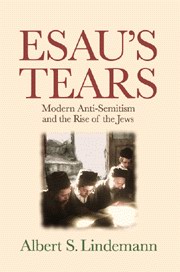
Esau’s Tears: Excerpts of chapter 6

Albert Lindemann is perhaps the only Jewish scholar who, unlike most Jewish pundits, acknowledges the reasons why they’ve been so disliked. No ellipsis added between unquoted paragraphs:


Esau’s Tears: Modern Anti-Semitism and the Rise of the Jews (Cambridge University Press, 2009)


Chapter 6. Austria-Hungary: Racial Radicalism and Schlamperei

Liberalism and the Rise of the Jews

These Jewish successes were less widely shared by members of the Gentile lower and lower-middle classes. Similarly, Jews did not become, or long remain, artisans, factory proletarians, or other kinds of manual laborers. Urban Jews were in general upwardly mobile; non-Jews were more often proletarianized—overwhelmed by the forces of modern urban civilization. Tens of thousands of small shops in Vienna went bankrupt in the latter half of the nineteenth century, and thousands of peasants plots in the surrounding countryside were put up for auction. The benefactors of these Gentile misfortunes were frequently Jews.

By the turn of the century, a German-Jewish writer who had moved to Vienna from the German Reich was struck by how much

all public life was dominated by Jews. The banks, the press, the theater, literature, social organizations, all lay in the hands of the Jews. The aristocracy would have nothing to do with such things. The small number of untitled patrician families imitated the aristocracy; the original upper-middle class had disappeared. The court, the lower-middle class and the Jews gave the city its stamp. And that the Jews, as the most mobile group, kept all the other in continuous motion is, on the whole, not surprising.

Henry Wickham Steed, correspondent for The Times of London in Berlin, Rome, and Vienna from 1896 to 1914, and widely recognized as one of the best informed, most pertaining observers of the day, wrote that “among the peoples of the Austria-Hungary the Jewish people stands first in importance. Economics, politically, and in point of general influence they are the most significant element in the Monarchy.” Moreover, embracing German language and culture by no means meant merging into German-Gentile society. Time and again assimilated Jews themselves referred to the Jews’ “stubborn emphasis on racial solidarity.”

It seems reasonable to conclude that any group, even one enjoying wide esteem, that rose as fast as the Jews in Austria-Hungary would have encountered some resentment and hostility.

The Jewish Press and the Crash of 1873

No area of Jewish influence in Austria-Hungary was more important than journalism in terms of spreading German language and culture—with a Jewish nuance. Jewish-owned and -operated newspapers in the empire were even more important than in Germany. “After Moritz Benedikt [the owner of Neue Freie Presse], the most popular man in the realm is Franz Joseph [the emperor of Austria]” was a popular witticism. He and his paper were admired by some, feared or detested by others. Nearly all observers regarded him as a man of fierce ambition and easy morals.

The complaint that Jewish journalists were vituperatively critical while remaining hypersensitive to criticism themselves was often expressed in Austria. Wickham Steed described the Neue Freie Presse as “a journal that embodies in concentrated form and, at times, with demonic force, the least laudable characteristics of Austro-German Jewry.”

The stock market crash in 1873, which catalyzed political anti-Semitism in Germany, affected Austria in similar ways. Jews were the obvious culprits, even more so in Vienna than in Berlin, since Jews in the stock market in Vienna were even more prominent than in Berlin. In Austria the capitalist robber barons, to borrow a phrase from the American scene, the railroad-building and factory-owning plunderers of the countryside, the noveaux riches, those ostensibly responsible for the bankruptcies of artisans and small retailers, the deceivers of the small investor were overwhelmingly made up of Jews, if only because Jews constituted a heavy majority of those involved in such modern economic activities.

Anti-Semitic Ideology

Friedrich Austerlitz asserted that the Jewish-owned liberal press was concerned to serve Jewish interests, to cover up misdeeds by Jewish capitalists, and to shower with abuse anyone who criticized Jews. Jewish press supremacy, he later observed, “was a conspiracy in favor of the Jews; the legend of the solidarity of all members of the people of Israel was at that time a reality.” Austerlitz granted that in the earlier part of the century, when Jews had been oppressed, criticism of their “eccentricities” was inappropriate, but by the latter half of the nineteenth century, when they dominated so much of public life in Austria and when their activities were so often corrupt, criticism was not only appropriate but the duty of all honest observers, Jews and non-Jews.

The notion of racial purity, of Aryan superiority, gained an even stronger hold on parts of the Austrian German-speaking Gentile population than it did in Germany itself. Similarly, in Austria fears about the “destructive mission” of Jews, their alleged tendencies to take over, dominate, and jewify, were even more pervasive.

Any synthesis of German and Jewish culture implied a distinctly larger Jewish component, an unacceptable result to many völkish Germans, who seem to have been driven, ostensibly because of the elusiveness of what it meant to be a German in the Austrian context, to an almost panicked assertion of the need to preserve the mystical “purity” of their race. They dreaded a loss of identity, a so-major dilution of what it meant to be a German that the world would lose its appeal for them. Feelings of German nationalism in Austria came increasingly to include a call for liberation from Jewish influence, a freeing of the Aryan-German spirit from the destructive inroads of “Semitism.”

Above all in Vienna and Budapest, assimilated, secular Jews were for traditional Catholics a formidable and alarming enemy. Jews were very rapidly increasing in numbers, and some were becoming spectacularly rich. They were articulate in ways that made many of their opponents feel the rage of impotence. As far as many Catholics were concerned, Jews were not only taking over modern economic life; they were also talking over the cultural life of the empire.

Catholic Antimodernism and Anti-Semitism

For large numbers of Austrian Catholics, Jews became “the enemy,” to be vigorously combated, and large numbers of Jews felt similarly about the church. The sophisticated, cosmopolitan, atomistic, and materialistic life of the modern city symbolized a world of evil and moral anarchy—prostitution, corruption, drunkenness, social and economic irresponsibility—for the Church, whereas for secular Jews the church was a repository of bigotry and unreasoning fear of the modern world.

In 1870 the doctrine of papal infallibility was proclaimed. One of the most penetrating Catholic social theorist of the time, Baron Karl von Vogelsang, hoped for a return to an idealized past, whereas Marx confidently predicated a transformed, if no less idealized, future. In their descriptions of liberal capitalism, however, they were in agreement: It was a system of unbridled egotism, and they were both inclined to derive anti-Semitic conclusions from that judgment.

Vogelsang further concluded that liberal rules favored Jews, allowing them to prosper extraordinarily and unjustly. Jewish prosperity, he observed, was paralleled by growing misery for the Christian lower orders. And that could hardly be accepted by a Christian as natural to the proper order of things.

Vogelsang lamented that Austria had lost its Christian bearing, had lost sight of the basis in Christian morality for social harmony. The country’s indigenous Christian population was being “robbed, dominated, and reduced to pariahs by the Jews.” The problem was not only exploitative Jewish capitalists; the “incredible insolent Jewish press” worked constantly to undermine the moral fabric of a society, as did the atheistic Jews at the head of the revolutionary parties.

Vogelsang was not a racist; he welcomed Jewish converts. He believed, however, that unconverted Jews could inflict and undermine an entire society if they were allowed to get out of control. And he was persuaded that just such an infected society had come into existence: “If by some miracle, “ he wrote, “all our 1,400,000 Jews were to be taken from us, it would help us very little, for we ourselves have been infected with the Jewish spirit.” The taste for pushing and shoving, the mocking of sacred tradition, the sardonic wit and intellectual arrogance, the sensuality and sexual immorality—these many “Jewish” traits had infected Catholics in Austria and were fatally undermining Christian society.

Vogelsang was willing to grant that capitalism and its associated modern industrial techniques could increase material wealth, but the price paid in moral terms, he believed, was too high. It meant the breakdown of the family, alcoholism, and urban crime; the replacement of quality production by the cheap and shoddy; swelling ranks of the chronically unemployed; and the bars, cabarets, and prostitutes. Capitalism and liberalism atomized society, destroyed valuable social and economic ties.

Modern secular Jews could be credited with bringing progress, new industrial techniques, scientific discoveries, cultural sophistication, and a new intensity and richness to life in cities like Vienna. They could also be credited with exploitation, corruption, crime, prostitution, alcoholism, social disintegration, and cultural nihilism. Both views had some basis in reality: “Progress” and “corruption” went hand-in-hand in nearly every country, whether or not Jews were present.

Anti-Semitism and Humanitarian Idealism: von Schönerer

In the early 1880s, particularly in the year 1882, the Austro-Hungarian Empire experienced an upsurge of popular hostility to Jews, much exceeding that in Germany, although not as physically violent as in pogrom-afflicted Russia.

Georg Ritter von Schönerer, in what might be interpreted as a rebellion against the world of his father, began to use language attacking the Jews that went much beyond anything so far heard in respectable circles. He spoke in coarse and brutal tones, with violent threats and violent actions.

_______________

Excerpted from a longer entry that eventually will contain most of the book’s chapters.

Wednesday, January 12, 2011

“It is the Ring, stupid!”

Presently I believe that the cause of Western malaise is fourfold: (1) Liberalism, understood as the last phase of Christendom; (2) the Jewish problem that strongly catalyzes liberalism, (3) a transferential revenge from our collective unconscious as explained in my essay, and last but not least corporate capitalism: the Ring of Greed and Power.

Whoever fails to see that the greatest danger to the white people is the Western plutocracy—led often by Jews hastens to add Michael O’Meara—fails to draw the key lesson of modern history. Capitalistic plutocracy is such a factor that sometimes I am tempted to imagine a socio-political-psychological reductionism when considering the other three factors:

One Ring to rule them all, One Ring to find them
One Ring to bring them all and in the darkness bind them
In the Land of Mordor where the Shadows lie.
O’Meara’s Toward the White Republic opened my eyes. These series of essays made me see that the United States, the main lackey of the One Ring, is probably the principal enemy of white Americans. Although O’Meara accepts the Jewish Problem as a very serious problem, he believes that the real enemy is the technocratic elite of both America and Europe. The contents of page 91 of Toward the White Republic provide a very vivid illustration of how the Ring destroyed far more our traditional culture than the communist regimes that the people of the Eastern bloc endured:
When Thomas Molnar, who played an important role in the US conservative movement of the 1960s and ’70s, returned to his native Hungary after the collapse of the Soviet empire, he found, to his astonishment, that traditional culture and education, which had virtually disappeared in the West, were still very much alive in the former Soviet bloc.
Can the One Ring be the culprit for the cultural and eventual demographic disappearance of the West and the white people—unless we destroy the Ring through nationalist revolutions in several Western states? I cannot answer the question in a single entry. But I can republish an article that originally appeared in Occidental Observer:


Lords of the Ring

by Michael Colhaze


Many moons ago and for a few years only, I wore my locks long and sported colourful garb and roamed the psychedelic haunts of Paris, London or Amsterdam, usually holding a joint in one hand while employing the other to underline with languid gestures my latest concept of how to bring instant peace and love to the world. As for my fellow freaks and hippies, most subsisted on very little, at least money-wise, but nearly all had pets, the latter named frequently after a brand of heroes much en vogue during those innocent times. For cats, Galadriel stood high on the agenda, also Arwen and Legolas. In Amsterdam my next-door neighbour, a middle-aged lady with henna-dyed hair, flowing dresses and tinkling bells around one fat ankle, owned a huge tomcat called Gollum. When he was one day run over by a lorry, she came and cried bitterly into my lap. I did my best to comfort her, though secretly rejoiced because the cunning bastard, nomen est omen, used to be a veritable bane for the local sparrows and blackbirds, and long since had I weighed means of abandoning him in a far-away place without coming under suspicion. As for dogs, I remember a Frodo, Bilbo and Pippin, also one Boromir, him a mighty Leonberger and the gentlest fellow I’ve ever met.


J.R.R. Tolkien

Which gives you an idea of how much Tolkien’s arrant epos was on our mind during those happy years. Wherever you came, you found in the bookshelves from cardboard boxes or orange crates at least one copy, usually a weighty paperback falling apart from much use. Walls were hung with coloured maps of Middle Earth, and Gandalf was a household name for anything from an Underground publication to a short-lived artistic society. Depending on fantasy and imagination, and perhaps also on the daily cannabis consume, an inordinate number of people identified with a member of the Fellowship, or wished fervently for the return of the King, or would have retired into the Shire without looking back even once.

On the other hand there were some, myself included, who had enjoyed the book but found it somewhat lacking in psychological depth. It was, after all, a monumental canvas painted largely in black and white, with protagonists either amazingly valiant, handsome and noble or the absolute opposite, namely unspeakably ugly and wicked. Which made the tale rather predictable and deprived it of the complex emotional touch that otherwise would have found a way into the heart. Still, Tolkien’s power of imagination cannot and will not be denied, and for his excuse it must be said that he relied much on the High Germanic saga like Edda or the Nibelungen, and that those were on the whole magnificent exemplifications of the eternal battle between Good and Evil. A battle where tads of intellectual embroidery might have seemed misplaced.

Yet under the heroic plainness hid an aspect that intrigued me and many of my friends considerably, namely the deeper meaning behind the fantasy. Because, as we all agreed, there had to be one since the tale was simply too carefully thought out to be without one. Never mind that the ghastly Sauron, title figure and main protagonist aiming to enslave the world and mankind particularly, didn’t turn up personally during the proceedings. But his presence is overwhelmingly felt, and he had to have an equivalent within the recent history of man, and as such a name that made sense.

First in line was of course Adolf Hitler, temporal saviour of a betrayed, ruined and starving Germany robbed naked by the Versailles victors, but for the rest and according to the New York Times the biggest blackguard ever to set foot on our sacred earth. Next came good old Joe Stalin, mass murderer par excellence supported by a closely knit clan of henchmen as described and defined by the great Solzhenitsyn in his Gulag and Two Hundred Years Together. Then the fabulous Chairman Mao, who most likely holds the Guinness record for accumulated corpses worldwide. And finally the inventors of the nuke, embodied by one Robert Oppenheimer who paid, just like that abominable fraud Freud, with lung cancer and a slow and painful death for his sins.

But try as you might, none of the above really made sense. One reason was of course that Tolkien had begun The Lord of the Rings already in the mid-thirties, long before those villains blossomed medially into full bloom.

As to the ring itself, what kind of power did it exactly wield? It was, this we know, potent enough to enslave the lesser ones, but not all-powerful. Because long ago Isildur King of Gondor, in a desperate attempt to stem the advance of the Orcs, had offered battle to Sauron their chieftain. And in a one-to-one succeeded with God’s help to cut off the latter’s hand which bore the ring. A feat that routed the Dark One and his hosts, at least for a while and until he tried another grab at the hideous thing.

My understanding of Tolkien’s political leanings is scant. He himself has, as far as I know, refused to give any clues. But there are hints. It is rumoured that he considered General Franco rather emphatically as the saviour of Catholic Spain, a view much at odds with contemporaries like that heartless hunter, boozer and scribbler Hemingway and his liberal chums. One of Tolkien’s close friends, the writer and poet Roy Campbell, had witnessed the atrocities committed by Marxist death squads against priests and nuns in Cordoba and described them in vivid detail. What makes him interesting in this context is that he also contributed articles to The European, a fascist gazette run by Lady Diana Mosley, wife of Sir Oswald and, as James Lees-Milne described her, “the nearest thing to Botticelli’s Venus as I have ever seen.” Ezra Pound, among others, was a fellow contributor to The European.

The latter should have rung a bell, but didn’t. Nearly twenty years had to pass before bits and pieces fell into place, at least within my much limited perception. One was an exhibition, the other a production of Wagner’s Ring.

The exhibition was staged in Frankfurt by one of the more affluent art establishments, meaning that decent Fizz, snacks with French pâté and a few interesting people could be expected on the eve of its grand opening. Which was the reason, some curiosity apart, why an old friend took me there. Both of us have no truck with Modern art and knew the artist only vaguely by name. Lucien Freud it was, grandson of you-know-who, and his hams about as uplifting as a dead rat under the sink. As we stood in front of one [painting], an uncouth male nude reclining on a smutty bedstead with legs spread wide open while scratching reddish genitals dangling above a cavernous anus, my friend cast a look around and said: “Grand Orc of the Crap Arts! Never had any sense of beauty, and never will!”

A remark that transported me immediately into a more sunny and innocent past, but also made me decline any comment. Because this was after all Germany, a country ruled by politically correct criminals that long since have booted the freedom of expression as laid down in the constitution, and who slap you for years on end into the cooler if you dare to insist on it.

Damned be the Ring I forged with a Curse!
Though the Gold gave me unlimited Might
Now its Sorcery has brought me Ruin!


The Rhinegold, 3rd Scene


About a week later I saw, and heard, Richard Wagner’s Ring of the Nibelung. I have no intention, and lack the intellectual acumen, to give this masterwork its proper due. George Bernhard Shaw, in his essay The Perfect Wagnerite, has summed it up like this: “Only those of a wider consciousness can follow it breathlessly, seeing in it the tragedy of human history and the whole horror of the dilemma from which the world is shrinking today.”

Dilemma? Horror? Shaw did not enter into detail as to the above, but the composer himself was more forthcoming.

You ask me about Jewry. I felt a long-repressed hatred for them, and this hatred is as necessary to my nature as gall is to blood. An opportunity arose when their damnable scribbling annoyed me most, and so I broke forth at last. It seems to have made a tremendous impression, and that pleases me for I really wanted only to frighten them in this manner. Because it is certain that not our princes, but the bankers and Philistines are nowadays our masters... [Correspondence between Wagner and Liszt, Vol. I, p.145, 18/4/1851]

He did however not intend, as stated very clearly elsewhere, to blame the whole tribe, just as you and I wouldn’t consider every Italian automatically a member of the Cosa Nostra.


Richard Wagner

As to the tremendous impression, this is how it commences. Namely at the very bottom of Germany’s mighty river Rhine. There a trove of gold lays embedded in a reef, glinting and gleaming mysteriously in the sunlight that filters through the timeless waves. Beautiful mermaids guard it on orders of their father, enjoying its dazzling radiance, cajoling and wriggling their lovely bodies in the bright reflection. Until one Alberich crawls out of the deep, a stunted Nibelung and Son of the Night who beholds the maids with greedy eyes. When he tries to seduce them, they only laugh, pull his beard and taunt him. Enraged, he asks about the significance of the gold. Carelessly they tell him that unlimited Power to rule the World is in store for the one who will forge a Ring out of the precious metal. But, they also warn him, this feat is only possible if he renounces forever the Power of Love.

It takes Alberich only a moment to make up his mind.
The World as heirloom would I gain!
And if I cannot have Love
Might I not cunningly extort Lust?
The Light will I extinguish for you
The Gold will I tear from the reef
And forge the avenging Ring!
Let the Waves be my witness:
Forever have I cursed love!

He rips the gold from the rocks and forges the Ring to rule the World with cunning and brute force—and of course without Love.

“My Ring and Wagner’s were round, but there the resemblance ceases!” scoffed Tolkien rather maliciously after his book had been published in the mid-fifties. Which is so transparent a denial that it seems almost laughable. Shaw’s aforementioned essay The Perfect Wagnerite, nearly of book-length, much acclaimed and widely read, must have been known in detail to Tolkien as well. Because his Ring and Wagner’s are identical in theme and essence, twins in fact if only in a different quality of clothing. Meaning that the former, compared to Wagner’s peerless magnum opus, is over-large and very entertaining, but not really a masterpiece of literature in the classical sense. Interesting might be that Tolkien uses words like Mordor or Sauron, clearly derived from the German Mord, or murder, and Sau, or sow. Though his claim that his own name derived from the German tollkuehn, meaning extremely foolhardy, seems unlikely since it doesn’t exist as a family name.

As to the deeper meaning in both cases, it is important to know that the one Ring of Power has no magical potentials as we understand them. It cannot destroy enemy armies simply by an order of its bearer. It cannot make you fly. It cannot stop the flow of time. It can’t even prevent you from getting wet if it rains. It can make you invisible, true, but that is just an illusion. And you’d still get wet in any case. So what is it really?

It really is only GOLD! And isn’t that enough to rule the world?

For many of those who had witnessed the last decades of the great European Empires, a reign of peace and general improvement that ended abruptly and horribly with World War One, the era afterwards must have seemed like the proverbial devaluation of all values. Because the bankers and Philistines, already so powerful in Wagner’s times, had by now metastasized out of all proportion. Germany, down on its knees, was hardest hit. During the ill-fated and debt-ridden Weimar Republic the country’s capital, Berlin, boasted 115 banking institutions of which 112 were Jewish-owned. The same ratio was true for innumerable cabarets and brothels where girls and boys as young as ten years old sold their famished bodies to the new caste of money acrobats. As to the banks, they used the country’s catastrophic finances to their advantage and tricked and forced the starving population out of their assets, be it shares, shops, houses, farmland, factories or newspapers, until half of Germany was in the hands of a very few. The same happened, though much less drastically, in much of the Western World and resulted finally in the cataclysmic Black Friday. An exercise, as the Orc-faced Robert Fuld of formerly Lehman Bros. has informed us so brazenly, where we ruin a national economy and pick up the bits and pieces for a song.

Now it must be remembered that in those years public opinion was on the whole far less brainwashed than today. No Holocaust had yet been invented to slap down undesirable critics, no worldwide Media Mafia could tell you convincingly that a crock of shit is a pot of gold. Thus in many of the national and international gazettes, accounts of thefts, crimes and injustices abounded, backed up with caricatures of the cruel and greedy Jew.

Accounts that surely have been observed and considered by Tolkien as well. Therefore it seems highly plausible that the Ring he began to forge in his mind during the early Thirties wasn’t so very different from the one Wagner had invented a hundred years earlier. Particularly if we remember a rather interesting detail, namely that indeed one Aragorn strode out of the wild and re-forged the sword that was broken. A man not of royal descent, it is true, but some kind of Mahdi or Sent-One, as Carl Gustav Jung has called him. Very powerful, a great orator, fearless too, and immediately setting to work and succeeding, almost overnight, to break the Ring’s terrible stranglehold. A feat he brought about by throwing worthless paper money out of the window and replacing it with barter based on real goods and honest work.

Well, we know what became of him and his folks, and how dearly they paid for an attempt that endangered the supremacy of Sauron’s banking institutions worldwide. The latter regrouped, giving his Ring full play, and Germany’s ancient cities and their innocent inhabitants, millions of them, perished in a Firestorm of unimaginable magnitude and barbarity. A sad moment in our great Christian European history, you will agree, and its final curtain fittingly drawn by one of its greatest conductors, Herbert von Karajan, who performed on the eve of Berlin’s destruction the Ring’s last episode, Twilight of the Gods.

As for the Sent-One, there comes a day when he will be assessed more objectively and not just demonised out of all proportion. When some of the most hideous accusations levelled against him might crumble like a house of cards in a cloud of dust about as big as the one at 9/11 and its official explanations. Which could result in two schools of thought, namely one where he remains indeed a villain, and another that pronounces him the most tragic character that ever walked the earth. Him and his people. As for myself, I still have to make up my mind.

As for Tolkien, nearly twenty years went by between the Ring’s first written page and its publication. A time span that radically changed the face of the world, including the book market. Which ended up, to a large part and small wonder, in Sauron’s hands as well. Thus it doesn’t come as a surprise if Sauron’s chronicler got somewhat mum and choose to refute any familiarity, let alone indebtedness, with and to his German forbear. And so removed any ideological obstacles and cleared the way for a tremendous literary success.

A success most certainly deserved, with the one little setback that we will never know what kind of Secret Fire the old wizard Gandalf the Grey has been serving, and which he so mightily evoked when he smote the Bridge of Khazad-Dùm from under the Balrog’s fiery feet. The latter an intriguing name, particularly if you keep in mind that Baal is the Canaanite god of fertility who demanded human sacrifices, and Rog the Hindi word for malady.

As for the rest of the world, the question is of course of how far the Lords of the Ring have succeeded to enslave us. Logically speaking, and seeing their immeasurable wealth and nearly unlimited influence, they should have long since consolidated the realm. Which seems indeed the case in most Western countries where presidents, prime ministers and chancellors are their obedient marionettes. Ring Wraiths, Tolkien has called them fittingly. Men and women like you and me, but empty-eyed. Outer shells of their former selves who command us to abandon our morals and artistic heritance, fight proxy wars for their masters, pay any amount of money into their purse, and generally order us to be at their service whenever it pleases them.

Yet something went badly wrong.

To begin with, the Shadows have been torn from the Land of Mordor, a mysterious region shrouded in deep secrecy for hundreds of years, but now glaringly illuminated. So much so that its schemes and crimes are every day more clearly observed and understood, be it the corruption of politicians, the doling out of jobs to foreign countries, the true intent behind globalism, the giant thefts, the resulting economical upheavals, the unspeakable atrocities in the occupied territories, the bungled assassinations, to name but a few.

Next come the Ring Wraiths, perhaps Tolkien’s finest invention. Enablers, Paul Gottfried has called them, and deems them worse than their criminal masters. Men and women who once possessed Christian souls and knew about the Power of Love, but sold both for thirty pieces of gold to forge their own insignificant rings. Trinkets that serve for a few brief years to ride the crest of power until a new contender wins the upper hand and sends them packing. Which is usually sweetened with honours and compliments to ease the approaching twilight years, a time when the ghosts and corpses of the past begin to whisper in the dark and the hour of reckoning draws close, slowly but inevitably.

Today this kind of sugar-coating can have a sour aftertaste, due to an unforeseen invention called the Internet which markedly diminished the control of the Media Mafia and its sniffing, lying, cajoling, mudslinging lackeys. That is why the Bushes and Blairs of this world have become lepers instead of paragons, with motions underway to hold them responsible for their crimes, including the death of countless women and children and that of many fine soldiers whose intentionally poor equipment has prolonged the conflict to this day.

Finally the Dark Lords themselves.

Those who have already entered the twilight years, like the one on top of this little essay [George Soros - I have omitted the images of the original article], watch with silent horror how the mountains of gold are seeping like water through their fingers, leaving them empty-handed and with nothing to bargain on Judgement Day. As for the others, still springy and enterprising, it is said they are preparing for the ultimate Armageddon with their nukes, viruses, bacteria, cheque books, connections and what not. And perhaps they do, because they see that the world has tired of them, of their lies and extortions. But if they do, they’ll have to fight themselves for a change and not let others do the dirty work. Which will result, as a kind of divine retaliation and since they are so few, in the final destruction of the Ring and the utter defeat of its forgers.

Because once, long ago, when tempted by a hoard of gold deep in the River Rhine, they made the wrong choice and…

forever cursed the Power of Love
.