Showing posts with label Communist Russia. Show all posts

Monday, February 28, 2011

Esau’s Tears: Excerpts of chapter 13

Albert Lindemann is perhaps the only Jewish scholar who, unlike most Jewish pundits, acknowledges the reasons why they’ve been so disliked. No ellipsis added between unquoted paragraphs:


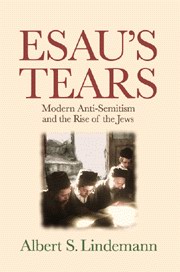
Esau’s Tears: Modern Anti-Semitism and the Rise of the Jews (Cambridge University Press, 2009)


Chapter 13: Jews and Revolution (1917-1934)


The horrors of the revolution from 1917 to 1921 were in some areas even more devastating than those of the war; the connections of Jews and socialist revolutionaries were more visible than ever before and the anti-Semitic potential greater. The perception that revolutionaries were predominantly Jewish and that Jews were particularly vicious as revolutionaries spread now from minds like those of Nicholas II—limited, paranoiac, almost pitiful—to those of a different cut, such as Woodrow Wilson and Winston Churchill. It was no longer only scandal sheets like La Libre Parole or the Bessarebetz that identified radical revolution with Jews; now that identification was made by newspapers like the London Times, the Chicago Tribune, or the Christian Science Monitor, all of which enjoyed a reputation for sobriety on Jewish issues and at least relative fairness.

Many of those who had been inclined to a hesitant or inconsistent anti-Semitism before the war, such as Wilhelm II, now embraced more extreme opinions. Wilhelm’s attitude to “the threat of international Jewry” was influenced by reports like those of Walther von Kaiserlingk, the German admiralty’s chief of operations, who had visited Petrograd in the winter of 1917-18: He described the new government as run by Jews in the interest of Jews; it was “insanity in power,” and it presented a moral threat not only to Germany but to the civilized world. Wilhelm agreed that the Russian people had been “turned over to the vengeance of the Jews, who are connected with all the Jews of the world.”

We have seen how, in western countries where Jews experienced less oppression, an active and highly visible minority of them, especially young, secularized Jewish intellectuals in the generation before the war, were powerfully attracted to socialist ideas. Jews such as Hess, Marx, Lassalle, Bernstein, Otto Bauer, Luxemburg, Martov, Trotsky, and León Blum played a major role in formulating, refining, and propagating those ideas. Non-Jews (Engels, Kautsky, Bebel, Plekhanov, Lenin, Guesde, Jaurès) were also important, in many regards more important than Jews, but considering that the Jewish population of Europe was approximately 2 percent of the total, the Jewish participation in socialism, revolutionary and democratic, was remarkably large.

Both Jewish and non-Jewish socialists in the late nineteenth century saw great merit in the idealism and radicalism of a moral elite of Jews. Just as the non-Jew, Friedrich Engels, had praised Jews for their contribution to the socialist movement, so V.I. Lenin, in a speech in Zurich in 1905, observed that “the Jews furnished a particularly high percentage of leaders of the revolutionary movement. It should be noted to the credit of the Jews, they furnish a relatively high percentage of internationalists.” On another occasion Lenin, in lamenting the low moral and intellectual level of his compatriots, remarked to Maxim Gorky that “an intelligent Russia is almost always a Jew or somewhere with Jewish blood in his veins.” León Blum, who after his participation of the Dreyfus Affair went on to become a prominent figure in the French socialist movement, “glorified in the messianic role of the Jews as social revolutionaries.” Although he was one of the most perceptive critics of Bolshevik theory in the debates within his own party in 1919 and 1920 concerning whether it should join the new Communist International, he had earlier written that “the collective impulse” of the Jews “leads them toward revolution; their critical powers… drive them to destroy every idea, every traditional form which does not agree with the facts or cannot be justified by reason.” Revolutionary socialism, he asserted, was a modern form of “the ancient spirit of the Jewish race.”

Most Russian Jews were pulled unwillingly, even uncomprehendingly into the vortex of revolution and ensuing civil war from 1917 to 1921, observers rather than actors. But others, especially many who had felt blocked in their dreams of a career or who had suffered daily under the irrationality and inefficiency of the tsarist regime, were only too understandably moved by a desire for violent revenge. Some of those revolutionaries, especially when driven into the moral anarchy of civil war, proved themselves capable of breath-taking ruthlessness.

Recognizing that there were fewer Jews in the Bolshevik faction than in the Menshevik, or even that Bolshevism was not a typically Jewish ideology, does not mean that the issue of the role of Jews in Bolshevism is settled, for there were still many Jewish Bolsheviks, especially at the very top of the party. And there were even more in the dreaded Cheka, or secret police, where the Jewish revolutionary became visible in a terrifying form.

Any effort to compose a list of the most important Bolsheviks must be unavoidable subjective, but it seems beyond serious debate that in the first twenty years of the Bolshevik Party the top ten to twenty leaders included close to a majority of Jews.

At a notch down in visibility was Yakov Mikhailovich Sverdlov. Described as “very Jewish looking,” he became secretary and main organizer of the Bolshevik Party in 1917. There was at any rate no little symbolism in the fact that a Jew was both the head of the state and the secretary of the ruling party. Percentages of Jews in state positions or in the party do not capture that adequately.

In approximately the same second-level category was Moisei Solomonovich Uritsky, notorious as the chief of the Cheka in Petrograd where Red Terror raged with special brutality. For anti-Semites he became the personification of “Jewish terror against the Russian people.” He was certainly less fanatical than Zinoviev [another Jew], whose pervasive cruelty and vindictiveness toward alleged counterrevolutionaries prompted Uritsky at one point to lodge an official complaint.

A list of prominent non-Jews in the party would begin with Lenin, whose name outweighs the others, although in the first year or so of the revolution, Trotsky’s name rivaled his. Yet his status as a non-Jew and “real Russian” is not as clear as subsequent Soviet propaganda tried to make it. His grandfather on his mother side was Jewish, though a convert to Christianity and married to a woman of German origin. On Lenin’s father side were Kalmyk and Swedish forebears. Lenin the non-Jew, in other words, was Jewish enough to have fallen under the shadow of doubt in Nazi Germany or to have been accepted in the state of Israel.

Lenin was of course considered jewified, if not exactly Jewish, by anti-Semites. As noted, he openly and repeatedly praised the role of the Jews in the revolutionary movement; he was one of the most adamant and consistent in the party in his denunciation of pogroms and anti-Semitism more generally. After the revolution, he backed away from his earlier resistance to Jewish nationalism, accepting that under Soviet rule Jewish nationality might be legitimate. On his death bed, Lenin spoke fondly of the Jewish Menshevik Julius Martov, for whom he had always retained a special personal affection in spite of their fierce ideological differences.

An even more remarkable case was Felix Dzerzhinsky, the head of the Cheka, a “non-Jewish Jew” in a different sense. (The destruction of his statue in front of the KBG building in Moscow in August 1991, after the ill-fated putsch by party conservatives, was widely seen as symbolic of the destruction of a hated past of secret police domination.) In origin a member of the Polish gentry, he had learned Yiddish as a young man in Vienna and had established close friendships with many Jews in the revolutionary circles of the town. He had several romances with Jews and finally married one.

The backgrounds and personal contacts of non-Jews such as Lenin, Kalinin, and Dzerzhinsky help explain how it was that so many observers believed the Bolsheviks were mostly Jews or were in some way under Jewish tutelage. The various refinements of Jewishness—traditional Jew, reform Jew, cultural Jew, half-Jew, non-Jewish Jew, self-hating Jew, Karaite, jewified Gentile—did not have much meaning to most of those who were in a life-and-death struggle with the Bolsheviks and who of course were not used to seeing Jews in any position of authority in Russia; to see them in such numbers spoke for some radical undermining of a previously accepted order. The leaders of the anti-Bolshevik White armies were convinced that they were fighting Jews and other foreigners (Georgians, Armenians, Lithuanians, Poles)—but most importantly Jews—who had somehow seized control of Mother Russia. To most of the Whites the differences between the various revolutionary factions were of little importance; they all appeared alien, foreign in inspiration, jewified, and destructive. Indeed, for many on the right even the liberal Kadets were viewed as westernized and jewified.

Such exaggeration was hardly limited to the White armies. One book published in the West, The Causes of World Unrest, presented a list of fifty members of the Bolshevik government and declared that 95 percent of them were Jews, a common conclusion, as was the notion that the Bolsheviks were murderously destructive.

Destruction of the Jews by the Nazis was from this perspective to be considered a preventive measure, ultimately one of self-defense. As early as 1917, Belloc’s friend and intellectual colleague, C.K. Chesterton, had sternly warned the Jews in Great Britain who were sympathetic to the revolution that “if they continue to incite people against the soldiers and their wives and widows, they will learn for the first time what anti-Semitism really means.”

Anti-Semitism, well entrenched on the right, revived in the rest of the political spectrum, undermining what had been achieved through the patriotic unity of August 1914. The older charges that Jews were unpatriotic or part of the capitalist conspiracy now refocused on the Jew as a social subversive, “taking orders from Moscow.”

A revolutionary unrest spread to central Europe in late 1918 and 1919. The party’s first two leaders, Rosa Luxemburg and, after her murder in January 1919 at the hands of a right-wing paramilitary organization, Paul Levi, were of Jewish origin. Even in France and Italy, with their small and overwhelmingly bourgeois populations, the emerging Communist parties counted a number of Jews in hardship positions. “Foreign Jews, taking orders from Moscow” became an issue.

A Communist coup was attempted in Berlin in January 1919 (the Spartacus Uprising, when Rosa Luxemburg was killed), and in the course of that tumultuous year in Germany pro-Bolshevik revolutionaries took over, however briefly and confusedly, in Munich. In France a general strike was launched in the spring of 1920, and in the autumn of that year there were massive factory occupations in the industrial north of Italy. Perhaps most worrisome to the western powers, the Red Army, headed by Trotsky, launched an offensive against Poland in the summer of 1920 that was touted as the beginning of a triumphant advance of the Red Army into western Europe.

Russian Jews in Revolution: From March to November

One of the first measures taken by the Provisional Government was a decree conferring complete civil equality upon Russia’s Jews. That action was hailed as long overdue by the Russian press; even Novoe Vremia, which, as a semiofficial organ before 1917, had often published anti-Semitic material, applauded the move.

Many of Russia’s Jews were jubilant at the news. In some Jewish homes, Passover was celebrated that year with the reading of the decree instead of the traditional Haggada. Plans were quickly made by Jewish activists for an all-Russian Jewish congress. The excited appeal that went out for it proclaimed that whereas elsewhere Jews had received civil equality, only now in revolutionary Russia were they also going to receive recognition of their separate nationality within another nation. Nothing finally came of this congress, since the Bolshevik Revolution, and then civil war, got in the way.

In Russia, perhaps even more than elsewhere, civil equality for Jews, to say nothing of an official recognition of Jewish nationality, opened up Pandora’s box.

Jews who had faced pervasive discrimination and persecution suddenly found government positions opened to them while closed to the older privileged classes, who were overwhelmingly of Great Russian background.

Still, after 1917, especially after November 1917, there was in Europe a most remarkable change in the status quo: Large numbers of individual Jews assumed, for the first time in modern history, a major role in the government of non-Jewish peoples. Such was the case not only in Russia but in other areas, most notably Hungary and Germany.

The Red Terror—a Jewish terror?

In some areas, for example, the Ukraine, the Cheka leadership was overwhelmingly Jewish. By early 1919 Cheka organizations in Kiev were 75 percent Jewish, in a city where less than a decade earlier Jews had been officially forbidden to reside, except under special dispensation, and constituted about 1 percent of the total population.

The pattern of employing non-Slavic ethnic minorities in the Cheka was duplicated in many other areas of Russia. George Leggett, the most recent and authoritative historian of the Russian secret police, speculates that the use of outsiders may have been a conscious policy, since such “detached elements could be better trusted not to sympathize with the repressed local population.”

It is instructive that the high percentage of Jews in the secret police continued well in the 1930s, when the population of Jews gradually diminished in most other areas of the Soviet and party cadres. The extent to which both Cheka and Gestapo leaders prided themselves in being an elite corps, characterized by unyielding toughness—unmoved by sympathy for their often innocent victims and willing to carry out the most stomach-turning atrocities in the name of an ideal—is striking.

The number of Jews involved in the terror and counterterror of this period is striking. These many Jewish terrorists helped to nurture, even when they killed Jewish Chekists, the belief that Jews, especially once they had broken from the confines of their traditional faith, turned naturally to fanaticism and anarchistic destructiveness.

An even more important institution than the Cheka in defending the revolution was the Red Army, and, again, Jews played a key role in its leadership.

Trotsky fascinated a broad public inside and outside Russia. In Hungary, a Jewish observer who was in fact hostile to the Bolsheviks nonetheless wrote: “The evolutionary flame which has burned beneath the surface of world history is now blazing up for the first time in a Jewish genius: Leo Trotsky!” According to Paul Johnson,

It was Trotsky who personally organized and led the armed uprising which actually overthrew the Provisional Government and placed the Bolsheviks in power. It was Trotsky who created the Red Army, and who ensured the physical survival of the new Communist regime during the Civil War.

Trotsky’s paramount role in the revolution cannot be denied; Johnson’s views even if exaggerated, underline how powerful and durable has been the mystique around Trotsky’s name. He was second to Lenin, but a strong second. There was no Jew in modern times, at least until the creation of the state of Israel, to rival him.

* * *

It has been claimed that the actual proportion of Jews in top party and state positions in the 1930s did not notably drop from the 1920s. However, “visible” Jewish leaders, comparable to Trotsky, Zinoviev, or Uritsky, diminished in numbers and would continue to do so in subsequent years, so that by the mid-twentieth century there were almost no Jews among the highest officials in the Soviet Union.

To state the obvious, Jews were never purged explicitly as Jews in the Soviet Union, and millions survived the worst years of Stalin’s terror.

_______________

Excerpted from a longer entry that eventually will contain most of the book’s chapters.

Saturday, July 17, 2010

The Gulag Archipelago – the redpill is not for cowards

“To live now and not to know this work is to be a kind of historical fool” —W.L. Webb

“When do you plan to campaign for a museum honoring the memory of the tens of millions of victims of Soviet terror? Why aren’t you outraged by the fact that not one has been built?” —Alex Kurtagic


The astute way to present the Jewish Problem to a misinformed public is not to deny the Holocaust, but to show the masses that they have been ill served by the mainstream media and Hollywood. So many movies depicting the Holocaust and zero about the Gulag can only mean that Hollywood’s masters have kept their gentile sheep in the dark. (Nazism was largely a reaction to the Red Terror, which nationalist Germans perceived as Jewish Terror when the world was a little saner than today.)

The Gulag, as a subject, is so huge that it shocks me that despite the Cold War even the well educated Anglo-Saxons I have spoken to don’t know the meaning of Solzhenitsyn’s main metaphor in the term Gulag Archipelago (see map above). Here I’ll drop only one fact. In what some people call the “Russian Holocaust,” the Bolsheviks, overrepresented by Jews, killed more civilians than what the Nazis did in their death camps.

Since the overwhelming majority of Westerners ignore these facts it could be said without hyperbole that they are profoundly sleeping in the Matrix of political correctness (PC) and disinformation.

Was Red Terror mainly Jewish Terror as the Nazis believed (and acted accordingly)? Thanks to Kevin MacDonald’s lead, Solzhenitsyn’s Two Hundred Years Together, a two-volume work on the history of Russian-Jewish relations, is being translated, step by step, in the Occidental Observer blogsite (here). The publishing houses in North America and the U.K., including the universities presses, are such PC cowards that Solzhenitsyn’s last major work, published since 2001-2002 in Russian, had not been translated to English! However, before reading it I would strongly recommend the abridged version of Solzhenitsyn’s most important book (the longer version of The Gulag Archipelago, published in 1973 is either for scholars or Russians).

If read in the context of MacDonald’s work, the abridged, printed Archipelago could have the effect of taking the redpill. Below I have typed excerpts of the first nine sections of Solzhenitsyn’s magnum opus. But first...

When I was much younger the Soviet dissidents had to smuggle copies of Solzhenitsyn’s work into the Soviet Union. Today totalitarianism has been inverted and it is us who are smuggling unauthorized translations of Solzhenitsyn’s last major work from Russia into the U.S. because of our PC deference to the philo-Semitic Zeitgeist.


One final comment in this sort of preface. I started blogging last year when, thanks to the online literature of the counter-jihad movement, I discovered that Western civilization is in great danger. Alas, as to the Jewish Question is concerned counter-jihadists, who are not exactly the embodiment of an Hector, a Roland or a Prince Valiant have chosen... the blue pill.

Will you pick one up?

*     *     *


The Gulag Archipelago (The Harvill Press, 1999), translated from the Russian by Thomas Whitney and Harry Willetts. Abridged by Edward Ericson

Foreword to the Abridgement (excerpt)

If it were possible for any nation to fathom another people’s bitter experience through a book, how much easier its future fate would become and how many calamities and mistakes it could avoid. But it is very difficult. There always is this fallacious belief: “It would not be the same here; here such things are impossible.”

Alas, all the evil of the twentieth century is possible everywhere on earth.

Yet I have not given up all hope that human beings and nations may be able, in spite of all, to learn from the experience of other people without having to live through it personally. Therefore, I gratefully accepted Professor Ericson’s suggestion to create a one-volume abridgement of my three-volume work, The Gulag Archipelago.

Aleksandr I. Solzhenitsyn


Introduction (no ellipsis added between excerpts)

For a few decades the word Holocaust has served us well as a shorthand term for modern man’s inhumanity to man. In recent years a second such shorthand term has entered our working vocabulary: Gulag. This term comes to us not from a host of witness but from one lone man: Aleksandr Solzhenitsyn, whose very name has become a household word around the world.

Were The Gulag Archipelago to be even more widely read than it has been, it would, I believe, make an indelible impression on the modern mind and have a salutary effect on the whole world. Here we have the greatest horror story of human history—in quantitative terms, at least (the comparable toll in China having not yet been calculated)—and, although it happened during our lifetime, most of us do not even know about it.

This work was written especially for future generations of Russians. It is these readers in particular who need to know, in as much detail as possible, the truth of their history. This abridged text is designed for the general reader, not for the scholar.

At Solzhenitsyn’s own suggestion, I have eliminated much of his personal story, though parts of it I treasure too much to drop.

Needless to say, I take responsibility for any errors of omission or commission. I hope only that any mistakes which I have made do not interfere with the transmission of Solzhenitsyn’s words to an audience which I believe desperately needs to hear them.

Edward Ericson


Author’s Note (no ellipsis added between excerpts)

And the Kolyma was the greatest and most famous island, the pole of ferocity of that amazing country of Gulag which, though scattered in an Archipelago geographically, was, in the psychological sense, fused into a continent—an almost invisible, almost imperceptible country inhabited by the zek people.

And this Archipelago crisscrossed and patterned that other country within which it was located, like a gigantic patchwork, cutting into its cities, hovering over its streets. Yet there were many who did not even guess at its presence and many, many others who had heard something vague. And only those who had been there knew the whole truth.

In this book there are no fictitious persons, nor fictitious events. People and places are named with their own names. If they are identified by initials instead of names, it is for personal considerations. If they are not named at all, it is only because human memory has failed to preserve their names. But it all took place just as it is here described.

This book could never have been created by one person alone. In addition to what I myself was able to take away from the Archipelago—on the skin of my back, and with my eyes and ears—material for this book was given me in reports, memoirs, and letters by 227 witness, whose names were to have been listed here.

What I here express to them is not personal gratitude, because this is our common, collective monument to all those who were tortured and murdered.

* * *


The Gulag Archipelago (the redpill is not for cowards)


Chapter 1: "Arrest" (no ellipsis added between excerpts)

How do people get to this clandestine Archipelago? At ticket windows or at travel bureaus for Soviet or foreign tourists the employees would be astounded if you were to ask for a ticket to go there. They know nothing and they’ve never heard of the Archipelago as a whole or of any one of its innumerable islands.

Arrest! Need it be said that it is a breaking point in your life, a bolt of lightning which has scored a direct hit on you? That it is an unassimilable spiritual earthquake not every person can cope with, as a result of which people often slip into insanity?

The Universe has as many different centers as there are living beings in it. Each of us is a center of the Universe, and that Universe is shattered when they hiss at you: “You are under arrest.” The gate behind us, the gate to our past life, is slammed shut once and for all.

It is an alien, brutal, and crushing force totally dominating the apartment for hours. And nothing is sacred in a search! During the arrest of the locomotive engineer Inoshin, a tiny coffin stood in his room containing the body of his newly dead child. The “jurists” dumped the child’s body out of the coffin and searched it. They shake sick people out of their sickbeds, and they unwind bandages to search beneath them.

For those left behind after the arrest there is the long tail end of a wrecked and devastated life. And the attempts to go and deliver food parcels. And this means once and for all: “No right to correspondence”—and that almost certain means: “Has been shot.”

They take you from a military hospital with a temperature of 102, as they did with Ans Bernshtein, and the doctor will not raise a peep about your arrest—just let him try! They’ll take you right off the operating table—as they took N.M. Vorobyev, a school inspector, in 1936, in the middle of an operation for stomach ulcer—and drag you off to a cell, as they did him, half-alive and all bloody.

And even in the fever of epidemic arrests, when people leaving for work said farewell to their families every day, because they could not be certain they would return at night, even then almost no one tried to run away and only in rare cases did people commit suicide. And that was exactly what was required. A submissive sheep is a find for a wolf.

Universal innocence also gave rise to the universal failure to act. Vanya Levitsky: “Every honest man is sure to go to prison. Right now my papa is serving time, and when I grow up they’ll put me in too.” (They put him in when he was twenty-three years old.) The majority sit quietly and dare to hope. Since you aren’t guilty, then how can they arrest you? It’s a mistake! They are already dragging you along by the collar, and you still keep on exclaiming to yourself: “It’s a mistake. They’ll set things straight and let me out!” Others are being arrested en masse, and that’s a bothersome fact, but in those other cases there is always some dark area: “Maybe he was guilty...?” But as for you, you are obviously innocent! You still believe that the Organs are humanly logical institutions: they will set things straight and let you out.

Once a person was arrested he was never released. Some still have hopes of a favorable outcome to their case and are afraid to ruin their chances by an outcry. (For, after all, we get no news from that other world, and we do not realize that from the very moment of arrest our fate has almost certainly been decided in the worst possible sense and that we cannot make it any worse.)

I myself lugged a fifth suitcase with no great joy since it contained my diaries and literary works, which were being used as evidence against me. My cellmates—tankmen in soft black helmets—hid nothing. They were three honest, openhearted soldiers—people of a kind I had become attached to during the war years because I myself was more complex and worse. All three had been officers.

“Out for toilet call! Hands behind your backs!”

I was bursting with indignation that some ignoramus of a master sergeant dared to give orders to us officers: “Hands behind your backs!” But the tank officers put their hands behind them and I followed suit.

Back of the barn was a small square area in which the snow had been all trampled down but had not yet melted. It was soiled all over with human feces, so densely scattered over the whole square that it was difficult to find a spot to place one’s two feet and squat. However, we spread ourselves about and the five of us did squat down. Two machine gunners grimly pointed their machine pistols at us as we squatted, and before a minute had passed the master sergeant brusquely urged us on:

“Come on, hurry it up! With us they do it quickly!”

* * *

Chapter 2: "The History of Our Sewage Disposal System" (no ellipsis added between excerpts)

Although I have no statistics at hand, I am not afraid of erring when I say that the wave of 1937 and 1938 was neither the only one not even the main one, but only one, perhaps, of the three biggest waves which strained the murky, stinking pipes of our prison sewers to bursting.

Before it came the wave of 1929 and 1930, the size of a good River Ob, which drove a mere fifteen million peasants, maybe even more, out into the taiga and the tundra. But peasants are a silent people, without a literary voice, nor do they write complaints or memoirs. This wave poured forth, sank down into the permafrost, and even our most active minds recall hardly a thing about it. It is as if it had not even scarred the Russian conscience. And yet Stalin (and you and me as well) committed no crime more heinous than this. And after it there was the wave of 1944 to 1946. But in this wave, too, the people were of the simpler kind, and they wrote no memoirs.

But the wave of 1937 swept up and carried off to the Archipelago people of position, people with a Party past, yes, educated people, around whom were many who had been wounded and remained in the cities... and what a lot of them had pen in hand!

It is well known that any organ withers away if it is not used. Therefore, if we know that the Soviet security organs, or Organs (and they christened themselves with this vile word), praised and exalted above all living things, have not died off even to the extent of one single tentacle, but, instead have grown new ones and strengthened their muscles—it is easy to deduce that they have had constant exercise. This action was, in fact, explained openly (Latsis, in the newspaper Red Terror, November 1, 1918):
“We are not fighting against single individuals. We are exterminating the bourgeois class. It is not necessary during the interrogation to look for evidence proving that the accused opposed the Soviets by word or action. The first question which you should ask him is what class does he belong to, what is his origin, his education and profession. These are the questions which will determine the fate of the accused. Such is the sense and the essence of Red Terror.”
A decree of the defense Council on February 15, 1919 (the meeting was evidently presided over by Lenin), suggest that the Cheka and the NKVD take hostages among the peasants of those regions where “the cleaning of snow from the railroads does not proceed quite satisfactorily” and noted that “these hostages be executed if the cleaning is not completed.” In other words, free people were simply arrested and executed immediately...

The practice of arresting students began in 1921. In the spring of 1922 the Patriarch Tikhon was arrested and two resounding trials were held, following by the execution of those who had publicized the Patriarch’s appeal. Metropolitans and bishops were arrested, and, as always, in the wake of the big fish, followed shoals of smaller fry: archpriests, monks, and deacons. They arrested and sentenced active laymen. The circles kept getting bigger, as they raked in ordinary believers as well, old people, and particularly women, who were the most stubborn believers of all. As Tanya Khodkevich wrote:
You can pray freely
But just so God alone can hear.
(She received a ten-year sentence for these verses.) A person convinced that he possessed spiritual truth was required to conceal it from his own children. In the twenties the religious education of children was classified as a political crime under Article 58-10 of the Code.

In 1929, also, those historians who had not been sent abroad in time were arrested... It even reached a point of such confusion that men and women were imprisoned in the same cells and used the latrine bucket in each other’s presence—who cared about those niceties? Give up your gold, vipers! The interrogators had one universal method: feed the prisoners nothing but salty food and give them no water. Whoever coughed up gold got water. One gold piece for a cup of water!

In sheer size this nonrecurring tidal wave (it was an ocean) swelled beyond the bounds of anything the penal system or even an immense state can permit itself. There was nothing to be compared with in all Russian history. It was the forced resettlement of a whole people, an ethnic catastrophe.

This wave was also distinct from all those which preceded it because no one fused about with taking the head of the family first and then working out what to do with the rest of the family. On the contrary, in this wave they burned out whole nests, whole families, from the start; and they watched jealously to be sure that none of the children—fourteen, ten, even six year old— got away: to the last scrapings, all had to go the same road, to the same common destruction. (This was the first such experiment—at least in modern history. It was subsequently repeated by Hitler with the Jews.)

In 1941 the Germans went round Tagnrog, cutting it off so swiftly that prisoners were left in freight wagons at the railway station where they had been brought to be evacuated. What should one do with them? Certainly not set them free nor leave them to the Germans. Oil tank trucks were rushed to the station, and the wagons were drenched with oil and set on fire. All the prisoners were burned alive.

* * *

Chapter 3: "The Interrogation" (no ellipsis added between excerpts)

What had already been regarded as barbarism under Peter the Great, what might have been used against ten or twenty people in all during the time of Biron in the mid-eighteenth century, what had already become totally impossible under Catharine the Great, was all being practiced during the flowering of the glorious twentieth century—in a society based on socialist principles—not by one scoundrel alone, but by tens of thousands of specially trained human beasts standing over millions of defenseless victims.

In 1952 Anna Skripnikova was undergoing her fifth imprisonment, and Sivakov, Chief of the Investigative Department of the Ordzhonikidze State Security Administration, said to her:
“The prison doctor reports you have a blood pressure of 240/120. That’s too low you bitch! We’re going to drive it up to 340 so you’ll kick the bucket, you viper, and with no black and blue marks; no beatings; no broken bones. We’ll just not let you sleep.”
She was in her fifties at the time. And if, back in her cell, after a night spent in interrogation, she closed her eyes during the day, the jailer broke in and shouted: “Open your eyes or I’ll haul you off that cot by the legs and tie you to the wall standing up.”

As early as 1921 interrogations usually took place at night. And there was an airtight cork-lined cell in which there was no ventilation and they cooked the prisoners. A participant in the Yaroslavl uprising of 1918, Vasily Aleksandrovich Kasyanov, described how the heat in such a cell was turned up until your blood begin to ooze through your pores.

Then in the years 1937-1938, in view of the extraordinary situation prevailing (the specified millions of admissions to the Archipelago had to be ground through the apparatus of individual interrogation in specified, limited periods, something which had simply not happened in the mass waves of kulaks and nationalities), interrogators were allowed to use violence and torture on an unlimited basis, at their own discretion. For the first time in human history the calculated torture of millions was being undertaken.

In the Novocherkassk NKVD, Yelena Strutimskaya was forced to remain seated on a stool in the corridor for six days in such a way that she did not lean against anything, did not sleep, did not fall off, and did not get up from. Six days! Just try to sit that way for six hours! People could be compelled to kneel in the interrogator’s office or the corridor for twelve, or even twenty-four hours. (The interrogator himself could go home, sleep, amuse himself in one way or another—this was an organized system; watch was kept over the kneeling prisoner, and the guards worked in shifts.) What kind of prisoner was most vulnerable to such treatment? It was a good method to use with women. Ivanov-Razumnik reports a variation of it: Having set young Lordkipanidze on his knees, the interrogator urinated in his face! And what happened? Unbroken by anything else, Lordkipanidze was broken by this. Watch shows that the method also worked well on proud people.

Then there is the method of simply compelling the prisoner to stand there, and if he goes to sleep and falls over he is given a kick and straightened up.

Sleeplessness, which they quite failed to appreciate in medieval times: They did not understand how narrow are the limits within which a human being can preserve his personality intact. Sleeplessness (yes, combined with standing, thirst, bright, light terror, and the unknown—what other tortures are needed?) befogs the reason, undermines the will, and the human being ceases to be himself, to be his own “I.” (As in Chekov’s “I Want to Sleep,” but there it was much easier, for there the girl could lie down and slip into lapses of consciousness, which even in just a minute could revive and refresh the brain.) A person deprived of sleep acts half-consciously or altogether unconsciously, so that his testimony cannot be held against him.

Sometimes, as a refinement, instead of making the prisoner stand up, they made him sit down on a soft sofa, which made him want to sleep all the more. (The jailer on duty sat next to him on the same sofa and kicked him every time his eyes began to shut.) Sleeplessness became the universal method of the Organs. The prisoners were forbidden to sleep even one minute. Whoever was undergoing interrogation got no sleep for at least five days and nights. The above method was further implemented by an assembly line of interrogators. Not only were you not allowed to sleep, but for three or four days shifts of interrogators kept up a continuous interrogation.

As long ago as 1933 this was one of the ways they tortured S.A. Chebotaryev in the Khabarovsk GPU. They locked him in a concrete alcove in such a way that he could neither bend his knees, nor straighten up and change the position of his arms, not turn his head. And that was not all! They began to drip cold water into his scalp—a classic torture—which then ran down his body in rivulets. They did not inform him, of course, that this would go on for only twenty-four hours. It was awful enough at any rate for him to lose consciousness, and he was discovered the next day apparently dead. He came to on a hospital cot. They had brought him out of his faint with spirits of ammonia, caffeine, and body massage. At first he had no recollection of where he had been, or what happened. For a whole month he was useless for interrogation.

[The] bridling, also known as “the swan dive”: This was a Sukhanovka method—also used in Archangel, where the interrogator Ivkov applied it in 1940. A lone piece of rough toweling was inserted between the prisoner’s jaws like a bridle; the ends were then pulled back over his shoulders and tied to his heels. Just try lying on your stomach like a wheel, with your spine breaking—and without water and food for two days!

Is it necessary to go on with the list?

* * *

Chapter 4. "The bluecaps" (no ellipsis added between excerpts)

“Just give us a person and we will create a case!” That was what many of them say jokingly, and it was their slogan. What we think of torture they think of as a good work. The wife of the interrogator Nikolai Grabishchenko (the Volga Canal Project) said touchingly to her neighbors: “Kolya is a very good worker. One of them didn’t confess for a long time—and they gave him to Kolya. Kolya talked with him for one night and he confessed.”

You have a power over all the people in that military unit, or factory, or district, incomparably greater than that of the military commander, or factory director, or secretary of the district Communist Party. These men control people’s military or official duties, wages, reputations, but you control people’s freedom. From the moment you don that heavenly blue service cap, you stand higher than the publicly acknowledged power.

The girl is blushing all over and in tears. “It doesn’t have anything to do with the case,” she protests. “Yes, it does, speak up!” If you want, she’ll demonstrate with her body. She has no way out. In your hands you hold the punishment cell and her prison term.

To know what it meant to be a bluecap one had to experience it! Anything you saw was yours! [But] let everyone ask himself: “If my life had turned out differently, might I myself not have become just such an executioner?” Twenty-year-olds, we marched in the ranks of those born the year the Revolution took place, and because we were the same age as the Revolution, the brightest of futures lay ahead.

It would be hard to identify the exact source of that inner intuition, not founded on rational argument, which prompted our refusal to enter the NKVD schools. It certainly didn’t derive from the lectures on historical materialism we listened to: it was clear from them that the struggle against the internal enemy was a crucial battlefront, and to share in it was an honorable task.

Still, some of us were recruited at that time, and I think that if they had really put the pressure on, they could have broken everybody’s resistance. So I would like to imagine: if, by the time war broke out, I had already been wearing an NKVD’s officer’s insignia on my blue tabs, what would I have become? So let the reader who expects this book to be a political exposé slam its covers shut right now.

If only it were all so simple! If only there were evil people somewhere insidiously committing evil deeds, and it were necessary only to separate them from the rest of us and destroy them. But the line dividing good and evil cuts through the heart of every human being.

Socrates taught us: Know thyself! Confronted by the pit into which we are about to toss those who have done us harm, we halt, stricken dumb: it is after all only because of the way things worked out that they were the executioners and we weren’t. Just how are we to understand that? As the act of an evildoer? What sort of behavior is this?

We would prefer to say that such people cannot exist, that there aren’t any. It is permissible to portray evildoers in a story for children, so as to keep the picture simple. But when the great world literature of the past—Shakespeare, Schiller, Dickens—inflates and inflates images of evildoers of the blackest shades, it seems somewhat farcical and clumsy to our contemporary perception. The trouble lies in the way these classic evildoers are pictured. They recognize themselves as evildoers, and they know their souls are black. And they reason: “I cannot live unless I do evil. So I’ll set my father against my brother! I will drink the victim’s sufferings until I’m drunk with them!” Iago very precisely identifies his purposes and his motives as being black and born of hate.

But no; that’s not the way it is! To do evil a human being must first of all believe that what he’s doing is good, or else that it’s a well-considered act in conformity with natural law. Fortunately, it is in the nature of the human being to seek a justification for his actions. Macbeth’s self-justifications were feeble—and his conscience devoured him. Yes, even Iago was a little lamb too. The imagination and the spiritual strength of Shakespeare’s evildoers stopped short at a dozen corpses. Because they had no ideology.

Thanks to ideology, the twentieth century was fated to experience evildoing on a scale calculated in the millions. This cannot be denied, nor passed over, nor suppressed. How then, do we dare to insist that evildoers do not exist? And who was it that destroyed these millions? Without evildoers there would have been no Archipelago. That is the precise line the Shakespearean evildoer could not cross. But the evildoer with ideology does cross it, and his eyes remain dry and clear...

In that same period, by 1966, eighty-six thousand Nazi criminals had been convicted in West Germany. And still we choke with anger here. The fact that the murderers of our husbands and fathers ride through our streets and we make way for them as they pass, doesn’t get us worked up at all, doesn’t touch us. That would be “digging the past.”

Meanwhile, if we translate 86,000 West Germans into our own terms, on the basis of comparative population figures, it would become one-quarter of a million. Why is Germany allowed to punish its evildoers and Russia is not? What kind of disastrous path lies ahead of us if we do not have the chance to purge ourselves of that putrefaction rotting inside our body? What, then, can Russia teach the world?

Someday our descendants will describe our several generations as generations of driveling do-nothings. In keeping silent about evil, in burying it so deep within us that no sign of it appears on the surface, we are implanting it, and it will rise up a thousandfold in the future.

* * *

Chapter 5: "First Cell, First Love" (no ellipsis added between excerpts)

How is one to take the title of this chapter? Out of all the cells you have been in, your first cell is a very special one. All your life you will remember it... those days when you rethought your entire life. But it was not the dirty floor, nor the murky walls, nor the odor of the latrine bucket that you loved. For a week or a month you had been an abandoned waif, alone among enemies, and you had already said good-bye to reason and to life; and you had already tried to kill yourself by “falling” from the radiator in such a way as to smash your brains against the iron cone of the valve. Then all of a sudden you are alive again. And reason returned to you.

And that was the purpose of silent Sukhanovka: to leave the prisoner not a single moment for sleep, not a single stolen moment for privacy. You were always being watched and always in their power. But if you endured the whole duel with insanity and all the trials and loneliness, and had stood firm, you deserved your first cell! And now when you got into it, your soul would heal.

I had been dueling for four days with the interrogator, when the jailer, having waited until I lay down to sleep in my blindingly lit box, began to unlock my door. I heard him all right, but before he could say: “Get up! Interrogation!” I wanted to lie for another three-hundredths of a second. One night of undisturbed sleep was more important than all the fates on earth! And I lay there. Interrogation still pending over me, but how far it had retreated!

And there was no reason to be bored with my companions. They were people to listen and people with whom to compare notes. The old fellow with lively eyebrows—and at sixty-three he in no way bore himself like an old man—was Anatoly Ilych Fastenko. There was much in Fastenko I could not understand. In my eyes, perhaps the main thing about him, and the most surprising, was that he had known Lenin personally. Yet he was quite cool in recalling this. (Such was my attitude at the time that when someone in the cell called Fastenko by his patronymic alone, without using his given name—in other words simply “Ilych,” asking: “Ilych, is it your turn to take out the latrine bucket?” —I was utterly outraged and offended because it seemed sacrilege to me not only to use Lenin’s patronymic in the same sentence as “latrine bucket,” but even to call anyone on earth “Ilych” except that one man, Lenin.) Observing my enthusiasm, more than once Fastenko said to me insistently: “You are a mathematician; it’s a mistake for you to forget that maxim of Descartes: ‘Question everything!’ Question everything!” What did this mean—“everything”? Certainly not everything!

When, in the spring of 1943, recruiters from the first Byelorussian “legions” put in an appearance, some POWs signed up with them to escape starvation. Yuri went with them out of conviction, with a clear mind. Yuri became lieutenant in the German Army. In all, Yuri spent three weeks in our cell. I argued with him all these weeks. I said that our Revolution was magnificent and just; that only its 1929 distortion was terrible. He looked at me regretfully, compressing his nervous lips.

On May 2 a thirty-gun salute roared out. That meant a European capital. Only two had not yet been captured—Prague and Berlin. We tried to guess which it was.

That victory was not for us. And that spring was not for us either.

* * *

Chapter 6: "That Spring" [The concealed history of forced repatriation to the Soviet Union]

Along with them [a big wave of civilians that flowed into the Archipelago] were seized no less than one million fugitives from the Soviet government —civilians of all ages and both sexes who in 1946-1947 were perfidiously returned by Allied authorities into Soviet hands [...]. Not until 1973—in the Sunday Oklahoman of January 21—was an article by Julius Epstein published. And I am here going to be so bold as to express gratitude on behalf of the mass of those who perished and those few left alive. One random little document was published from the many volumes of the hitherto concealed case history of forced repatriation to the Soviet Union.

That spring of 1945 was, in our prisons, predominantly the spring of the Russian prisoners of war. Not only war prisoners passed through those cells. A wave of those who had spent any time in Europe was rolling too: émigrés from the Civil War; the “ostovtsy”—workers recruited as laborers by the Germans during World War II. It was the war prisoners who constituted the bulk of the wave.

“The Motherland has forgiven you! The Motherland has forgiven you!” and snared them the moment they reached the frontiers. It would appear that during the one thousand one hundred years of Russia’s existence as a state there have been, ah, how many foul and terrible deeds! But among them was there ever so multimillioned foul a deed as this: to betray one’s own soldiers and proclaim them traitors? Then, under the most just social system in the world, came the most just war of all—and all of nowhere millions of traitors appeared, from among the simplest, lowliest elements of the population. How is this to be understood and explained? Capitalist England fought at our side against Hitler; Marx had eloquently described the poverty and suffering of the working class in the same England. Why was it that in this war only one traitor could be found among them—but in our country millions?

The Vlasov men.

In addition, there were a few volunteer anti-Soviet units, made up of former Soviet citizens but under the command of German officers. The Lithuanians were the first to start supporting the Germans (understandably so: we had really hurt them beyond endurance in just one year!). Then the Ukrainians formed a voluntary SS division, and the Estonians joined a few SS units. In Byelorussia there was a people’s militia fighting against the partisans: 100,000 men. When the Germans conquered our southern regions, the number of volunteer battalions increased: there was a Georgian one, an Armenian one, a battalion of the Northern Caucasus peoples, and sixteen Kalmyk battalions. During the German retreat from the Don region, about fifteen thousand Cossacks followed the German army. The Briansk region had twenty thousand armed men. They called themselves “The Russian National Liberation Army.”

Vlasov made public appearances in the theaters of Smolensk and Pskov, both filled to capacity; he spoke about the goals of the liberation movement and then proceeded to declare openly that national socialism was unacceptable for Russia but that, on the other hand, it was impossible to overthrow the Bolsheviks without the Germans. Those were the last months during which millions of Soviet people were still out of Stalin’s reach and could fight against the Bolshevik slavery and organize their own independent existence.

But there was a gap between the Russian and the Western conscience which exist to this day. The West was fighting only against Hitler, and for this purpose all means and all allies were good, the Soviets above all. Not only could the West not concede that the Soviet people might have their own purposes which did not coincide with the goals of the Communist government; it did not want to admit any such thought, because it would have been embarrassing and difficult to live with. It is a tragicomic fact that on the leaflets which the Western allies were distributing among the anti-Bolshevik volunteer battalions on the Western front, they wrote: “We promise all defectors that they will be immediately sent back to the Soviet Union.” We soon discovered that they really were Russians fighting against us and that they fought harder than any SS men.

The West simply has to understand that Bolshevism is an enemy for all mankind. But the West did not understand at all. In World War II the West kept defending its own freedom and defended it for itself. As for us and as for Eastern Europe, it buried us in an even more absolute and hopeless slavery. But nobody heard that squeaking. Most of the America military commanders were amazed to learn about the existence of Russians who were not Soviets; they thought it quite natural to hand them all over to the Soviet state. The ROA [Russian Liberation Army] not only surrendered to the Americans; it implored them to accept its capitulation and begged for one thing only: the promise that Americans would not extradite them to the Soviets.

In Yalta Churchill and Roosevelt had signed the agreement to repatriate all Soviet citizens, and especially the military, without specifying whether the repatriation was to be voluntary or enforced: How could any people on earth not be willing to return to their homes? The nearsightedness of the West was condensed in what was written at Yalta.

The English turned over the Soviet army command a Cossack corps of forty to forty-five thousand men which had fought its way to Austria from Yugoslavia. The extradition was carried out with perfidy which is characteristic of British diplomatic tradition. The Cossacks did not grow suspicious when they were asked to turn in their weapons, on the grounds that this was necessary in order to standardize their equipment. On May 28... [Chechar's note: Solzhenitsyn describes in this paragraph how the Allied forces extradited these Russian people, against their will, to Stalin.]

They could not even shoot or stab themselves to death, since all their weapons had been taken away. Some jumped off the high viaduct into the river or onto the stones. The hearts of the British were not troubled, nor were their democratic minds. British tanks and soldiers arrived. The British soldiers started beating them with rifle butts and clubs, grabbing them and throwing them into the trucks, including the wounded, as if they were packages. Entire families sought death by throwing themselves into the river. Meanwhile, the British units in the neighborhood pursued and shot at the fugitives. (The cemetery where the people who were shot or trampled to death and buried still exists in Lienz.)

But even that was only the beginning. During all of 1946 and 1947 the Western allies, faithful to Stalin, continued to turn over to him Soviet citizens, former soldiers as well as civilians. It did not really matter who they were as long as the West could get rid of this human confusion as quickly as possible. People were extradited from Austria, Germany, France, Denmark, Norway, and Sweden, from the American occupation zones, and from the territory of the United States as well.

Now, a quarter of a century later, when most of the Vlasov men have perished in camps and those who have survived are living out their lives in the Far North, I would like to issue a reminder, through these pages, that this was a phenomenon totally unheard of in all world history: that several hundred thousand young men, aged twenty to thirty, took up arms against their Fatherland as allies of its most evil enemy.
Thursday, May 06, 2010

The Culture of Critique’s preface (5 of 10)


“The Jewish problem is one of the greatest problems in the world, and no man, be he writer, politician or diplomatist, can be considered mature until he has striven to face it squarely on its merits.”

…......................—Henry Wickham Steed


Here I present the fifth part of Prof. MacDonald’s 2002 Preface to The Culture of Critique. The inclusion of images is entirely my own initiative. No images appear in the printed text of MacDonald’s Preface. For the Contents Page and my introduction, click here.


Jewish Involvement in Communism and the Radical Left
Beat them, Red Fighters, clobber them to death, if it is the last thing you do! Right away! This minute! Now!... Slaughter them, Red Army Fighters, Stamp harder on the rising lids of their rancid coffins! [Isaac Babel, described by Cynthia Ozick (2001, 3) as “an acutely conscious Jew,” propagandizing for the Bolshevik Revolution; in Ozick 2001, 4]
Another recent development related to the issues raised in CofC was the publication of The Black Book of Communism: Crimes, Terror, Repression (Courtois et al. 1999). Reading this book has caused me to expand on some of the ideas in Chapter 3 of CofC. I didn’t emphasize enough the truly horrific nature of the Soviet regime, nor did I place sufficient emphasis on the consequences of Jewish involvement in the rise and maintenance of Communism.


A map of the Gulag "archipelago"

The Soviet government killed over 20 million of its own citizens, the vast majority in the first 25 years of its existence during the height of Jewish power. It was a “state against its people” (Werth 1999), mounting murderous campaigns of collective punishment (usually involving deportation or forced starvation) against a great many ethnic groups, including Great Russian peasants, Ukrainians, Cossacks, Chechens, Crimean Tatars, Volga Germans, Moldavians, Kalmyks, Karachai, Balkars, Ingush, Greeks, Bulgars, Crimean Armenians, Meskhetian Turks, Kurds, and Khemshins as groups (Courtois 1999, 10; Werth 1999, 219ff). Although individual Jews were caught up in the Bolshevik violence, Jews were not targeted as a group.(24)

In CofC (Ch. 3), I noted that Jews were prominently involved in the Bolshevik Revolution and formed an elite group in the Soviet Union well into the post-World War II-era. [Since publication of this preface, Yuri Slezkine’s book, The Jewish Century (Princeton University Press, 2004) provides a great deal of information showing that Jews were a hostile elite in the USSR.] It is interesting that many of the non-Jewish Bolsheviks were members of non-Russian ethnic groups or, as noted in CofC, were married to Jewish women. It was a common perception during the early stages of the Soviet Union that the government was dominated by “a small knot of foreigners” (Szajkowski 1977, 55). Stalin, Beria, and Ordzhonikidze were Georgians; Dzerzhinsky, the ruthless head of the Checka (Secret Police) during the 1920s, was a Pole with strong pro-Jewish attitudes. The original Cheka was made up largely of non-Russians, and the Russians in the Cheka tended to be sadistic psychopaths and criminals (Werth 1999, 62; Wolin & Slusser 1957, 6)—people who are unlikely to have any allegiance to or identification with their people.

The Bolshevik revolution therefore had a pronounced ethnic angle: To a very great extent, Jews and other non-Russians ruled over the Russian people, with disastrous consequences for the Russians and other ethnic groups that were not able to become part of the power structure. For example, when Stalin decided to deport the Chechens, he placed an Ossetian—a group from which he himself was partly derived and an historic enemy of the Chechens—in charge of the deportation. Ossetians and Georgians, Stalin’s own ancestral groups, were allowed to expand at the expense of other ethnic groups.

While Stalin favored the Georgians, Jews had their own ethnic scores to settle. It seems likely that at least some of the Bolshevik mass murder and terror was motivated by revenge against peoples that had historically been anti-Jewish. Several historians have suggested that Jews joined the security forces in such large numbers in order to get revenge for their treatment under the Czars (Rapoport 1990, 31; Baron 1975, 170). For example, the Cossacks served the Czar as a military police force, and they used their power against Jewish communities during the conflicts between the government and the Jews. After the Revolution, the Cossacks were deported to Siberia for refusing to join the collective farms. During the 1930s, the person in charge of the deportations was an ethnic Jew, Lazar Kaganovich, nicknamed the “wolf of the Kremlin” because of his penchant for violence. In his drive against the peasants, Kaganovich took “an almost perverse joy in being able to dictate to the Cossacks. He recalled too vividly what he and his family had experienced at the hands of these people... Now they would all pay—men, women, children. It didn’t matter who. They became one and the same. That was the key to [Kaganovich’s] being. He would never forgive and he would never forget” (Kahan 1987, 164). Similarly, Jews were placed in charge of security in the Ukraine, which had a long history of anti-Semitism (Lindemann 1997, 443) and became a scene of mass murder in the 1930s.

In Cof C (Ch. 3), I noted that Jews were very prominently involved in the Soviet secret police and that they played similar roles in Communist Poland and Hungary. In addition to many lower ranking security personnel, prominent Jews included Matvei Berman and Naftali Frenkel, who developed the slave labor system which resulted in hundreds of thousands of deaths. (The construction of a canal between the Baltic and the White Sea claimed many thousands of lives. The six overseers of the project were Jews: Firin, Berman, Frenkel, Kogan, Rappoport, Zhuk.) Other Jews who were prominent in carrying out the Red Terror included Genrik Yagoda (head of the secret police), Aron Soltz, Lev Inzhir (chief accountant of the Gulag Archipelago), M. I. Gay (head of a special secret police department), A. A. Slutsky and his deputy Boris Berman (in charge of terror abroad), K. V. Pauker (secret police Chief of Operations), and Lazar Kaganovich (most powerful government official behind Stalin during the 1930s and prominently involved in the mass murders that took place during that period) (Rapoport 1990, 44-50). In general, Jews were not only prominent in the leadership of the Bolsheviks, but they “abounded at the lower levels of the party machinery—especially, in the Cheka, and its successors the GPU, the OGPU and the NKVD” (Schapiro 1961, 165). The special role of Jews in the Bolshevik government was not lost on Russians: “For the most prominent and colourful figure after Lenin was Trotsky, in Petrograd the dominant and hated figure was Zinoviev, while anyone who had the misfortune to fall into the hands of the Cheka stood a very good chance of finding himself confronted with, and possibly shot by, a Jewish investigator” (Schapiro 1961, 165). Beginning in 1917 it was common for Russians to associate Jews with the revolution (Werth 1999, 86). Even after the German invasion in 1941, it was common for many Russians to hope for German victory to rid the country of “Jews and Bolsheviks”—until the brutality of the invaders became apparent (Werth 1999, 215).

The discussion of Jewish power in the Soviet Union in CofC notes that in stark contrast to the campaigns of mass murder against other peoples, Stalin’s efforts against a relative handful of high-ranking Jewish Communists during the purges of the 1930s were very cautious and involved a great deal of deception intended to downplay the Jewish identity of the victims. Jewish power during this period is also indicated by the fact that the Soviet government established a Jewish autonomous region (Birobidzhan) in 1934, at least partly to curry favor with foreign Jewish organizations (Gitelman 1988). During the 1920s and throughout the 1930s the Soviet Union accepted aid for Soviet Jews from foreign Jewish organizations, especially the American Jewish Joint Distribution Committee which was funded by wealthy American Jews (Warburg, Schiff, Kuhn, Loeb, Lehman, Marshall).

Another revealing incident occurred when Stalin ordered the murder of two Polish-Jewish leaders of the international socialist movement, Henryk Ehrlich and Victor Alter. These murders created an international incident, and there were protests by leftists around the world (Rapoport 1990, 68). The furor did not die down until the Soviets established a Jewish organization, the Jewish Anti-Fascist Committee (JAC), dedicated to winning the favor of American Jews. American Jewish leaders, such as Nahum Goldmann of the World Jewish Congress and Rabbi Stephen S. Wise of the American Jewish Congress (AJCongress), helped quell the uproar over the incident and shore up positive views of the Soviet Union among American Jews. They, along with a wide range of American Jewish radicals, warmly greeted JAC representatives in New York during World War II.

Again, the contrast is striking. The Soviet government killed millions of Ukrainian and Russian peasants during the 1920s and 1930s, executed hundreds of thousands of people who were purged from their positions in the party and throughout the economy, imprisoned hundreds of thousands of people in appalling conditions that produced incredibly high mortality and without any meaningful due process, drafted hundreds of thousands of people into forced labor with enormous loss of life, and ordered the collective punishment and deportation of Cossacks and other ethnic groups, resulting in mass murder of these groups. At the same time, actions against a handful of Jewish Communists were taken cautiously and performed with reassurances that the government still had very positive views of Jews and Judaism.

A major theme of Chapter 3 of CofC is that in general Jewish leftists, including supporters of Bolshevism, continued to identify as Jews and that Jewish support for these causes waxed or waned depending on their congruence with specific Jewish issues. However, I should have emphasized more just how much specifically Jewish issues mattered, that indeed Jewish involvement with Bolshevism is perhaps the most egregious example of Jewish moral particularism in all of history. The horrific consequences of Bolshevism for millions of non-Jewish Soviet citizens do not seem to have been an issue for Jewish leftists—a pattern that continues into the present. In CofC, I noted that Ilya Ehrenberg’s silence about Soviet brutalities involving the murder of millions of its citizens during the 1930s may have been motivated largely by his view that the Soviet Union was a bulwark against fascism (Rubenstein 1996, 143-145). This moral blindspot was quite common. During the 1930s, when millions of Soviet citizens were being murdered by the Soviet government, the Communist Party USA took great pains to appeal to specific Jewish interests, including opposing anti-Semitism, supporting Zionism, and advocating the importance of maintaining Jewish cultural traditions. During this period, “the American radical movement glorified the development of Jewish life in the Soviet Union... The Soviet Union was living proof that under socialism the Jewish question could be solved” (Kann 1981, 152-153). Communism was perceived as “good for Jews.” Radical Jews—a substantial percentage of the entire Jewish community at that time—saw the world through Jewish lenses.

A fascinating example of an American Jewish radical who extolled the virtues of the Soviet Union is Joe Rapoport (Kann 1981, 20-42, 109-125)—mentioned briefly in CofC, but his example bears a deeper examination. Rapoport joined a Jewish detachment of the Red Army that was fighting the Ukrainian nationalists in the civil war that followed the Bolshevik Revolution in 1917. Like many other Jews, he chose the Red Army because it opposed the anti-Jewish actions of the Ukrainian nationalists. Like the vast majority of Russian Jews, he greeted the revolution because it improved the lives of the Jews.

After emigrating to the U.S., Rapoport visited the Ukraine in November of 1934, less then one year after the famine created by Soviet government actions that killed 4 million Ukrainian peasants (Werth 1999, 159ff ). The peasants had resisted being forced to join collective farms and were aided by local Ukrainian authorities. The response of the central government was to arrest farmers and confiscate all grain, including reserves to be used for next year’s harvest. Since they had no food, the peasants attempted to leave for the cities but were prevented from doing so by the government. The peasants starved by the millions. Parents abandoned starving children before starving themselves; cannibalism was rampant; remaining workers were tortured to force them to hand over any remaining food. Methods of torture included the “cold” method where the victim was stripped bare and left out in the cold, stark naked. Sometimes whole brigades of collective workers were treated in this fashion. In the “hot” method, the feet and the bottom of the skirt of female workers were doused with gasoline and then set alight. The flames were put out, and the process was repeated (Werth 1999, 166). During the period when the famine claimed a total of 6 million lives throughout the country, the government exported eighteen million hundredweight of grain in order to obtain money for industrialization.

These horrors are unmentioned by Rapoport in his account of his 1934 visit. Instead, he paints a very positive portrait of life in the Ukraine under the Soviets. Life is good for the Jews. He is pleased that Yiddish culture is accepted not only by Jews but by non-Jews as well, a clear indication of the privileged status of Judaism in the Soviet Union during this period. (For example, he recounts an incident in which a Ukrainian worker read a story in Yiddish to the other workers, Jews and non-Jews alike.) Young Jews were taking advantage of new opportunities not only in Yiddish culture but “in the economy, in the government, in participation in the general life of the country” (Kann 1981, 120). Older Jews complained that the government was anti-religious, and young Jews complained that Leon Trotsky, “the national pride of the Jewish people,” had been removed. But the message to American radicals was upbeat: “It was sufficient to learn that the Jewish young people were in higher positions and embraced the Soviet system” (Kann 1981, 122). Rapoport sees the world through Jewish-only eyes. The massive suffering in which a total of nearly 20 million Soviet citizens had already died because of government actions is irrelevant. When he looks back on his life as an American Jewish radical, his only ambivalence and regrets are about supporting Soviet actions he saw as not in the Jewish interest, such as the non-aggression pact with Germany and failure to consistently support Israel.

Rapoport was thus an exemplar of the many defenders of Communism in the U.S. media and intellectual circles (see below and Ch. 3). A prominent example of malfeasance by the media was the New York Times, owned by a Jewish family and much on the mind of those concerned about Jewish media influence (see above). During the 1930s, while it was highlighting German persecution of Jews and pushing for intervention into World War II against Germany, the Times whitewashed the horrors of Soviet rule, including the Ukrainian famine, even though the story was covered extensively by the Hearst newspapers and even though the leadership of the Times had been informed on numerous occasions that its correspondent was painting a false picture of Stalin’s actions.(25)

Peter Novick’s recent book, The Holocaust in American Life (Novick 1999), contributes to scholarship on the involvement of Jews in the radical left during the 20th century. He shows that Jewish organizations in the U.S. were well aware of Jewish involvement in Communism, but they argued that only a minority of Jews were involved and downplayed the fact that a majority of Communists were Jews, that an even greater majority of Communist leaders were Jews, that the great majority of those called up by the House Un-American Activities Committee in the 1940s and 1950s were Jews, and that most of those prosecuted for spying for the Soviet Union were Jews (see also Chapter 3 of CofC and MacDonald 1998a, 200-201).

Indeed, the proposal that leftist radicalism represented a minority of the American Jewish community is far from obvious. In fact, the immigrant Jewish community in the U.S. from 1886 to 1920 can best be described as “one big radical debating society” (Cohn 1958, 621). Long after this period, leftist sympathies were widespread in the AJCongress—by far the largest organization of American Jews, and Communist-oriented groupswere affiliated with the AJCongress until being reluctantly purged during the McCarthy era (Svonkin 1997, 132, 166). Recently no less a figure than Representative Samuel Dickstein, discussed in Chapter 7 as a strong Congressional proponent of immigration and certainly a prominent and mainstream figure in the Jewish community, was revealed as a Soviet spy. Dickstein was motivated at least partly by his sympathy with Soviet anti-fascism (Weinstein & Vassiliev 1999, 140-150).

Novick notes that Jewish organizations made sure that Hollywood movies did not show any Communist characters with Jewish names. Newspapers and magazines such as Time and Life, which were at that time controlled by non-Jews, agreed not to publish letters on the Jewishness of American Communists at the behest of a staff member of the AJCommittee (Novick 1999, 95).

Novick also notes that Jewish Communists often used the Holocaust as a rhetorical device at a time when mainstream Jewish organizations were trying to keep a low profile. This fits well with the material in CofC indicating a strong Jewish identification among the vast majority of Jewish Communists. Invocations of the Holocaust “became the dominant argument, at least in Jewish circles, for opposition to Cold War mobilization” (Novick 1999, 93). Julius and Ethel Rosenberg, convicted of spying for the Soviet Union, often invoked the Holocaust in rationalizing their actions. Julius testified that the USSR “contributed a major share in destroying the Hitler beast who killed 6,000,000 of my co-religionists” (p. 94). Public demonstrations of support for the Rosenbergs often invoked the Holocaust.

Although Bendersky (2000) presents an apologetic account in which Jewish involvement in radical leftism is seen as nothing more than the paranoia of racist military officers, he shows that U.S. military intelligence had confirmation of the linkage from multiple independent sources, including information on financial support of revolutionary activity provided by wealthy Jews like Jacob Schiff and the Warburg family. These sources included not only its own agents, but also the British government and the U.S. State Department Division of Russian Affairs. These sources asserted that Jews dominated the Bolshevik governments of the Soviet Union and Hungary and that Jews in other countries were sympathetic to Bolshevism. Similarly, Szajkowski (1977) shows that the view that Jews dominated the Bolshevik government was very widespread among Russians and foreigners in the Soviet Union, including American and British military and diplomatic personnel and administrators of relief agencies. He also shows that sympathy for the Bolshevik government was the norm within the Eastern European immigrant Jewish community in the U.S. in the period from 1918-1920, but that the older German-Jewish establishment (whose numbers were dwarfed by the more recent immigrants from Eastern Europe) opposed Bolshevism during this period.

While the Jewish Holocaust has become a moral touchstone and premier cultural icon in Western societies, the Jewish blind spot about the horrors of Bolshevism continues into the present time. Jewish media figures who were blacklisted because of Communist affiliations in the 1940s are now heroes, honored by the film industry, praised in newspapers, their work exhibited in museums.(26) For example, an event commemorating the blacklist was held at the Academy of Motion Picture Arts and Sciences in October 1997. Organized by the four guilds—the American Federation of Television and Radio Artists (AFTRA), Directors Guild of America (DGA), Screen Actors Guild (SAG) and Writers Guild of America, west (WGAw), the event honored the lives and careers of the blacklisted writers and condemned the guilds’ lack of response fifty years earlier.(27) At the same time, the Writers Guild of America has been restoring dozens of credits to movies written by screenwriters who wrote under pseudonyms or used fronts while blacklisted. Movies on the topic paint a picture of innocent Jewish idealists hounded by a ruthless, oppressive government, and critics like Bernheimer (1998, 163-166) clearly approve this assessment. In the same vein, the 1983 movie Daniel, based on a novel by E. L. Doctorow and directed by Sydney Lumet, portrayed the conviction of the Rosenbergs as “a matter of political expediency. The persecution is presented as a nightmarish vision of Jewish victimization, senseless and brutal” (Bernheimer 1998, 178).

A nostalgic and exculpatory attitude toward the Jewish Old Left is apparent in recent accounts of the children of “red diaper babies,” including those who have come to reject their leftist commitments. For example, Ronald Radosh’s (2001a) Commies describes the all-encompassing world of Jewish radicalism of his youth. His father belonged to a classic Communist Party front organization called the Trade Union Unity League. Radosh was a dutiful son, throwing himself fervently into every cause that bore the party’s stamp of approval, attending a party-inspired summer camp and a New York City red-diaper high school (known as “the Little Red Schoolhouse for little Reds”), and participating in youth festivals modeled on Soviet extravaganzas. It says a lot about the Jewish milieu of the Party that a common joke was: “What Jewish holidays do you celebrate?” “Paul Robeson’s birthday and May Day.” Radosh only questioned the leftist faith when he was rejected and blackballed by his leftist comrades for publishing a book that established the guilt of Julius Rosenberg. Radosh shows that academic departments of history remain a bastion of apologia for the far left. Many academic historians shunned Radosh because of his findings, including Eric Foner, another Red Diaper Baby, who was a president of the American Historical Association. Radosh writes of the “reflexive hatred of the American system” that pervades the left. It was indeed a “reflexive hatred”—a hatred that, as discussed in CofC, was due far more to their strong Jewish identifications than to anything objectively wrong with American society. Nevertheless, despite his reservations about the leftism of his past, he presents the motivations of Jewish communists as idealistic even as they provided “the ideological arguments meant to rationalize Soviet crimes and gain the support by Americans for Soviet foreign policy” (Radosh 2001b).

Despite the massive evidence for a very large Jewish involvement in these movements, there are no apologies from Jewish organizations and very few mea culpas from Jewish intellectuals. If anything, the opposite is true, given the idealization of blacklisted writers and the continuing tendency to portray U.S. Communists as idealists who were crushed by repressive McCarthyism. Because many Communist societies eventually developed anti-Jewish movements, Jewish organizations portray Jews as victims of Communism, not as critical to its rise to power, as deeply involved in the murderous reign of terror unleashed by these regimes, and as apologists for the Soviet Union in the West.
Forgotten in this history are the millions of deaths, the forced labor, the quieting of all dissent that occurred during the height of Jewish power in the Soviet Union. Remembered are the anti-Jewish trends of late Communism.

The 20th century in Europe and the Western world, like the 15th century in Spain, was a Jewish century because Jews and Jewish organizations were intimately and decisively involved in all of the important events. If I am correct in asserting that Jewish participation was a necessary condition for the Bolshevik Revolution and its murderous aftermath, one could also argue that Jews thereby had a massive influence on later events. The following is an “alternative history”; i.e., a history of what might have happened if certain events had not happened. For example, alternative historian Niall Ferguson’s The Pity of War makes a plausible case that if England had not entered World War I, Germany would have defeated France and Russia and would have become the dominant power in Europe. The Czar’s government may well have collapsed, but the changes would have led to a constitutional government instead of the Bolshevik regime. Hitler would not have come to power because Germans would have already achieved their national aspirations. World War II would not have happened, and there would have been no Cold War.

But of course these things did happen. In the same way, one can then also ask what might have happened in the absence of Jewish involvement in the Bolshevik Revolution. The argument would go as follows:

(1) Given that World War I did occur and that the Czar’s government was drastically weakened, it seems reasonable that there would have been major changes in Russia. However, without Jewish involvement, the changes in Russia would have resulted in a constitutional monarchy, a representative republic, or even a nationalist military junta that enjoyed broad popular support among the Great Russian majority instead of a dictatorship dominated by ethnic outsiders, especially Jews and “jewified non-Jews,” to use Lindemann’s (1997) term. It would not have been an explicitly Marxist revolution, and therefore it would not have had a blueprint for a society that sanctioned war against its own people and their traditional culture. The ideology of the Bolshevik revolution sanctioned the elimination of whole classes of people, and indeed mass murder has been a characteristic of communism wherever it has come to power (Courtois et al. 1999). These massacres were made all the easier because the Revolution was led by ethnic outsiders with little or no sympathy for the Russians or other peoples who suffered the most.

(2) Conservatives throughout Europe and the United States believed that Jews were responsible for Communism and the Bolshevik Revolution (Bendersky 2000; Mayer 1988; Nolte 1965; Szajkowski 1974). The Jewish role in leftist political movements was a common source of anti-Jewish attitudes, not only among the National Socialists in Germany, but among a great many non-Jewish intellectuals and political figures. Indeed, in the years following World War I, British, French, and U.S. political leaders, including Woodrow Wilson, David Lloyd George, Winston Churchill and Lord Balfour, believed in Jewish responsibility, and such attitudes were common in the military and diplomatic establishments in these countries (e.g., Szajkowski 1974, 166ff; see also above and Ch. 3). For example, writing in 1920, Winston Churchill typified the perception that Jews were behind what he termed a “world-wide conspiracy for the overthrow of civilization.” The role of Jews in the Bolshevik Revolution “is certainly a very great one; it probably outweighs all others.” Churchill noted the predominance of Jews among Bolshevik leaders (Trotsky, Zinoviev, Litvinoff, Krassin, Radek) and among those responsible for “the system of [state] terrorism.” Churchill also noted that Jews were prominent in revolutionary movements in Hungary, in Germany, and in the United States. The identification of Jews with revolutionary radicalism became a major concern of the military and political leaders throughout Western Europe and the United States (Bendersky 2000; Szajkowski 1974). Moreover, as noted above, the deep involvement of Jews in Bolshevism was privately acknowledged within Jewish activist organizations. Lucien Wolf, a fixture in the Anglo-Jewish establishment, noted that, “I know the political history of the Jews in Europe and the part played by Jews in Bolshevism much too well not to realise the danger that we run in pretending that they always did hold aloof from revolution. There would have been no progress in Europe without revolution and I have often written and lectured—and I shall do so again—in praise of the Jews who have helped the good work” (in Szajkowski 1974, 172).

(3) In Germany, the identification of Jews and Bolshevism was common in the middle classes and was a critical part of the National Socialist view of the world. For middle-class Germans, “the experience of the Bolshevik revolution in Germany was so immediate, so close to home, and so disquieting, and statistics seemed to prove the overwhelming participation of Jewish ringleaders so irrefutably,” that even many liberals believed in Jewish responsibility (Nolte 1965, 331). Hitler was also well aware of the predominance of Jews in the short-lived revolutions in Hungary and in the German province of Bavaria in 1919. He had experienced the Jewish involvement in the Bavarian revolution personally, and this may well have been a decisive moment in the development of his anti-Jewish ideas (Lindemann 2000, 90).

Jewish involvement in the horrors of Communism was therefore an important ingredient in Hitler’s desire to destroy the USSR and in the anti-Jewish actions of the German National Socialist government. Ernst Nolte and several other historians have argued that the Jewish role in the Bolshevik Revolution was an important cause of the Holocaust. Hitler and the National Socialists certainly believed that Jews were critical to the success of the Bolshevik Revolution. They compared the Soviet Union to a man with a Slavic body and a Jewish-Bolshevik brain (Nolte 1965, 357-358). They attributed the mass murders of Communism—“the most radical form of Jewish genocide ever known”—to the Jewish-Bolshevik brain (Nolte 1965, 393). The National Socialists were well aware that the Soviet government committed mass murder against its enemies and believed that it was intent on promoting a world revolution in which many more millions of people would be murdered. As early as 1918 a prominent Jewish Bolshevik, Grigory Zinoviev, spoke publicly about the need to eliminate ten million Russians—an underestimate by half, as it turned out.

Seizing upon this background, Hitler wrote:
Now begins the last great revolution. By wrestling political power for himself, the Jew casts off the few remaining shreds of disguise he still wears. The democratic plebeian Jew turns into the blood Jew and the tyrant of peoples. In a few years he will try to exterminate the national pillars of intelligence and, by robbing the peoples of their natural spiritual leadership, will make them ripe for the slavish lot of a permanent subjugation. The most terrible example of this is Russia. (In Nolte 1965, 406)
This line of reasoning does not imply that there were no other critical factors. If World War I had not occurred and if the Czar hadn’t entered that war, then the Czar could have stayed in power much longer. Russia might have been transformed gradually into a modern Western state rather than be subjected to the horrors of Communism. In the same way, Hitler may not have come to power if there had been no Great Depression or if Germany had won World War I. Such events also would have altered things enormously.

(4) The victory over National Socialism then set the stage for the tremendous increase in Jewish power in the post-World War II Western world. This new-found power facilitated the establishment of Israel, the transformation of the United States and other Western nations in the direction of multi-racial, multi-cultural societies via large-scale non-white immigration, and the consequent decline in European demographic and cultural pre-eminence. The critical details of these and other consequences of Jewish rise to international elite status and power are described in CofC.


Note of February 28, 2011:

See also this chapter about Jews and Revolution from another book.


________________

NOTES [the Bibliography will appear in the 10th entry]

24. In the early 1950s Stalin appears to have planned to deport Jews to a Jewish area in Western Siberia, but he died before this project was begun. During their occupation of Poland in 1940, the Soviets deported Jews who were refugees from Nazi-occupied Western Poland. However, this action was not anti-Jewish as such because it did not involve either Jews from the Soviet Union or from Eastern Poland. This deportation is more likely to have resulted from Stalin’s fear of anyone or any group exposed to Western influence.

25. Taylor, S. J. (1990). Stalin’s Apologist, Walter Duranty: The New York Times’s Man in Moscow. New York: Oxford University Press; R. Radosh (2000). From Walter Duranty to Victor Navasky: The New York Times’ Love Affair with Communism. FrontPageMagazine.com, October 26; W. L. Anderson (2001), The New York Times Missed the Wrong Missed Story, November 17, 2001. Radosh’s article shows that the Times’ sympathy with communism continues into the present. The Times has never renounced the Pulitzer Prize given to Walter Duranty for his coverage of Stalin’s Five-Year Plan.

26. Hamilton, D. (2000). “Keeper of the Flame: A Blacklist Survivor.” Los Angeles Times, October 3.

27. See www.otal.umd.edu/~rccs/blacklist/ [Chechar’s note: this link is now dead].