Showing posts with label Feminism. Show all posts

Tuesday, March 01, 2011

Roger Devlin’s “Sexual Liberation & Racial Suicide”

What is “sexual liberation”? It is usually spoken of by way of contrast with the constraints of marriage and family life. It would seem to be a condition under which people have more choice than under the traditional system of monogamy. Hugh Hefner’s “Playboy philosophy” seemed to offer men more choices than just sleeping with the same woman every night for fifty years. Feminism promised women it would liberate them from “domestic drudgery” and turn marriage and motherhood into just one among many lifestyle choices.

On the other hand, there was always an element of free choice even regarding marriage: one may choose whether, and to a certain extent whom, one will marry. Indeed, marriage is perhaps the most important example of a momentous life choice. But on the traditional view you cannot make your choice and still have it. Once one takes the vow and enters into the covenant, ipso facto one no longer has a choice. In other words, marriage is a one-way nonrefundable ticket. Your wife is your choice even if she eventually displeases you in certain ways, as all mortal wives necessarily must. Keeping your choice of mate open forever is called “celibacy.”

Ultimately, the ideal of sexual liberation rests upon a philosophical confusion which I call the absolutizing of choice. The illusion is that society could somehow be ordered to allow us to choose without thereby diminishing our future options. Birth control, abortion, the destigmatizing of fornication and homosexuality, arbitrary and unilateral divorce—all these have been pitched to us as ways of expanding our choices.

Now, I am in favor of giving people all the choice they can stand. But I would like to be careful about what this means: analysis will reveal that the term “choice” has distinct and partly contradictory senses which may not be equally applicable in all contexts. In other words, choice is not a single thing which can be expanded indefinitely at no cost; the appearance of greater choice in one area can be shown to entail reducing one’s possibilities in another.

One perfectly legitimate sense of choosing is doing as one desires. When we are asked to choose a flavor of ice cream, e.g., all that is meant is deciding which flavor would be the most pleasing to us at the moment. That is because the alternative of chocolate or strawberry involves no deep, long-term consequences. But not all choices can be like this.

Consider, for example, a young man’s choice of vocation. One of the charms of youth is that it is a time when possibility overshadows actuality. One might become a brain surgeon, or a mountain climber, or a poet, or a statesman, or a monk. It is natural and good for boys to dream about all the various things they might become, but such daydreams can breed a dangerous illusion: that, where anything is still possible, everything will be possible. This is only true in the case of trivial and inconsequential matters. It is possible to sample all of Baskin-Robbins’ thirty-one flavors on thirty-one successive days. But it is not possible to become a brain-surgeon and a mountain climber and a poet and a statesman and a monk. A man who tries to do so will only fail in all his endeavors.

The reason for this, of course, is that important enterprises demand large amounts of time and dedication, but the men who undertake them are mortal. For every possibility we realize, there will be a hundred we must leave forever unrealized; for every path we choose to take, there will be a hundred we must forever renounce. The need for choice in this sense is what gives human life much of its seriousness. Those who drift from one thing to another, unable to make up their minds or finish anything they have begun, reveal thereby that they do not grasp an essential truth about the human condition. They are like children who do not wish to grow up.

Now, sexual choices, especially for women, are analogous to a man’s in regard to his calling. Inherently, they cannot be made as easy and reversible as choosing flavors of ice cream. But this is what sexual liberation attempts to do. The underlying motive seems to be precisely a fear of difficult choices and a desire to eliminate the need for them. For example, a woman does not have to think about a man’s qualifications to be a father to her children if a pill or a routine medical procedure can remove that possibility. There is no reason to consider carefully the alternative between career and marriage if motherhood can be safely postponed until the age of forty (as large numbers of women now apparently believe). What we have here is not a clear gain in the amount of choice, but a shift from one sense of the word to another—from serious, reflective commitment to merely doing as one desires at any given time. Like the dilettante who dabbles in five professions without finally pursuing any, the liberated woman and the playboy want to keep all their options open forever: they want eternal youth.

The attempt to realize a utopia of limitless choice in the real world has certain predictable consequences: notably, it makes the experience of love one of repeated failure. Those who reject both committed marriage and committed celibacy drift into and out of a series of what are called “relationships,” either abandoning or being abandoned. The lesson inevitably taught by such experiences is that love does not last, that people are not reliable, that in the end one has only oneself to fall back on, that prudence dictates always looking out for number one. And this in turn destroys the generosity, loyalty, and trust which are indispensable for family life and the perpetuation of our kind.

Most of those who have obeyed the new commandment to follow all of their hearts’ desire do not appear to me to be reveling in a garden of earthly delights. Instead I am reminded of the sad characters from the pages of Chekhov: sleepwalking through life, forever hoping that tomorrow things will somehow be changed for the better as they blindly allow opportunities for lasting happiness to slip through their fingers. But this is merely the natural outcome of conceiving of a human life as a series of revocable and inconsequential choices. We are, indeed, protected from certain risks, but have correspondingly little to gain; we have fewer worries but no great aspirations. The price we pay for eliminating the dangers of intimacy is the elimination of its seriousness.

In place of family formation, we find a “dating scene” without any clear goal, in which men and women are both consumed with the effort to get the other party to close options while keeping their own open. There is a hectic and never-ending jockeying for position: fighting off the competition while keeping an eye out for a better deal elsewhere. The latest “singles” fad, I am told, is something called speed dating, where men and women interact for three minutes, then go on to someone else at the sound of a bell.

Sex belongs to early adulthood: one transient phase of human life. It is futile to attempt to abstract it from its natural and limited place in the life-cycle and make it an end in itself. Sustainable civilization requires that more important long term desires like procreation be given preference over short term wishes which conflict with them, such as the impulse to fornicate.

The purpose of marriage is not to place shackles upon people or reduce their options, but to enable them to achieve something which most are simply too weak to achieve without the aid of a social institution. Certain valuable things require time to ripen, and you cannot discover them unless you are faithful to your task and patient. Marriage is what tells people to stick to it long enough to find out what happens. Struggling with such difficulties—and even periods of outright discouragement—is part of what allows the desires of men and women to mature and come into focus. Older couples who have successfully raised children together, and are rewarded by seeing them marry and produce children of their own, are unlikely to view their honeymoon as the most important event of their marriage.

People cannot know what they want when they are young. A young man may imagine happiness to consist in living on Calypso’s Island, giving himself over to sexual pleasure without ever incurring family obligations; but all serious men eventually find such a life unsatisfying. The term “playboy” was originally derogatory, implying that the male who makes pursuing women his highest end is not to be taken seriously. The type of man who thinks he’s hot stuff because he’s able to have one night stands will never raise sons capable of carrying on the fight for our embattled civilization.

Confusion about one’s desires is probably greater in young women, however. For this reason, it is misleading to speak of women “wanting marriage.” A young woman leafing through the pages of Modern Bride does not yet know what marriage is; all she wants is to have her wedding day and live happily ever after. She may well not have the slightest notion of the duties she will be taking on.

Parenthood is what really forces young men and women to grow up. Young men whose idea of the good life was getting drunk, getting laid, and passing out suddenly start focusing on career planning and building capital. They find it bracing to have a genuinely important task to perform, and are perhaps surprised to find themselves equal to it.

But without the understanding that marriage is an inherently irreversible covenant, both men and women succumb to the illusion that divorce will solve the “problem” of dissatisfaction in marriage. They behave like the farmer who clears, plows, and plants a field only to throw up his hands on the first really hot and sweaty day of work, exclaiming: “Farming is no fun! I’m going to do something else!” And like that farmer, they have no one to blame but themselves when they fail to harvest any crops.

Understanding the marriage bond as an irreversible covenant similarly influences the way economic activity and property are understood. Rather than being a series of short-term responses to circumstance, labor and investment become an aspect of family life transcending the natural life span of any individual. From a mere means to consumption, wealth becomes a family inheritance. In Burke’s fine words: “The power of perpetuating our property in our families is one of the most valuable and interesting circumstances belonging to it, and that which tends most to the perpetuation of society itself.” By contrast, the characteristically modern view of property finds its clearest expression in the title of a bestselling 1998 financial planning guide: Die Broke. This amounts to a scorched earth policy for our own civilization. Perhaps someday the author will favor us with a sequel entitled Die Alone or Die Childless.

But not everyone is equally receptive to this kind of message. Women in parts of West Africa are averaging over eight children apiece. The revolt against marriage and childrearing is an overwhelmingly white phenomenon. It is primarily in white countries that the birthrate has fallen below replacement level. It would behoove racially conscious whites, therefore, not to ignore the sexual side of the revolt against our civilization, nor shortsightedly to limit our attention to the single issue of miscegenation. The homosexual bathhouse view of sex as merely a means to personal pleasure attacks our race from within and at its source. As much as with inimical races and racial ideologies, our survival will depend upon our ability to organize effective resistance.

When we look around at all the forces arrayed against our race, it can be daunting. How can we fight them all? Are circumstances right? Would we be ready even if they were? And what to do in the meantime? The situation becomes a lot less daunting when we realize that the first battle, and the first victory, must take place within ourselves.

___________________

An address given at The Occidental Quarterly Editor’s Dinner on October 30, 2008 in Atlanta, Georgia, I read this article in Counter-Currents.

Monday, December 14, 2009

Who’s to blame?


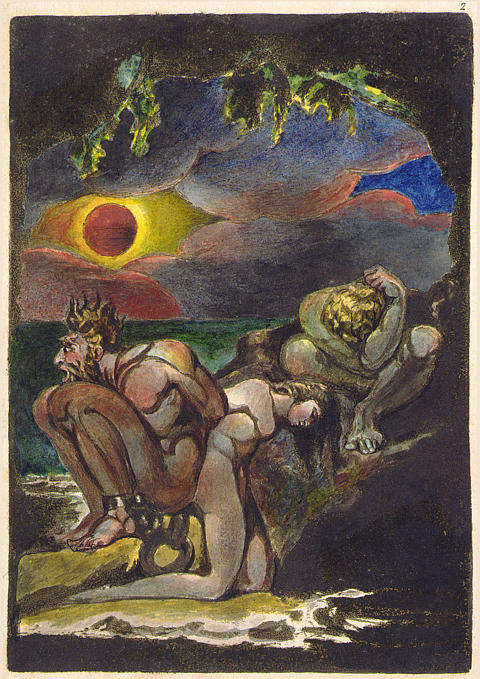
Frontispiece to William Blake's
Visions of the Daughters of Albion (1793)
which contains Blake’s critique of
Judeo-Christian values of marriage.


Sometimes the best stuff about the whys of the West’s darkest hour is found not in the main article, but in the commenters section. Below I quote three illuminating posts from the thread “Be the Change” in Gates of Vienna (GoV).

Fjordman said...
Takuan Seiyo, I like to think of it this way: If you have one brainwashed generation then you have a problem. If you have two brainwashed generations then you have a very serious problem. If you have three brainwashed generations then you have a problem that is so big that it almost cannot be solved, because nobody in living memory can remember how it was to have a sane worldview. We are now fast approaching a point where young Westerners, indoctrinated with anti-Western hatred, not only do not receive a correction from their parents, but in many cases not even from their grandparents. By then we have witnessed a complete cultural discontinuity.

As much as I loathe to admit it, Marxists and other anti-European forces have been far more successful in staging a slow, “permanent” revolution in the West than they ever were in staging an armed revolution. They have largely succeeded in their goal of eradicating Western civilization, and are now working hard to physically eradicate the European peoples who created this civilization to ensure that it cannot be rebuilt in the future, either. They achieved this feat not by gaining control over the means of production but over the means of indoctrination, the mass media and the education system.

The only thing left to do is to let the current ruling paradigm crash under the weight of its own uselessness and work to survive so that we can build something new out of the ashes. We need a new paradigm as the current post-WWII “suicide paradigm” isn’t sustainable. The question is whether the coming discontinuity will be so severe, just like it was in the Middle Ages, that we will end up with an entirely new civilization, the third generation of European civilization.

Takuan Seiyo said…
Fjordman, I think we have to go to the giants of science fiction, maybe Philip Dick, to get an idea where this is leading. But restoring a common Western culture is no longer possible. Even intelligible conversation with the other side is no longer possible. We don’t share the same language anymore, even if we were born in the same country. Words like justice, nation, freedom, culture, racism, constitution, wealth, work, love, marriage, gender, right versus privilege etc. no longer have a common referent, and words like honor, merit, fidelity, prudence, civilization, civility, manners, graciousness, manliness, femininity, modesty, class, elegance, valor don’t even exist in the other side’s vocabulary anymore.

Or look at American films between 1935 and 1955. These are recent pop culture artifacts that seem 150 years old. See how much French or German dialogue is included in these films meant for the broad and relatively unsophisticated American audience, how good English, good manners and virtues prevail even in plots that are cynical or risqué (Hitchcock’s To Catch a Thief is a good example).

I need to modify what I wrote in the previous comment. While it’s only our last three generations that have been transformed into changelings, the left has been working on all that really for 100 years, not 40. Much of what one can find in the works or speeches of Lenin, Trotsky and Gramsci reads like a blueprint for a soft coup d’état, exactly of the kind as has been unfolding in the last 40 years.

Whiskey said...
I take issue with both Seiyo and Fjordman. This is not “Gramscian” stuff out of the Frankfort School. It is the natural result of Christianity. That most Christian of poets, William Blake, in Daughters of Albion compared marriage and family to slavery and prison. Mary Wollstonecroft, mother to Mary Shelley, preached free love in the 1780’s. The Oneida Commune predated Marx and the Revolutions of 1848. Much of the current morass stems [from] the Romantic poets and the thoughts of Thoreau and Whitman.

Which boil down to this: if you have some amount of money, better to behave like a depraved French Aristocrat than an upright member of the “square” bourgeoisie. Or more concretely, elites wish to maximize sexual, personal, and monetary freedom of action for themselves while cloaking themselves in Caesarian “for the people” morality.

You can’t sell things people don’t already want. The tremendous amounts of money flowing to elites, making them richer than the richest French aristo under Louis XIV, create the tremendous appetite to cast off any restriction in a decadent, depraved elite. The impact of the condom, improved female earnings, and anonymous urban living make women the natural home of the Hard Left, combining as it does “the New Aristocracy” of the Kennedys, Obama, etc. with a massive female-friendly social safety net. Anyone watching little girls play princess or adult women wanting understandably to jigger the system for them can understand this. The impact of the collapse of marriage (which ties female well-being to that of men’s opportunities) is to my mind, far more explanatory than the idea of the pod-people and bodysnatchers.

The films of Hitchcock in San Francisco reflected a married, bourgeoisie world. The current city reflects a decadent, aristocratic single world dominated by single women seeking aristocratic princesses and a safety net.

Chechar’s comment (off GoV):
I agree with Whiskey that liberalism is the natural result of Christianity. Today’s crisis can best be understood if we go beyond Gramscian or commie brainwash into a meta-perspective that involves Christian ethics.

Conservative Swede has explained such perspective here (see also here). If we keep in mind Swede’s philosophy that modern liberalism is but the last stage of a dying, giant red star, Whiskey’s answer to Seiyo and Fjordman makes sense within my framework of a noxious “helping”-mode of childrearing, because that was precisely what originated feminism (cf. my criticism of Lloyd deMause). Parents allowed their daughters to “enjoy” the new lifestyle, thus endangering Caucasians with extinction since women avoid to reproduce with healthy population-replacement levels. In the thread of one of my Quetzalcoatl chapters I commented:
This is resonant with our struggles against today’s liberals. In the last chapter I said that liberty should not be confused with licentiousness. And the big paradox with the “helping mode” psychoclass of the late 20th and early 21st centuries is that it is akin to the emergency from bicameralism three millennia ago. And so are the measures to be taken! For Con Swede, a Franco or a Pinochet is badly needed in Europe.
Reference to Franco or a Pinochet must have seemed a little rough for the GoV commentariat since I didn’t get any answer. But I must add that despite being a republican in heart the times are so dark that they require an imperial solution. It’s time for a new Caesar...


The Great Gatsby

The Jewish question has started to intrigue me. But yesterday I watched for the first time in my life the 1974 film The Great Gatsby, starring Robert Redford and Mia Farrow; directed by Jack Clayton from a screenplay of Coppola based on the novel by F. Scott Fitzgerald. None of these people are Jewish. But I found a subliminal message very akin to the more recent race-treasonous films that paint the whites and the West as the bad guys, quite a few of them directed or screen-written by the Jews at Hollywood. The whole point is that we must blame with equal ferocity all of the gentile liberals who also have contributed to demonize the white nationalists and the western culture. After all, it was Scott Fitzgerald, an Irish Catholic, who featured a reference to a conservative racialist author in The Great Gatsby. The film where the good guy Jay Gatsby (Robert Redford) is murdered starts with the following dialogue between Tom Buchanan (Bruce Dern) and his guest. At the end Tom is exposed as the bad guy of the movie, the one who incited the murder of poor Jay:
Tom: “Nick, have you read that book, The Rise of the Coloured Empires by Goddard?”

Nick: “Why? no.”

Tom: “Well, it is a fine book. Everyone ought to read it. See the point is that if we don’t watch out, the white race will be utterly submerged...”

[Nick’s face denotes incredulity]

Tom: “No, that’s so! It’s up to us. We, the dominant race, must watch out, or the other races will have control of things.”

Daisy [Mia Farrow] sarcastically says: “We’ve got to beat them down.”

Tom: “Daisy, it has all been scientifically proved. You see we’re Nordics. You are, and I am and... Anyway, we are responsible for all the things that made civilization: art science, and all that.”
The Rise of the Coloured Empires is a real book that today very few take seriously despite of the fact that, if the West had really watched out, neither China nor Islam would have awakened. If we look for an explanation of why Tom’s message fell upon the deaf ears of those who watch Hollywood films, the answer lays precisely in The Great Gatsby where frivolous parties ran amok in America’s 1920s, the zeitgeist when Fitzgerald wrote his novel. (Of course: today, frivolity has degenerated even further.)


Postscript of 25 August 2010:

Now that I am reordering the entries of this blog that I had written before the lightning that divided my intellectual life in twain, and removing mere copy-and-paste entries from other blogs, I see that accidentally I deleted a post with a couple of interesting comments in the commenters section. Fortunately I had saved them in my computer:

Monsieur Calguès said...
The book this conversation alluded to is The Rising Tide of Color Against White World Supremacy; the Goddard in the conversation refers to the book’s author, Lothrop Stoddard. I am not sure if you are familiar with the book. I have read it and it’s worth the effort. No author today could get away with writing some of the things Stoddard wrote. He would encounter difficulty finding a willing publisher today.

Chechar said...
Monsieur Calguès: As soon as I get a few bucks I will buy a long list of must-read books, such as this one. Here’s what an Amazon Book reviewer has to say about The Rising Tide. Ask me: who for decades have suffered the tsunami of uneducated semi-Indians that destroyed my beautiful neighborhood in Mexico City!:
“Forbidden book, very informative. I was impressed with how this work counters much of the ‘politically correct’ nonsense on campus. The egalitarian establishment would very much like to ban this work, they have already done much to keep it from potential readers. Changing demographics mated with Pavlovian ‘PC’ conditioning will allow them to ban this book soon. My advice is to get this book and read it while you still can.”

Monsieur Calguès said...
Forbidden indeed. Which makes it more surprising that I managed to find the book in a university library some time ago.

The Turner Diaries, however, would be impossible to find in any library in any form. One must access it online or order it through the mail. I believe some countries have even banned it.

But a society built on lies cannot endure, eventually it must collapse. The Soviet Union proved that maxim. There are violent times ahead for the West. They cannot come soon enough for me.

Sunday, August 30, 2009

On women


In his chapter “On Women” of the very brilliant collection published in English as Essays and Aphorisms, Schopenhauer wrote the most insightful thoughts about women I have ever read, of which I’ll quote some sentences (no ellipsis added between excerpts):

1

Women are suited to being the nurses and teachers of our earliest childhood precisely because they themselves are childish, silly and short-sighted, in a word big children, their whole lives long: a kind of intermediate stage between the child and the man, who is the actual human being, “man”.

In the girl nature has had in view what could in theatrical terms be called a stage-effect: it has provided her with superabundant beauty and charm for a few years at the expense of the whole remainder of her life, so that during these years she may so capture the imagination of a man that he is carried away into undertaking to support her honorably in some form or another for the rest of his life, a step he would seem hardly likely to take for purely rational considerations. Thus nature has equipped women, as it has all its creatures, with the tools and weapons she needs for securing her existence, and at just the time she needs them; in doing which nature has acted with its usual economy.

2

The nobler and more perfect a thing is, the later and more slowly does it mature. The man attains the maturity of his reasoning powers and spiritual faculties hardly before his twenty-eight year; the woman with her eighteenth. And even then it is only reasoning power of a sort: a very limited sort. Thus women never see anything but what is closest to them. To consult women when you are in difficulties, as the ancient Teutons did, is by no means a bad idea: for their way of looking at things is quite different from ours, especially in their propensity for keeping in view the shortest road to a desired goal and in general what lies closest to hand, which we usually overlook precisely because it is right in front of our noses.

It is for this reason too that women display more pity, and consequently more philanthropy and sympathy with the unfortunate, than men do. Thus, while they possess the first and chief virtue [compassion], they are deficient in the secondary one which is often necessary for achieving the first.

3

Fundamentally, women exist solely for the propagation of the race. Men are by nature indifferent to one another; but women are by nature enemies. Because in our case a hundred different considerations are involved, while in theirs only one is decisive, namely which man they have succeeded in attracting. Another reason may be that, because they are all in the same profession, they all stand much closer to one another than men do.

Man strives for a direct domination over things, either by comprehending or by subduing them. But women is everywhere and always relegated to a merely indirect domination, which is achieved by means of man, who is consequently the only thing she has to dominate directly. Thus it lies in the nature of women to regard everything simply as a means of capturing a man, and their interest in anything else is only simulated, is no more than a detour, i.e., amounts to coquetry and mimicry.

Nor can one expect anything else from women if one considers that the most eminent heads of the entire sex have provided incapable of a single truly great, genuine and original achievement in art, or indeed of creating anything at all of lasting value. What there ought to be is housewives and girls who hope to become housewives and who are therefore educated, not in arrogant haughtiness, but in domesticity and submissiveness.

- end of “On Women” excerpts -


Schopenhauer’s chapter boggled my mind when I read it back in 1992. Here we had a 19th century philosopher that, unlike the coward men of my world, told the naked truth about the fair sex; and I would like to expand his crude, albeit realistic views to its ultimate consequences, especially from my present viewpoint of this most darkest hour for what I treasure the most: Nordish women.

The first weapon of mass destruction against our civilization has been the ideology of anti-white racism. Along with it comes feminism: the other fatal weapon for the West and the inexorable dwarfing of the white people.

Let me indulge in a little fantasy for a minute, “If I ran the zoo...”

If I were dictator of the West, I thought in my daily peripatetic walk in my town, I’d reverse feminism back to Victorian and pre-Victorian ages (yes: I’m a fan of Jane Austen). The reversal would be brutal and swift: but the psychological plan in my racial dictatorship would be to gradually “liberate” women not beyond the values of, say, America in the 1940s and 50s. All of this would be pure Machiavellianism of course: to convey angry women the misleading message that the “liberal” wing in my dictatorship overcame an idealized Austen-like world when, in fact, the ultimate goal would have been from the beginning to fix forever Western society’s sex roles in about the 1940s and 50s.

Arthur C. Clarke wrote The City and the Stars in 1956. The Machiavellian psychologists and social engineers who created the mega-city Diaspar discussed the Utopia blueprints for centuries before elaborating a closed society (yes: Popper was wrong!) albeit a rather stable culture for whites, which in the novel lasts a billion years.

Although Arthur Clarke was an incorregible liberal who took feminism for granted, it’s a highly recommended novel along with its almost identical precursor, Clarke’s 1953 Against the Fall of Night. But if the westerners finally make it after the race wars it will be obvious that Clarke was wrong: technology was not the ultimately axis of cultural transformation but psychogenic development with the corresponding reversal of the suicidal “women’s rights” movement. Feminism may not be the subject-matter of Michael O’Meara’s Toward the White Republic, just released this week. But its first chapters are worth reading to grasp how psychogenic emergency about one’s own ethnic group could be the transforming factor in the forthcoming future, a future that I still envision like some of Clarke’s best novels.


Postscript of 20 September 2010


Stags sometimes sustain smashed antlers or broken legs, or are blinded in one eye in their lust to win the female; fatal injuries are not unknown.


The target-audience for this entry are obviously the males. However, in order to understand women, the subject-matter of this post, we must first understand the biological basis of our lust to win the favor of one of these beautiful specimens. Just as Schopenhauer spoke out the naked truth about women, so naked that no woman will ever accept it, in this postscript I will quote zoologist John Sparks, the producer of the 1996 TV series Battle of the Sexes in the Animal World.

Sparks’ brutal honesty shocked me. It turns out that we males are, quite literally, driven by our gonads (cf. “the sperm and its slave” way below). Thanks to the attraction toward young nymphs, what I have called the crown of evolution, our unattainable goal is to fill the world with duplicates of us. In the introduction to his book, Sparks wrote:

* * *


Every living creature has an overwhelming urge to breed. This is not simply a trivial expression of bestial lust, but a fundamental characteristic of life, the fulfilment of which determines whether an animal is a success or a failure. The nature of sex is widely misunderstood, a matter which this book [Battle of the Sexes, BBC Worldwide, 1999] will attempt to rectify.

Animals of every kind strive to ensure the survival of as many of their genes as possible. Sex specifically demands very public behaviour among many species. With an almost unlimited supply of sperm at their disposal, [the males’] best reproductive strategy is to mate with as many females as possible; each of which will provide them with offspring. From the male’s perspective, there are never enough females to go around [My note: this strategy doesn’t work with humans. See, e.g., my entry on Abraham & Casanova]. Competition between the lusty males is therefore intense. However, in species in which males have opted for dedicated monogamy the females are usually the larger sex; in some cases, the males are miniaturized. Charles Darwin was aware of degenerate males.

Suicidal sex

For most kinds of animals, no matter what tactics the males employ to further their sexual aspirations, it is the females which determine the winners. This is because—as we shall see in the next chapter—it is they which do the choosing.

Remarkable strategies have evolved which illustrate the extremes to which males will go to give their own sperm the best chance of reaching the eggs first. In Australia, male red-tailed phascogales—small, squirrel-like carnivores—burn themselves out in an all-or-nothing quest for fatherhood. These endearing little marsupials [are] so intent on finding as many targets as possible for their precious sperm that they have no time to feed during their week of frenzied sexual activity. While the freshly impregnated females retire to their nests, the knackered males rapidly succumb to a combination of infections, failed livers, gut ulcers, extensive hemorrhages and extreme weight loss. Not one adult male survives. But 50 per cent of the females’ babies will be males and by the following spring they will be mature enough to enter the same lethal sexual arena.

One battle over, another looms

The egg is now fertilized—in a split second, a new life has been initiated. This has been achieved against astronomical odds. Both the sperm and its slave, the male body which produced it [my emphasis] and propelled it into the female’s tract, have had to be supreme players in the most rigorous and demanding contest on earth—survival. The male has relied on countless brawling ancestors, themselves winners endowed with the skills needed to overcome both physical dangers and cut-throat competition from rivals. His sperm has passed the female’s demanding tests for quality control. Of the billions that started the race, many were deformed, most simply got lost or died of exhaustion. Of the few that lashed their way to the egg, only one was victorious.

Although it takes place on a microscopic scale, this is the key event over which the sexes have been striving to exert control.

* * *


My comment:

From the zoological viewpoint it is worth noting that, unlike the birds, in our species a male can force a female to copulate. In fact, among the primates rapes are pretty common, especially among orang-utans and chimpanzees.

On the other hand, while it is true that from the fruit fly to the elephants the females choose the male or the males, at least in my case I declined marriage proposals from several Mexican ladies throughout my life. They were honourable ladies, yes: but not “beautiful nymphs.”

What a predicament it is not to live in a little whiter nation...